The $10M Gap in Winna's Slide Record
A player lost $7.3 million on Winna's Slide, most of it in one final fourteen-minute burst. Three days later, the game's history was wiped. There is now no public way to check whether those rounds were fair.


· 16 min · 16 min read
In fourteen minutes on May 16, 2026, one player at the crypto casino Winna burned through nearly $8 million on 41 bets, the finale of a two-day session that cost him $7.3 million of his own money.
The public bet feed shows a slice of it: a player listed only as Hidden, placing 31 bets on Winna's crash game Slide, often three or four in the same round. At least, the screen said Slide. Winna's API tagged those rounds "slide-vip," a separate invitation-only build of the game.
A $500,226 bet busts. Then $700,243. Then $900,313, $760,264, $800,365. One bet in the run pays out: $150,068 at 6x. And the feed doesn't see everything. The full session record, spanning that afternoon and the day before, lists 62 bets, 61 of them losers, most of the money deposited while the bets were still landing, in transfers that sit on the public blockchain to this day.
Three days later, the game's past disappeared. At 02:28 UTC on May 19, a Bitcoin miner sealed block 950020, and Slide came back proving itself honest on a brand-new "provably fair" chain: round counter reset to zero, and every round played before it, including the 62 that decided that fortune, gone from the public record.
The player says the money was winnings he had fairly won, and that the rounds that took it were rigged. He took the case public in July; Winna has not commented publicly. Between them sits a question FairGambling can actually test: was Slide provably fair when it mattered?
So we tested all of it.
What Winna's Provably Fair System Promises
Provably fair replaces "trust us" with "check us." Before anyone plays, the casino commits to every future result in a way it cannot change; afterward, anyone can check every result against that commitment.
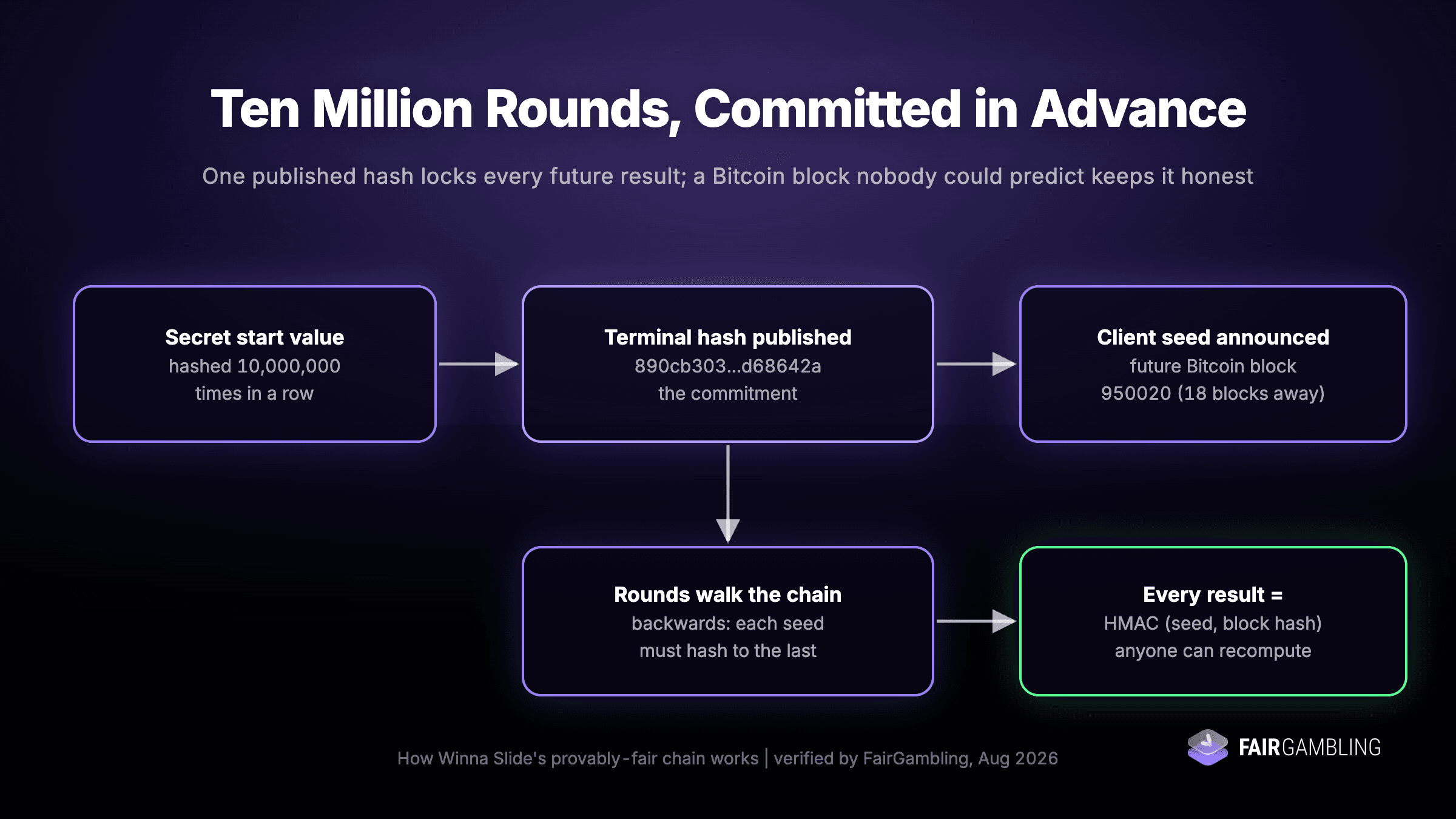
Winna's current implementation is typical. Before the chain went live, the operator took one secret value and ran it through a one-way scrambling function, a hash, ten million times, publishing only the final result. That single published fingerprint locks in ten million rounds' worth of secret values at once. For the randomness the casino cannot control, it named a future Bitcoin block, 950020, as the public half of each round's recipe, choosing it eighteen blocks before the block existed, so not even Winna could know what it would contain.
The game then reveals those secret values in reverse order, one per round. Anyone can re-scramble a revealed value and check that it produces the one before it, so one skipped or swapped round breaks the chain in front of everyone.
This detail comes into focus later: Slide turns the secret value and the block into a crash result in one calculation per round (Limbo-style, one HMAC per round, rather than a classic crash scheme), which leaves each round's fairness resting on that up-front commitment alone.
The story here is that this design can only prove the future, not the past. And the past is what is under scrutiny in this investigation.
224,564 Verified Rounds (None Before May 19)
We audited the current game for one reason: to establish what Winna's own system can prove, and where the proof stops.
We pulled the latest round's seed from Winna's own history API and hashed backward. 224,564 steps later we landed exactly on the published terminal hash. No round since the chain began has been skipped, swapped or inserted. The block-950020 hash sits in every round, and Winna's published formula reproduces every result we checked bit for bit, to 15 decimal places.
Then we backtested the full chain against the advertised 96.5% return:
Cashout target | Hit rate | Empirical RTP |
|---|---|---|
1.01x | 95.53% | 96.48% |
2x | 48.42% | 96.84% |
10x | 9.52% | 95.21% |
100x | 0.95% | 94.81% |
1000x | 0.10% | 95.30% |
Instant busts came in at 3.516% against a theoretical 3.5%. The median round crashes at 1.94x. Every deviation sits inside normal randomness.
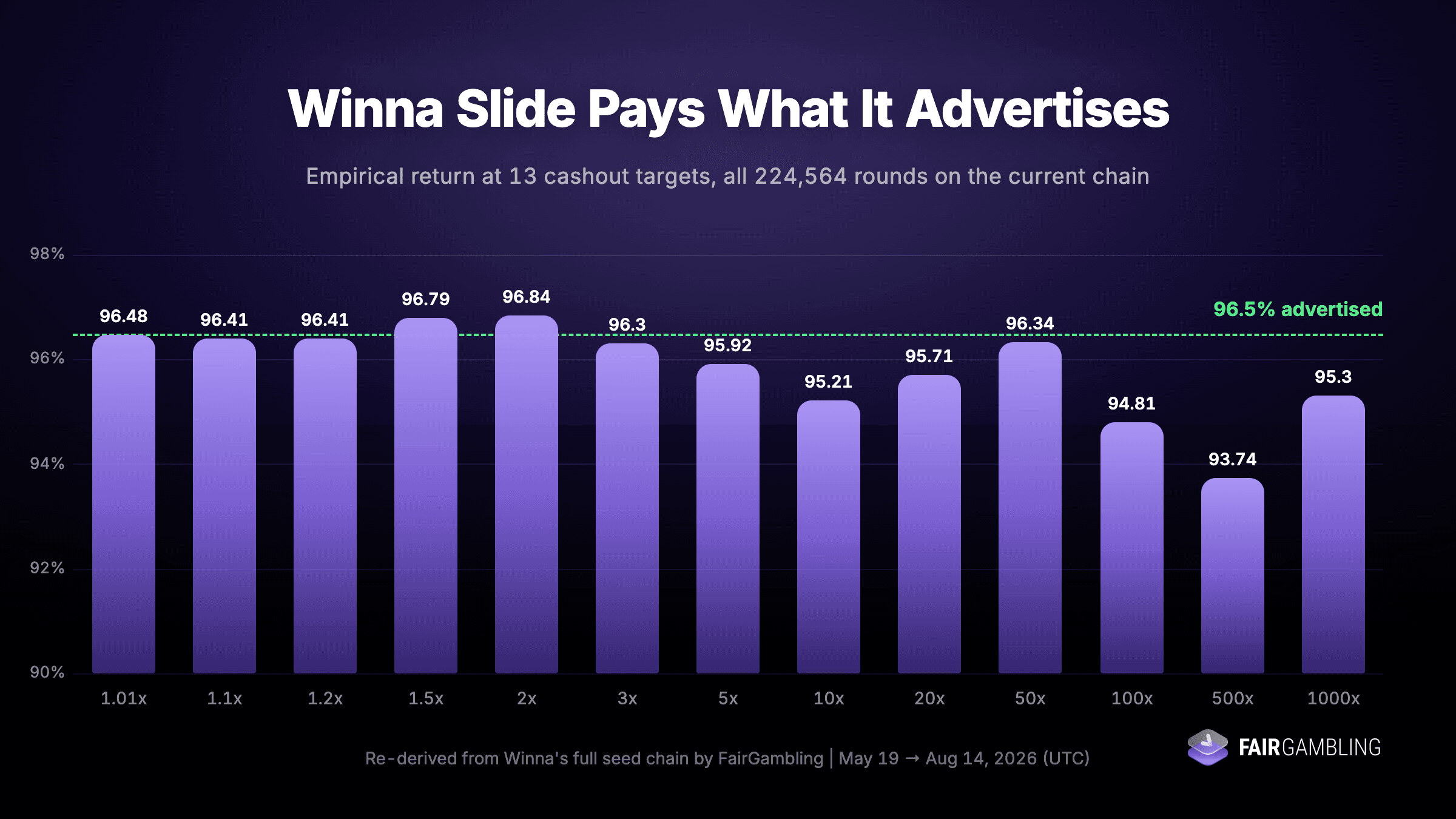
From May 19, 2026 onward, and only from then, Winna Slide pays exactly what it advertises.
Before May 19, things start looking murky.
Slide's Verifiable History Starts May 19
Round 0 of the chain we verified sits on May 19, 2026. Two clocks agree: the block's mining time, and 224,565 rounds at Slide's pace as reversed from mid-August.
The problem is, Slide is older than that. What happened is a reseed: Winna took the game down, generated a fresh ten-million-hash chain, and restarted the round counter at zero.
Our bet feed shows this in play: bets thin through mid-May, hit ~zero on May 17 and 18, and the new chain goes live on the 19th.
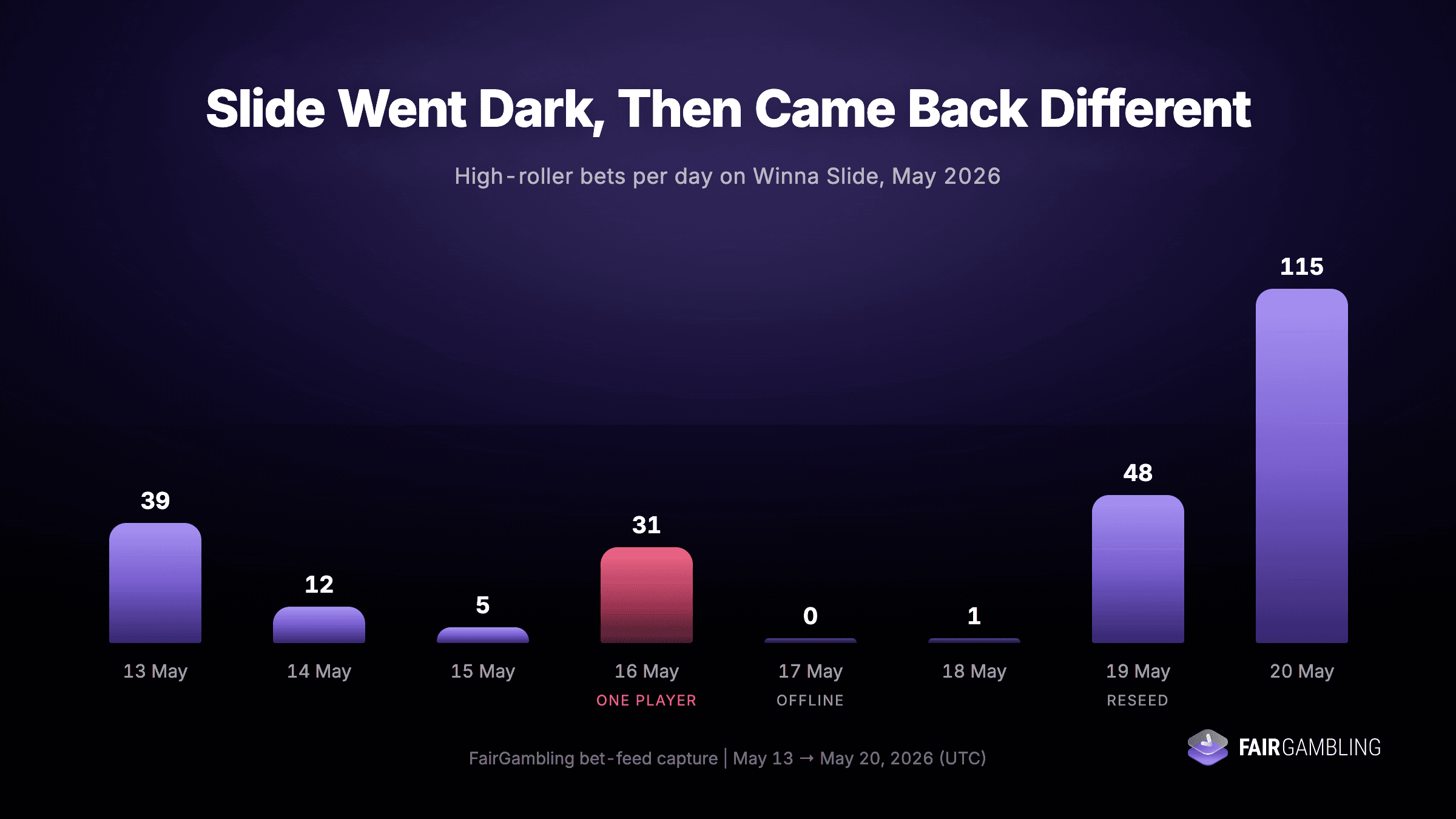
A reseed is not inherently suspicious; operators rotate chains as common practice. But at 33 seconds a round, a ten-million-hash chain lasts about a decade before it runs out of rounds.
This one was replaced years early, and everything played before round 0 of the current chain vanished from the interface with it.
The $16M Winner Who Went Anonymous
To understand what sits on the wrong side of round 0, we cast our view back two months.
From March 17 to May 2, an account named heyri was the largest Slide player on Winna's public feed by a wide margin: 821 bets, $95.9 million staked, average bet $116,800.
He typically cashed out at 3.5x and 4x, stacking multiple bets per round.
He won, too: our capture has him roughly $16.5 million up on Slide over six and a half weeks, about $20 million ahead of what the math expects at his targets. The same feed limits apply in this direction: $16.5 million is what the visible bets show, not audited profit, and it says nothing about what the account won or lost elsewhere on the site.
This looks like sustained, heavy luck, in public, on a game the operator runs without an outside bankroll behind it.
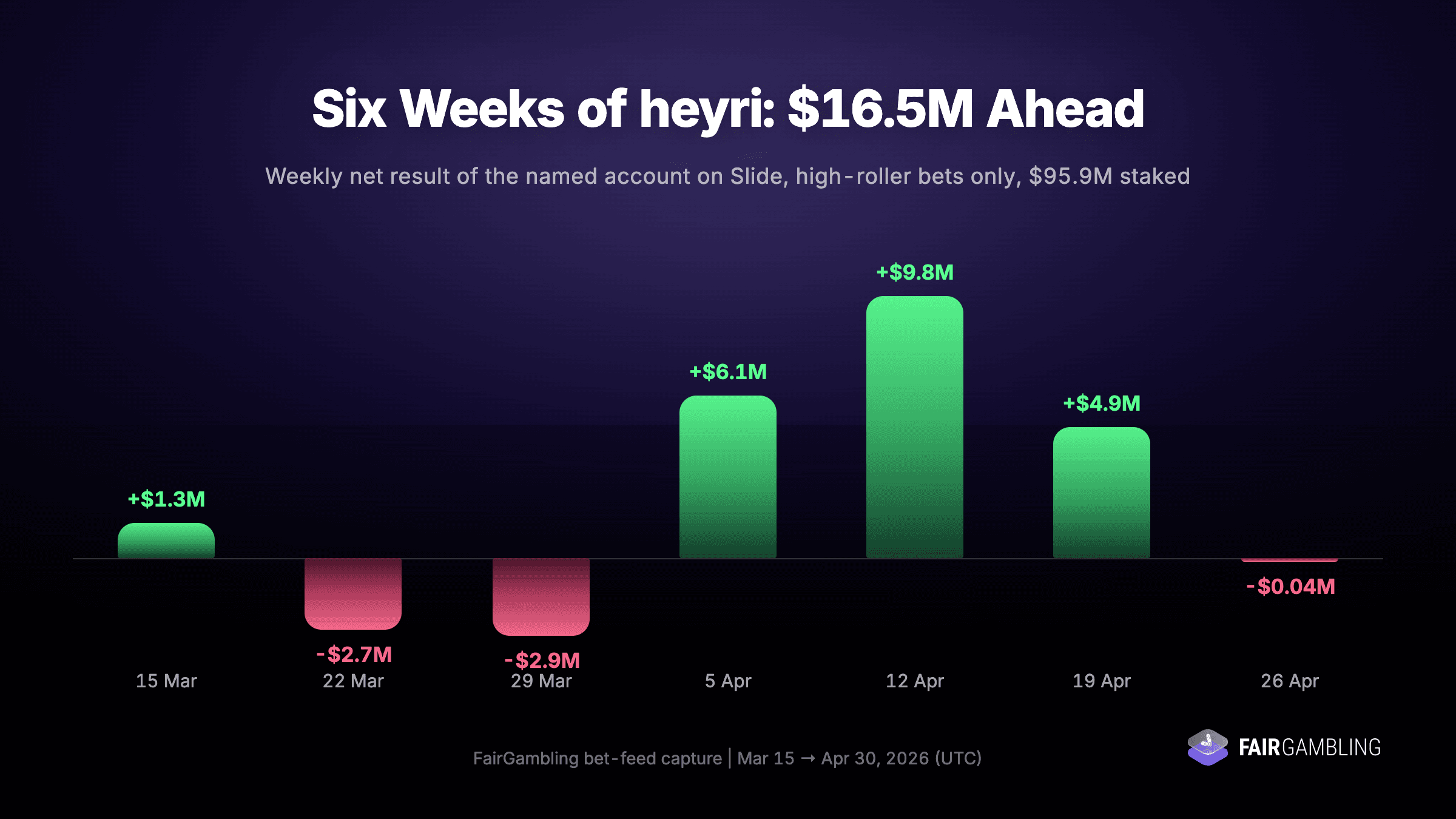
On May 2 at 01:38 UTC the name places its last bet and never appears again.
From then on, the account tier that heyri had reached, nebula tier, shows up on Slide only under the Hidden flag.
Going hidden is not itself suspicious: it is a standard privacy toggle in Winna's own settings, and other anonymous players appear in our capture the same way.
The timing is what draws our attention.
Three Disputed Sessions, One Missing
The player's complaint describes three sessions after he went ghost. Our feed, which captured 40.9 million Winna bets without a gap through this period, can check each claim against what Winna itself broadcast.
Session | The claim | Our capture |
|---|---|---|
May 14, tequ_slider | 61 bets, $9.76M staked, player wins | Nothing. No game called tequ_slider exists anywhere in 40.9M bets; the biggest Slide bet on the feed that day was $555 |
May 15-16, the disputed session | 62 bets, $10.5M staked, net -$9.6M, largest bet $900,000 | The 32 bets above the broadcast threshold, from Hidden nebula/2 (a VIP tag): $5.52M staked, 31 busts, net -$4.62M; the $800,000 bet is there to the dollar |
June 14, public Slide | About $500K lost | 13 bets from the same Hidden nebula/2 tag, $405K staked; the captured part reads positive, the rest sits under the broadcast threshold |
The May 15–16 session is real, to the timestamp and the bet ID. Across the full 62 bets the player lost $9.6 million on the game. Winna credited $2.28 million back to him during the run as lossback bonuses, and he leaves those out of his claim: what he demands is the $7.3 million that came out of his own pocket.
Our capture recorded $4.62 million of the loss, and it could not have recorded all of it. The public feed is an incomplete window: it skips bets below a broadcast threshold, and when a player stacks several bets in the same round, the feed does not show every one. That is why we captured 32 bets where the session record lists 62.
Treat our figure as a floor, not a total. The June 14 sessions in the claim also match our feed, again partially, for the same reason.
The Money Is on the Chain
The bet feed is not the only public record of that afternoon. A Tron deposit address the complainant identifies as his, labeled a Winna deposit wallet by the blockchain intelligence platform Arkham, shows six USDT deposits landing between 14:30 and 14:50 UTC on May 16, totaling $6,348,711. The money arrived during the fourteen-minute betting window: $1.3 million at 14:41, $800,000 at 14:43, $900,000 at 14:46, fresh funds flowing in as the bets busted.
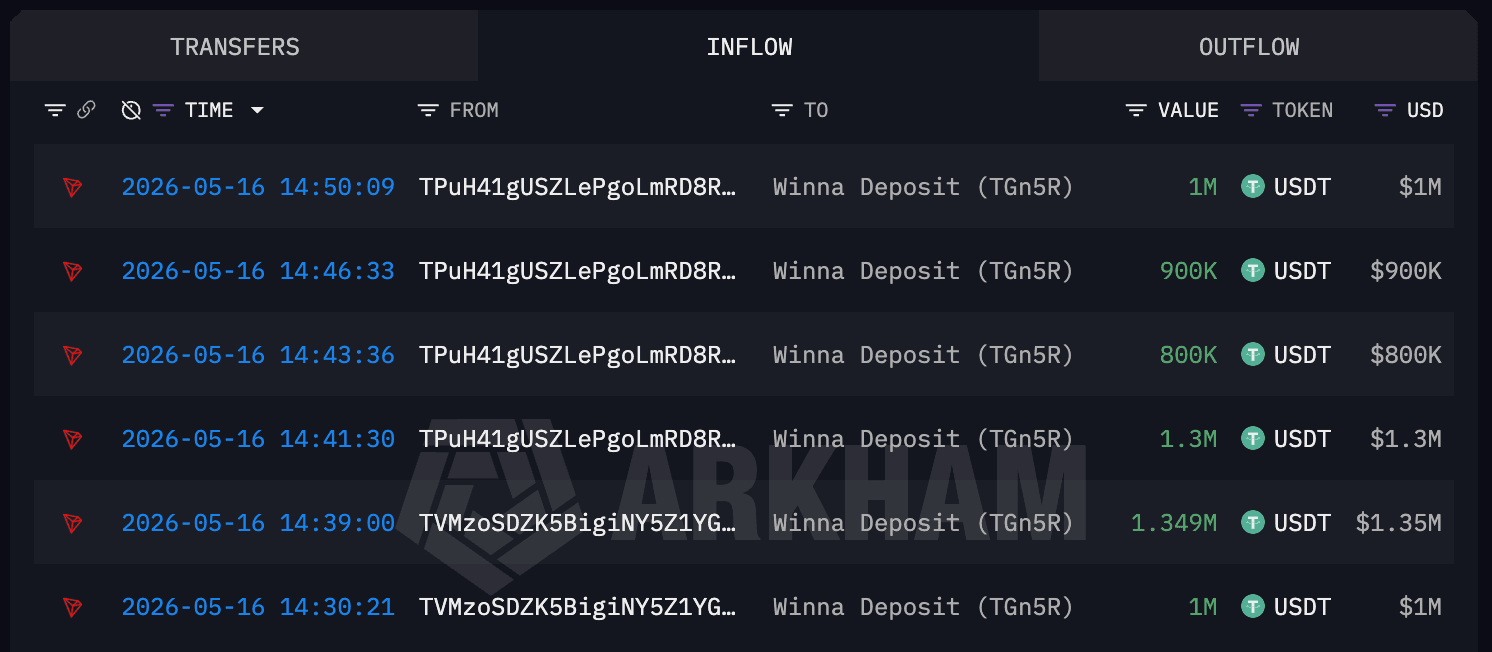
The case file puts the money deposited during the session at $6,345,857.66. The on-chain total matches it to within 0.05%. Minutes after each deposit, the funds were swept onward to Winna's hot wallet in two batches of $5.35 million and $1 million, the standard custody pattern for a per-user deposit address. Anyone can verify the transfers on a public block explorer.
The chain also shows $4 million deposited on the morning of May 14, the day of the session our feed never saw. What it cannot show is the win the player claims from that day: winnings live inside the casino's ledger until withdrawn, and none appear on this trail.
The May 14 session, the one where the player says he staked $9.76 million on a Slide instance called tequ_slider, was not broadcast at all: not under a name, not as Hidden, not at any stake. Whatever tequ_slider was, it was not wired into the public feed that every other session in this story passed through.
The complainant's public case file adds a detail from Winna's own systems: the API labeled the 62 disputed rounds "slide-vip," a separate private build displayed on screen as plain Slide, while tequ_slider, a provider-supplied game, is what the same screen ran the day before.
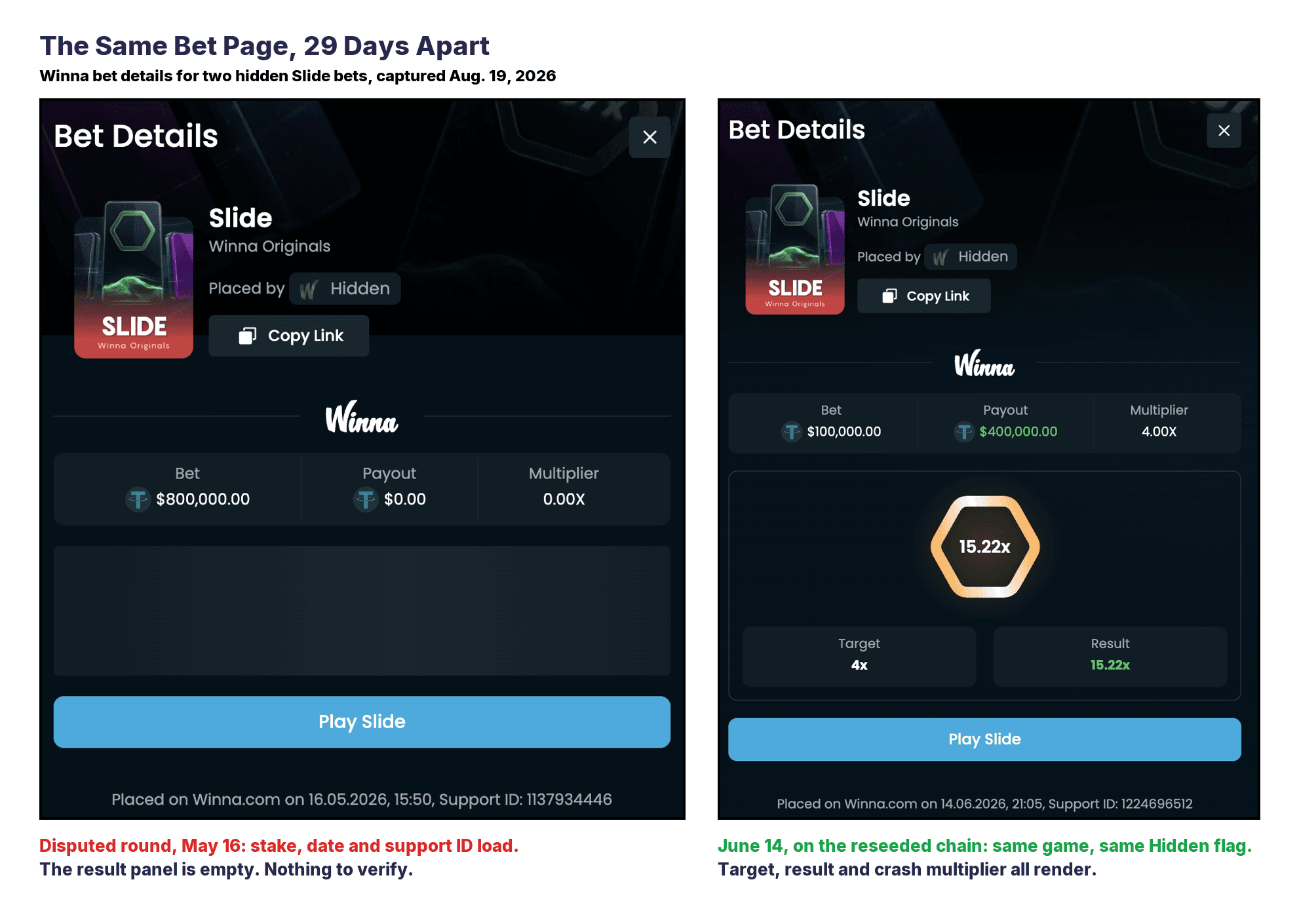
We checked what Winna's own interface serves for those rounds on Aug. 19. The bet page for the disputed $800,000 bet still loads its stake, its date and a support ID; the panel where the result belongs is empty.
The page for a Hidden player's June 14 win on the reseeded chain, carrying the same nebula level-2 tag in our feed capture, renders everything: target, result, crash multiplier. Both links are live; check them yourself.
The bet survives in Winna's systems, but the outcome is absent. That June 14 win, for good measure, sat at the top of Winna's own biggest-wins leaderboard when we captured it.
The feed alone cannot prove the Hidden player is heyri; it can say that every whale bet in both captured windows carries the identical nebula level-2 tag the named account had earned before it went dark.
This is consistent with one player, but not to be confused with proof.
Three Days From $9.6M Loss to Reseed
Here is the story assembled as a simple timeline. Note that likely one of the biggest losing runs in the game's history occurred just before a chain swap.
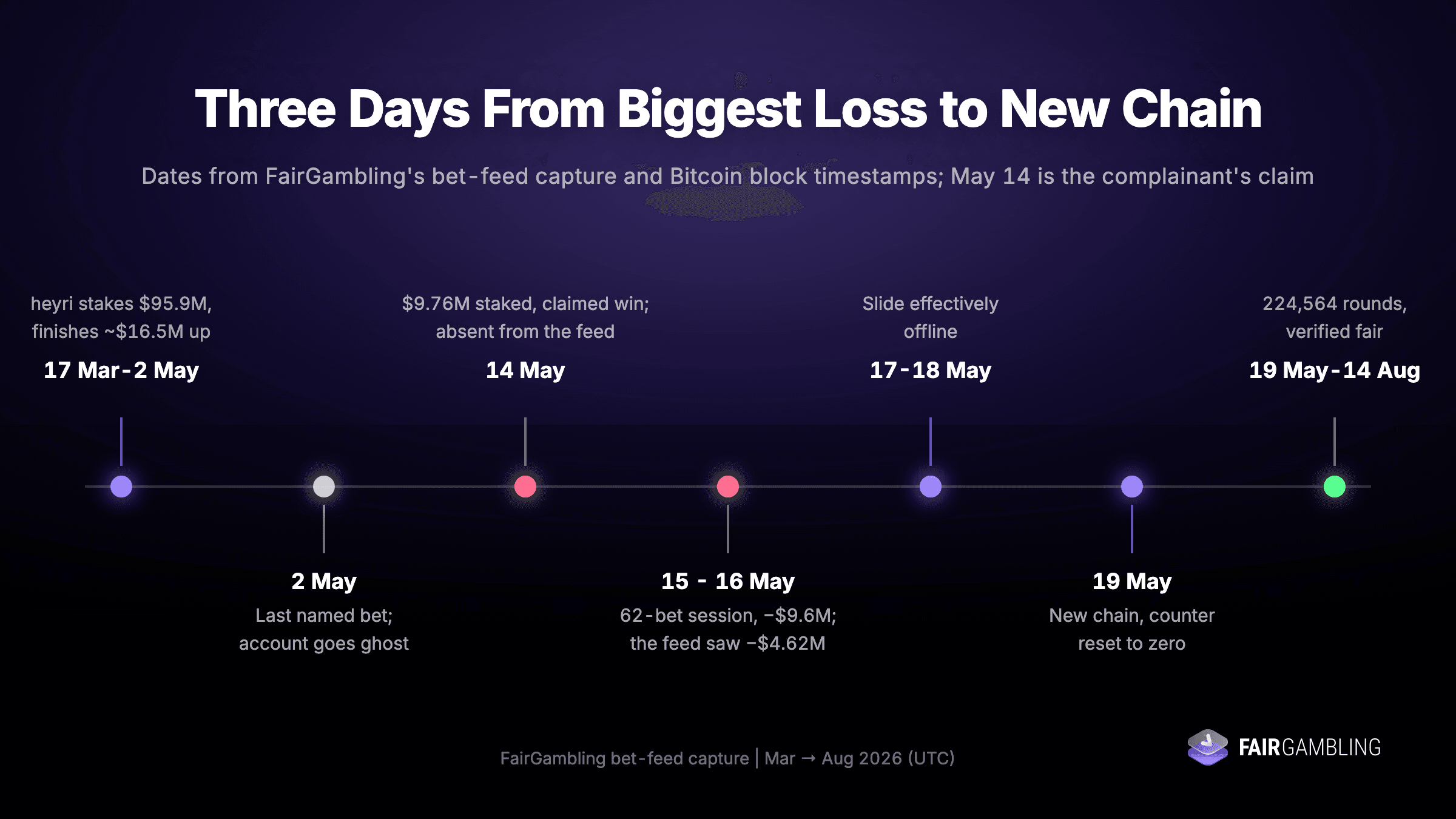
The rounds that decided roughly $10 million in wagers sit on the old chain, before round 0. Our verification, the one Winna passes so cleanly, says nothing about them, because it cannot. The old chain's seeds were never published. The rounds that mattered most are the only ones nobody can check.
There's a deeper problem too: a commitment only counts if it is published before the bets. For the current chain, Winna did this properly, and we can prove it. For the chain that was live on May 14 to 16, we have found no published commitment at all: no seeding announcement, no terminal hash, no client-seed block. The May 19 announcement is explicitly for a new chain.
If no commitment existed before those bets, then the disputed rounds were never provably fair in the first place, whatever the interface said.
A round is provably fair for the player if the commitment was visible before each bet, and we have not seen what the interface showed on those days. If a hash was displayed pre-bet and the chain is later published, the fairness case most likely holds.
The door is still open, but only Winna can provide the data necessary to close the case. The player has asked Winna for exactly this commitment since May. He does not have it. Neither do we.
We are not the only ones who looked. The reviewer ProvablyFair.org, asked by the player to examine the case, reported on July 28 that he had been served a private, account-gated VIP version of Slide, visually identical to the public game, running a fresh operator seed every bet with the nonce fixed at zero and a client seed tied to a Bitcoin block mined in 2023: "no published commitment chain."
Its conclusion, on the evidence available to it: "the VIP Slide was not provably fair and the disputed bets are not independently verifiable," while making "no claim that any outcome was manipulated."
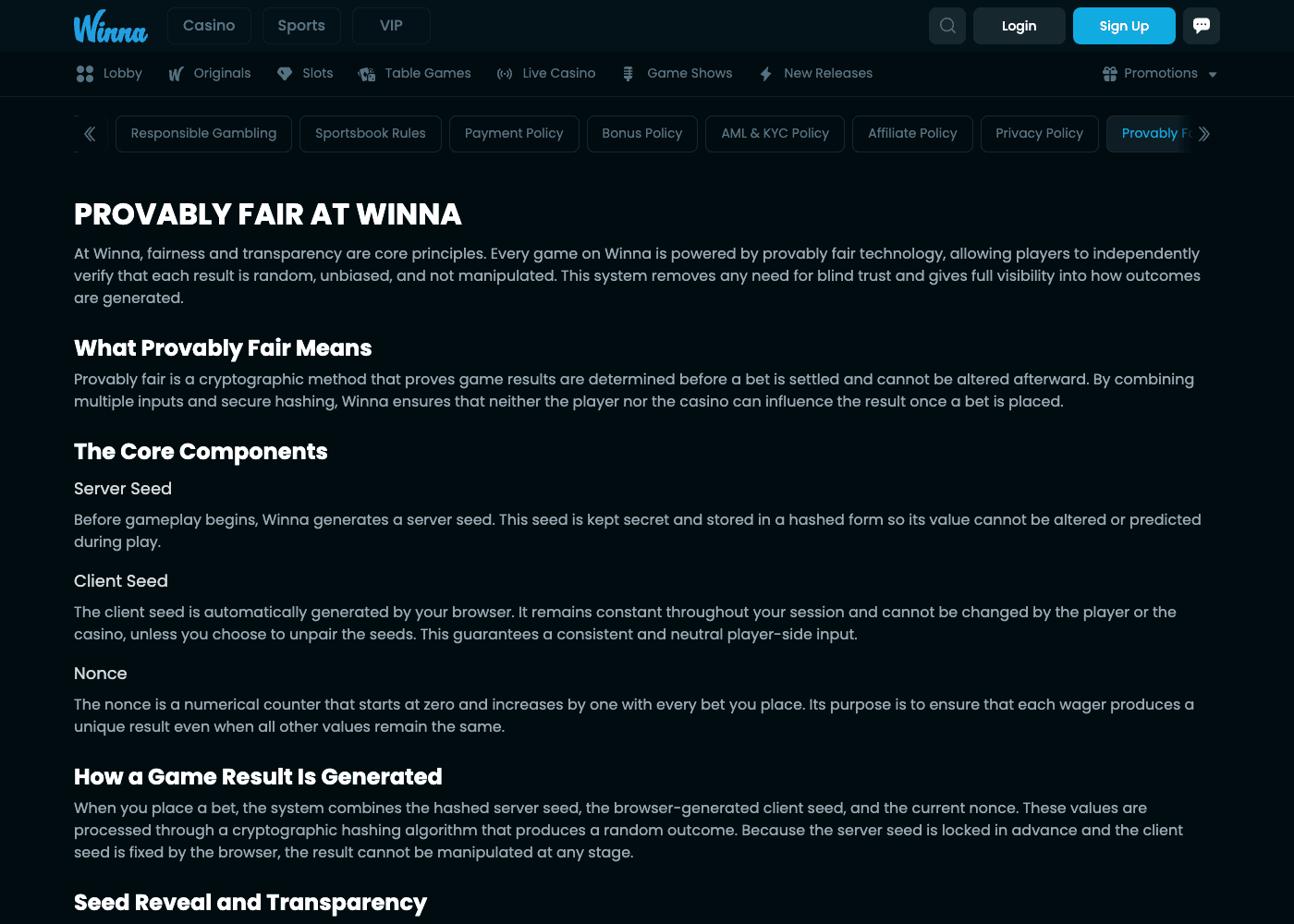
Winna's own fairness page, still live when we captured it on Aug. 19, promises that "every game on Winna is powered by provably fair technology" and that the client seed "cannot be changed by the player or the casino."
On the evidence above, the VIP build kept neither sentence.
The case file goes further, reproducing what it presents as Winna's own written words from the private negotiation.
The owner, on July 3: "it was clear that the client:server seed pair is fixed and we didn't link to any public commitment." The host, the same day: "With a fixed - and not publicly committed - client seed this could have happened." And the owner, on May 28: "technically we would know the outcome of the rounds — but ofc couldn't adjust them."
FairGambling has not seen the original messages; the excerpts are the complainant side's reproduction, and Winna has not addressed them publicly. Knowing the outcome without adjusting it is precisely the scenario a pre-bet commitment exists to rule out, and no commitment for those rounds has been produced.
That's the whole issue: the chain that proves Winna honest today was born three days after the biggest loss in the game's public feed history, the counter reset erased the old rounds from view, and the proof that would settle everything has never been produced.
Provably fair is a promise about the future, not the past, and a reseed is the exact moment the past becomes unverifiable.
What Winna Could Publish to Settle This
Resolving the dispute is trivial, only a casino posting what provably fair casinos exist to post. Publish the old chain's terminal hash and client seed, and the seeding announcement if one ever existed.
Publish the server seeds for the 62 disputed rounds; we hold Winna's own bet IDs for 32 of them. State why Slide was reseeded on May 19 with the counter at zero.
With the seed, block hash and the public formula, anyone can recompute every disputed crash in minutes. No player data, no commercial secrets.
The case has been with the Tobique Gaming Commission since July 22, the player states publicly.
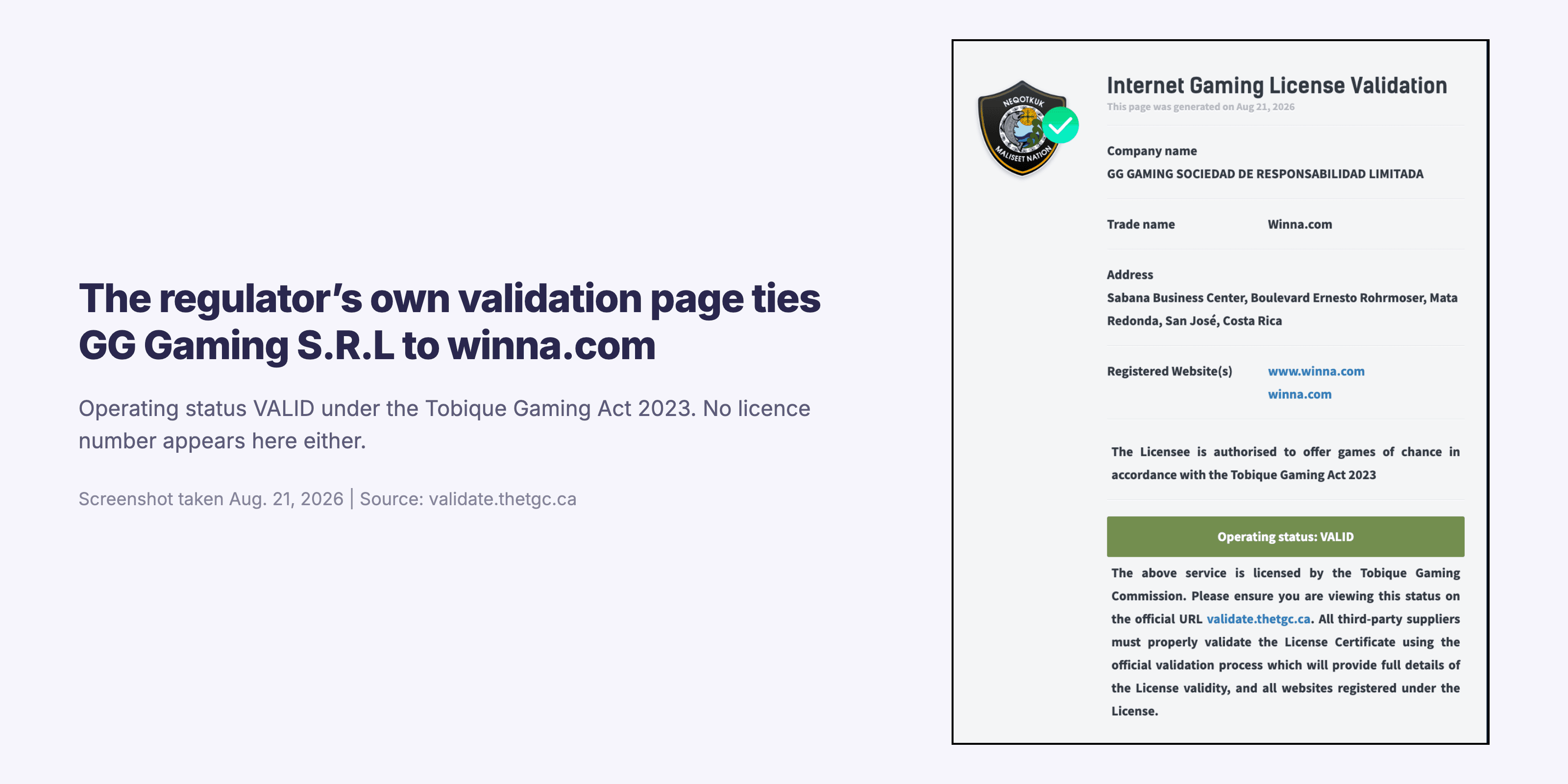
A note on the licence itself: Winna's site displays no licence number, and the Commission's register publishes no numbers for any holder. The register does list GG Gaming S.R.L, the Costa Rican company winna.com's own page code names as its legal operator, with a B2C licence running to May 8, 2027; both checked Aug. 20. So the public record supports a licence existing.
The Commission's own seal-validation service confirms the match: GG Gaming S.R.L, trade name Winna.com, status VALID under the Tobique Gaming Act 2023, checked Aug. 21. What no public source supplies, including that validator, is the licence number itself.
Winna's counsel replied by the July 29 deadline without addressing one technical point or disputing one finding, the complainant reports; in his words, the letter "spent the entire letter arguing about whether my friend is allowed to speak for me." The player wrote to the Commission again on Aug. 9 and reports silence since.
An operator that holds the proof posts a hash. Winna has posted a lawyer.
On Aug. 3 the player put the ask in his own name: "I am not asking anyone to believe me. Publish the commitment and the logs. If it checks out, I will say publicly that I was wrong, in my own name."
We say plainly what we do not have: the crash multipliers of the 31 losing rounds, proof that the Hidden player = heyri, and the bets under the broadcast threshold.
Every number we do have comes from public data or our own capture, verified down to Winna's own bet IDs, timestamps and stakes for all 32 captured bets; the full list is on file and available to Winna, the Commission or any credible reviewer on request.
The dispute runs against a turbulent backdrop: in mid-August Winna's third-party slots went offline site-wide, owner Paul answered bankroll questions on X with a wallet-tracker screenshot and a promised apology bonus, and FairGambling's analytics show Winna's deposit share falling from about 3% in March to under 0.9% as of writing.
We put our questions to Winna by email before publication: publish the old chain's commitment and the disputed rounds' seeds, explain slide-vip and tequ_slider, and say why Slide was reseeded when it was. Winna's response, or the absence of one, will be added to this article and reflected in Winna's trust ranking, which will state on its face exactly which evidence it rests on. Winna did not respond before publication.
Further reading: Inside Bluff's $21M Raise: White-Label Tech, Withheld Winnings, 743 Players.
Methodology
- Chain verification: we pulled the latest round's seed from Winna's own history API on Aug. 14, 2026, hashed backward 224,564 steps to the published terminal hash, and reproduced results with Winna's published formula, matching 13 of 13 checked rounds to 15 decimal places.
- On-chain deposits: TRC-20 transfers for the deposit address the complainant provided, pulled from the public Tron ledger on Aug. 22, 2026, and cross-checked against the session accounting in the public case file.
- RTP backtest: all 224,564 rounds tested at 13 cashout targets against the advertised 96.5% return.
- Bet-feed capture: our own continuous recording of Winna's public high-roller broadcast, 40.9 million bets since early 2026 with no gaps May through July. Only bets above Winna's broadcast threshold appear; we store what Winna transmits and cannot alter it.
- Bet feed limitations: the public feed omits bets below a broadcast size threshold and does not display every bet when several are stacked in one round.
- Bet pages and screenshots: captured Aug. 19, 2026; the bet links in the body were live at publication.
- Limits: we cannot see bets below the broadcast threshold, crash multipliers of losing rounds, anything played on the pre-May 19 chain, or the tequ_slider build. Claims sourced from the complainant or his case file are labeled as such throughout.
Disclosure: Winna is one of more than a dozen casinos in FairGambling's wager-share program: players who sign up through our links earn rakeback on their wagers, and the casino pays us a share. That is the extent of the relationship, and per our transparency policy, it has no bearing on our rankings or coverage. Our Winna wallet and deposit figures come from our own on-chain analysis, not from Winna.