Inside Bluff's $21M Raise: White-Label Tech, Withheld Winnings, 743 Players.
A $21 million raise, $10 billion "wagered," 600,000 sign-ups. So, how does a casino that almost nobody actually bets on raise that kind of money?

· 12 min · 12 min read
In February 2026, a betting site called Bluff announced a $21 million raise led by blockchain fund 1kx, with Makers Fund, Maximum Frequency Ventures, Delphi Ventures founders and NBA champion Tristan Thompson. Its founding team is drawn from Stake, Bet365, William Hill and Bodog, and the pitch is "next generation" betting: social, fast, crypto-native, built around "live prediction markets, binary outcomes and creator-led events."
Bluff.com is a brand of Playlink, a Web3 iGaming company, licensed on the Autonomous Island of Anjouan, Union of Comoros, through Wink Wink Ltd under license ALSI-202506028-FI1.
The seal validates against the Anjouan Gaming Board, so the license is real. Anjouan is one of the most widely used licenses in the crypto-casino sector, a lower-cost offshore regime that many of Bluff's peers also hold.
In our review of the site, we found a conventional crypto casino underneath: slots from 22 providers including Pragmatic Play, Hacksaw and Evolution, plus originals, crash games, live tables, a sportsbook, and the prediction markets it is built around.
But for a brand that markets "transparency and player alignment," the foundation is opaque.
Where the headline numbers come from
Bluff's early traction claims are big: 600,000 sign-ups, tens of thousands of daily active users, and 125 million bets in roughly three months.
Every figure traces to a single paid press release on Chainwire, recycled across crypto outlets that did little checking.
But these numbers aren't real bets in the way most would imagine. Bluff's pre-launch was a free game: sign up, collect a $1,000-a-day play-money faucet, and farm "Blink Points" toward a future $BLUFF airdrop, with 2,000 more points for every referral. By the eve of its 27 January launch, it was claiming $10 billion "wagered."
That volume is play money, farmed by people who came for a token, on a referral loop that did little to exclude Sybils.
Bluff opened real-money play on 27 January 2026 and announced the raise about a week later; by then it had almost no real-money activity to show.
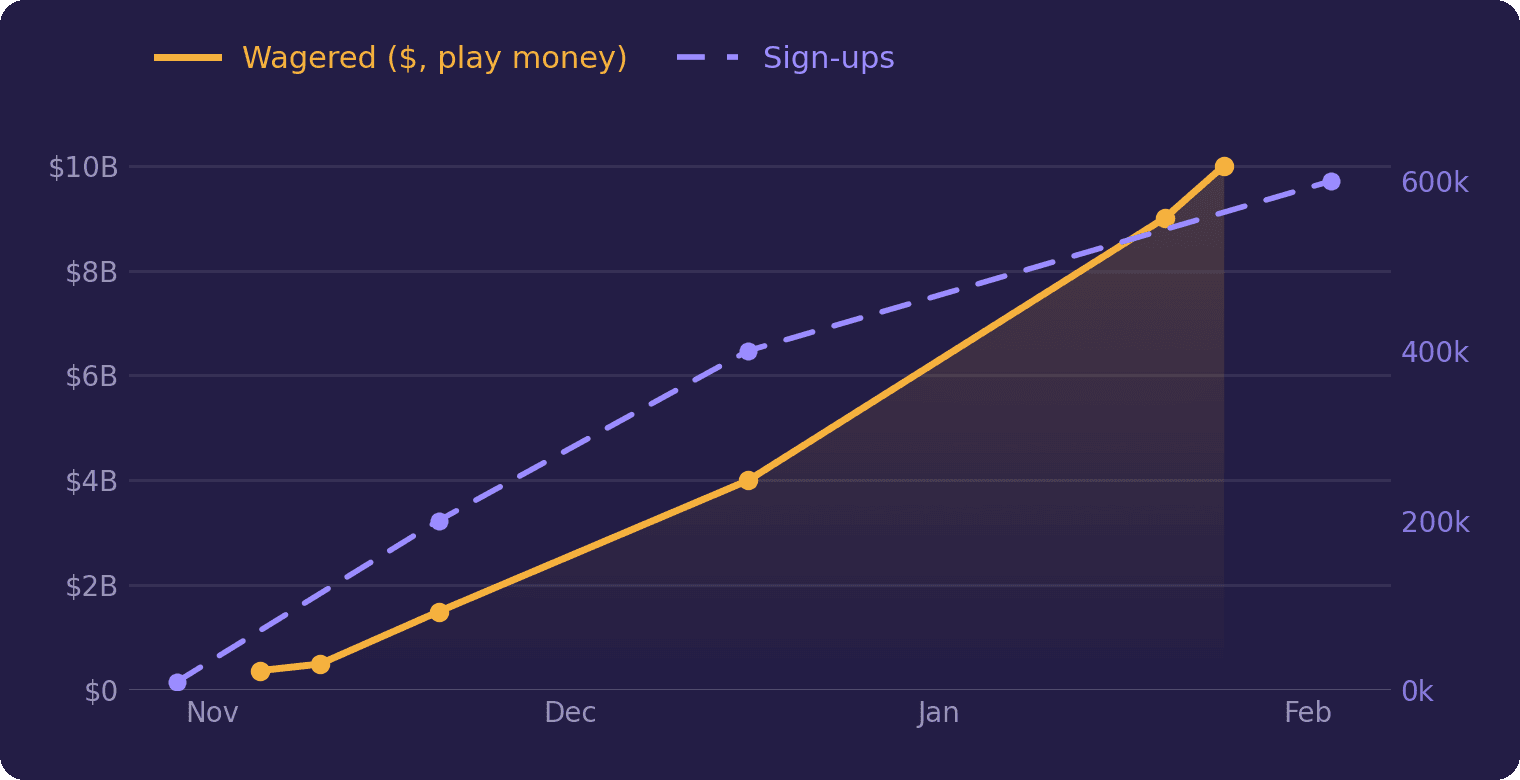
'Wagered' volume rose from $375 million to $10 billion and sign-ups to 600,000 between late October 2025 and early February 2026, around its 27 January launch.
Its actual activity sits in a closed play-money sandbox that leaves nothing to audit. But real deposits and withdrawals settle on public blockchains, and we track them across three chains.
For reference, Bluff's deposit reference wallets:
- BNB Chain (BSC): 0x5412F1347C6b2713De274314Ec6208DC14F22804
- Ethereum: 0x5412F1347C6b2713De274314Ec6208DC14F22804
- Solana: 4yEYGy3QgwAtp5EyybD7iVnFiEsUZ8CkhR3ykrkvNqfF
Over the last 30 days, roughly 743 unique wallets made a real deposit, putting in $828,500 between them, which ranks Bluff 37th of the 40 crypto casinos we track. Over the same window Stake drew 483,700 real depositors and took $1.67 billion in deposits. Bluff is holding $313,700 across its hot wallets, against Stake's $137.0 million.
The company that raised $21 million sits on about a third of a million dollars of real money: 600,000 sign-ups, 743 depositors. To put this into perspective, that's a conversion rate of 0.124%.
They didn't build it
Part of the tech is borrowed too.
Open Bluff's betting pages with network tools running and the odds arrive from sptpub.com, a third-party feed served per brand, with a brand ID in every request; the sportsbook and the prediction markets pull from the same source. That domain traces back to Betby, the B2B sportsbook supplier that, in April 2026, launched a fixed-odds prediction-markets product for crypto, finance, and entertainment events.
The same kind that Bluff offers.
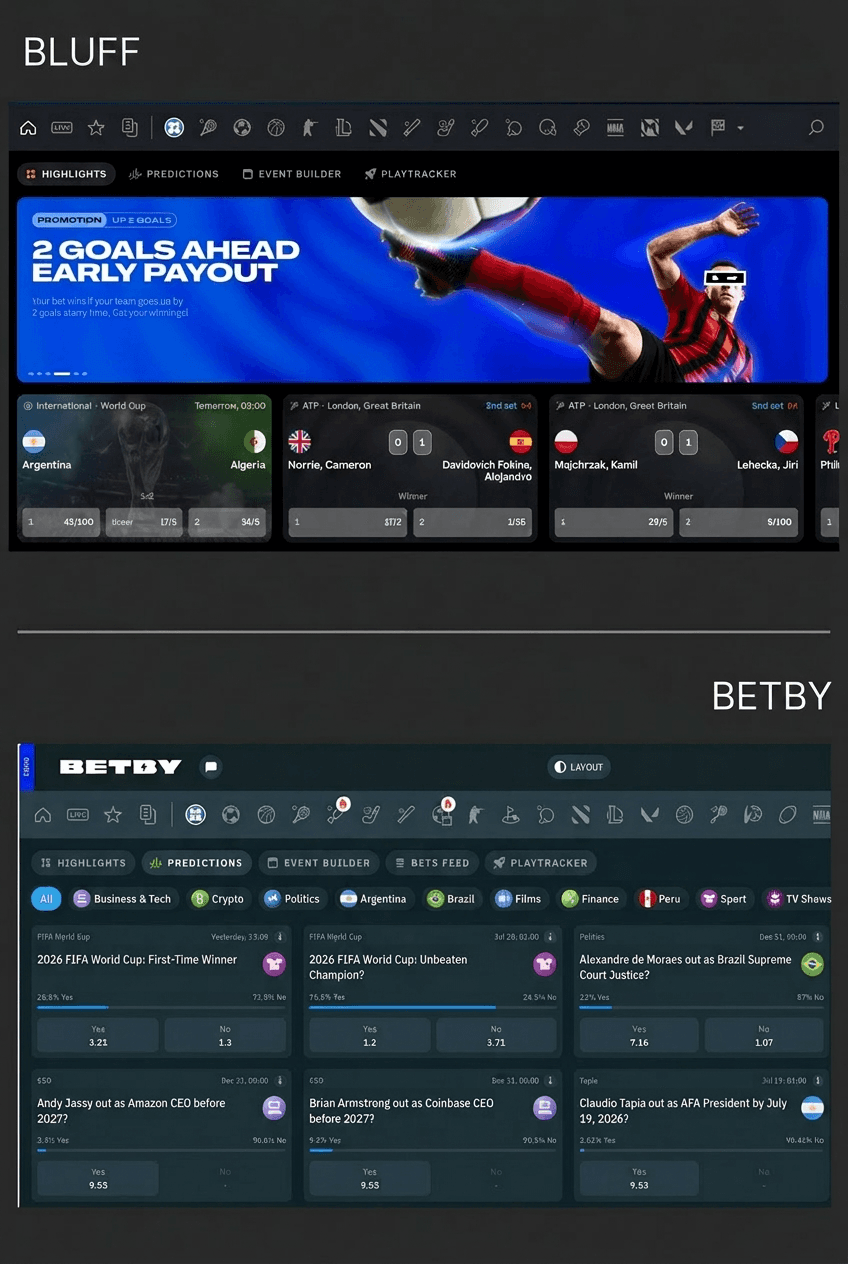
Now, this wouldn't usually be a major problem. Many otherwise innocuous iGaming venues are built on top of white-label software. The issue is Bluff clearly states the opposite:
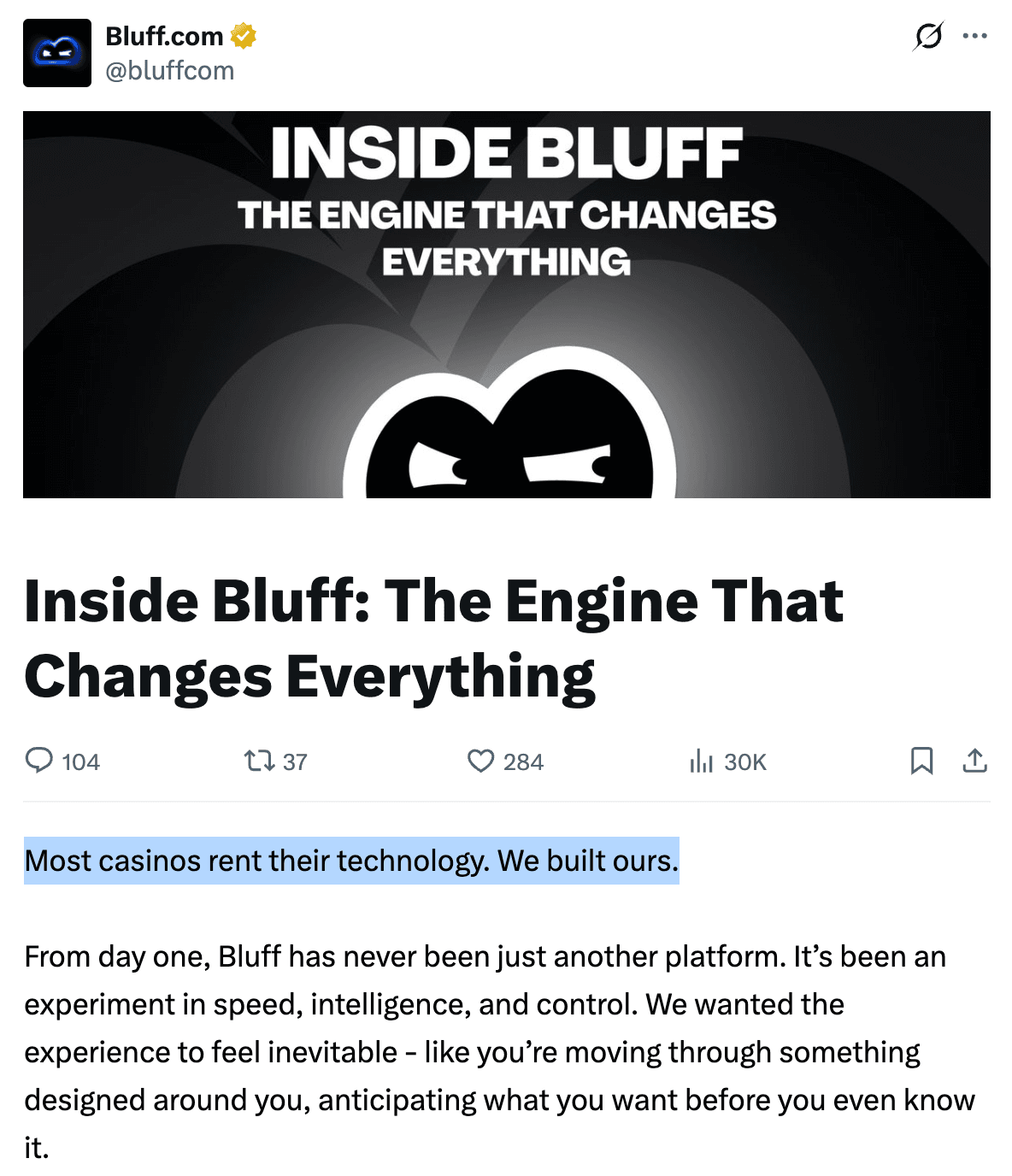
"Most casinos rent their technology. We built ours," one launch thread declared. Its network traffic says otherwise.
Bluff said the boast described its own platform and games, and confirmed that its sports odds come from Betby and other third parties. The prediction markets and sportsbook that it heavily markets are the parts it doesn't build.
Betby did not respond to our request for comment.
Easy to get in. Hard to get out.
An operator is generally expected to verify a player's identity before it takes their money, not after a win. When we tested Bluff, we created an account and deposited immediately, with no identity verification at any stage. The only age step was a checkbox confirming we were over 18, with no proof requested.
Bluff confirms this is deliberate. It says full KYC is triggered before withdrawals and once a customer's deposits reach $10,000, that age is confirmed at registration, and that allowing deposits before full verification is consistent with its Anjouan licence and a risk-based anti-money-laundering programme.
Whether that meets the licence's identity obligations is a matter for the Anjouan Gaming Board. We asked the board about operators that take deposits before running identity checks. Its reply did not address Bluff directly:
"The Board takes allegations concerning AML, KYC, age verification, and financial transaction controls seriously. Licensed operators are required to maintain appropriate controls in accordance with the terms of their licence and applicable regulatory obligations. The Board does not comment publicly on specific licensee reviews, complaints, or potential enforcement matters. However, any credible information provided to the Compliance and Enforcement Team will be reviewed and assessed in accordance with the Board's standard supervisory procedures."
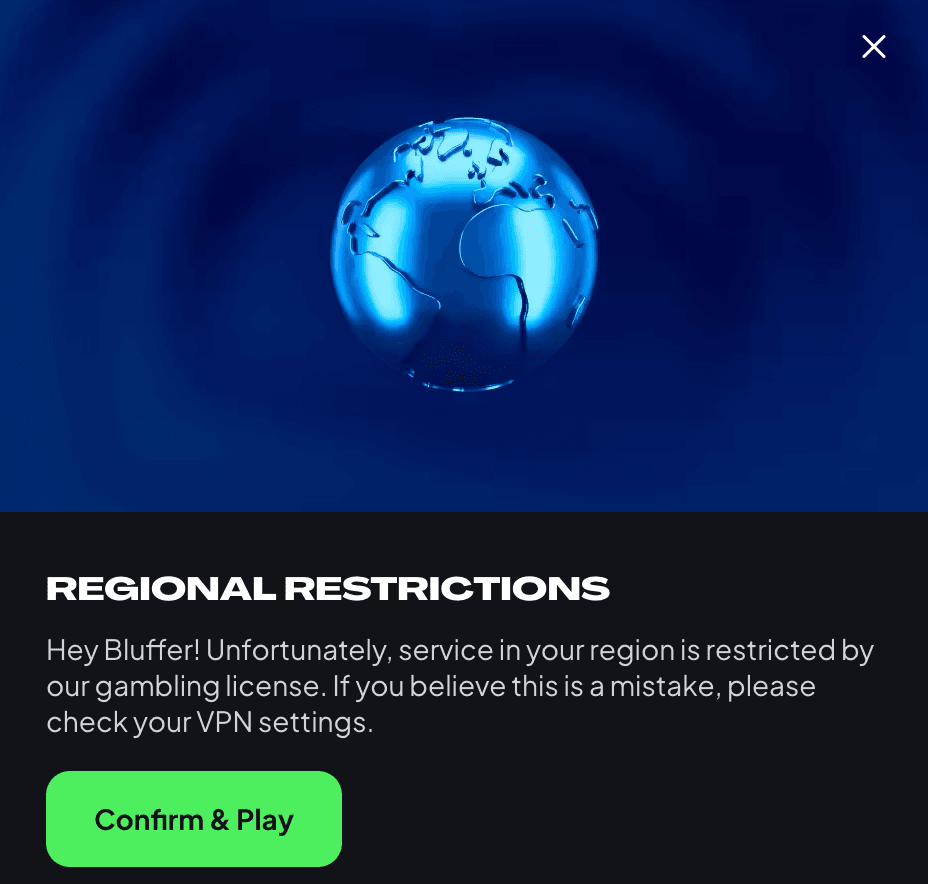
The front door is looser. Bluff holds no UK Gambling Commission license, so like its offshore peers it should block British players. In our own test, from a UK connection with no VPN, a notice flagged our location but cleared with a single click, and the deposit went through.
Bluff can plainly identify a UK user, since it flagged us. But it treats that as a box to click rather than a door to close, while keeping the click as a contractual reason it could later use to void a UK winner.
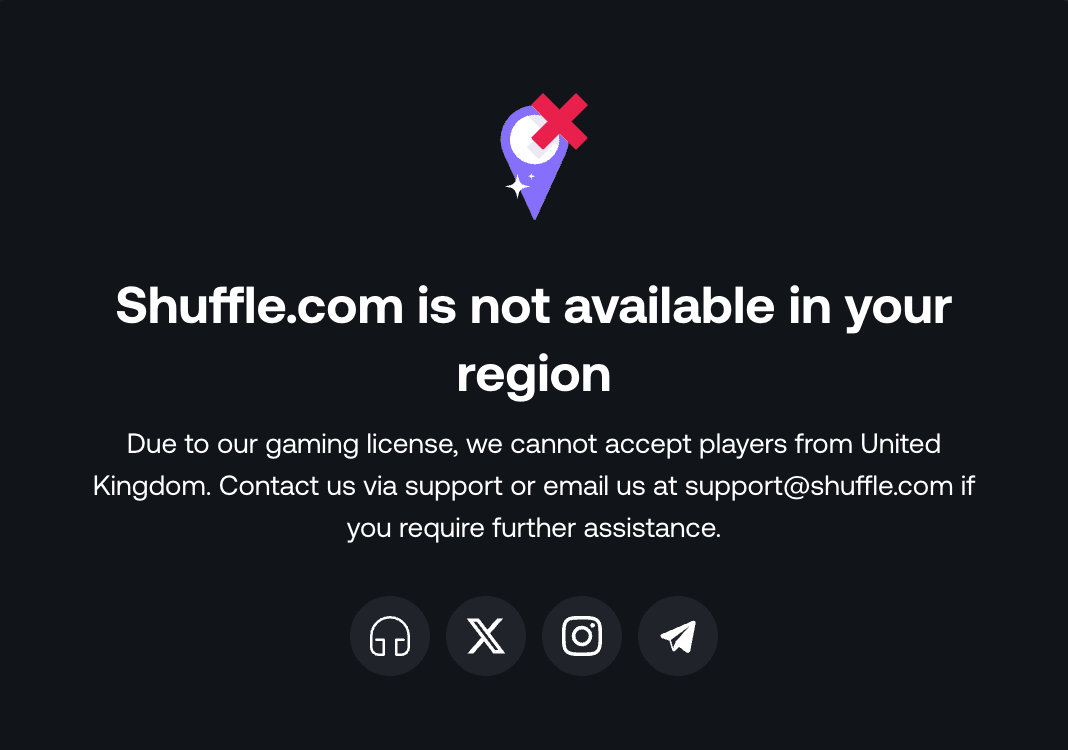
A licensed offshore peer shows what a real block looks like: from the UK, Shuffle returns a hard wall stating it cannot accept players from the United Kingdom, with no way past it. Bluff flags the same location and then lets you click straight through. Seems like more of an invitation to bypass.
Bluff's real-money record is short, but not clean, and the friction shows up when players try to withdraw.
We counted 19 separate clauses in its published terms that define bonus abuse, in language broad enough to sweep in ordinary cautious play: low-volatility games, instant cashouts, what the terms call "repetitive minimal exposure betting."
Clause 11.28 stands out as particularly vague.
Without limitation, conduct considered "Bonus Abuse" may include low-volatility gameplay, instant cashout patterns, repetitive minimal exposure betting, or any pattern of play that the Company in its sole discretion deems non-recreational. Where Bonus Abuse is suspected, the Company reserves the right to void any associated winnings, including winnings indirectly derived from such play.
— Bluff Terms · §11.28
One interpretation is: cash out fast and you're abusing the system; cash out slow and you're also abusing the system.
Bluff says that reading overstates the rules: low-volatility play, instant cashouts, and minimal-exposure betting do not (on their own) amount to abuse, and each case considers the overall pattern of play rather than any single action.
They also let Bluff confiscate winnings "indirectly derived" from suspected abuse, wording loose enough to reach genuine real-money wins. Shuffle covers the same risk in essentially one clause, defining abuse as "intentionally exploiting a Bonus in bad faith," and its remedy there is to remove the bonus rather than to confiscate winnings.
10.4. We reserve our right to remove any bonus from inactive accounts and accounts that we determine at our sole discretion to be intentionally exploiting a Bonus in bad faith.
— Shuffle Terms · §10.4
What happens when you win
One player, who asked not to be named, told FairGambling that a $400,000 payout was refused after a short, lucky session, with Bluff citing "lossback abuse" but never specifying which rule was broken.
Their reading, which the terms do not make easy to dismiss, is that the rules let Bluff withhold winnings on suspicion of non-recreational play alone.
It echoes an open, unresolved Casino.Guru complaint from a Brazilian player who had a roughly $10,000 slots win on a welcome bonus, voided for bonus abuse and "low-risk" play. This, after completing wagering and full KYC.
Running KYC and anti-bonus-abuse rules is standard, and broad terms are common offshore, so one disputed payout is not a pattern. What's concerning is the breadth of Bluff's winnings-confiscation language, and early signs that it may be applied selectively, only once a player wins.
For reference, the standard safeguard is that an operator can freeze an account or limit it to withdrawals when it suspects abuse, but it is not meant to claw back a settled balance.
Bluff said it never acts on suspicion alone, and that any action follows a review of account and gameplay records. It did confirm, though, that winnings indirectly derived from abuse can be forfeited under its terms.
Why "prediction market" is worth saying
So why does a crypto casino with thin real volume and an off-the-shelf betting engine work so hard to be called a prediction market?
The "prediction markets" it currently offers are built around Betby's fixed-odds product, a standard module Betby offers to its clients. It's nothing revolutionary.
Bluff's real edge is the label itself, since capital is rotating heavily into the prediction market sector.
Kalshi raised $1 billion at a $22 billion valuation led by Coatue, double its mark four months earlier; Polymarket was valued at roughly $9 billion when the Intercontinental Exchange, owner of the NYSE, invested in October 2025, and has reportedly sought funding at around $15 billion since. The first dedicated prediction-market fund, 5c(c) Capital, launched with backing from the CEOs of both Polymarket and Kalshi and from Marc Andreessen.
Getting a prediction market label could offer a regulatory advantage.
Kalshi and Polymarket argue that prediction markets fall under the federal CFTC rather than state gambling regulators, which potentially buys near nationwide reach and an "asset class" story that institutional money will buy.
That regulatory footing is the real draw, and parts of the gambling industry are beginning to reach for the same label: Novig, a sweepstakes sports exchange, raised $75 million from Pantera at a $500 million valuation while pivoting to a CFTC-regulated prediction market, and DraftKings and FanDuel have launched prediction arms. Pantera's own partner has put sports betting at up to 90% of prediction-market volume.
That is the spectrum Bluff is leveraging: at one end, federally-tracked exchanges worth tens of billions; at the other, an offshore crypto casino borrowing the same vocabulary to raise $21 million off play-money metrics.
Kalshi, Polymarket and Novig are real, regulated businesses. Bluff is not one of them (at least not yet), but it's still looking to benefit from the halo they built.
How did Bluff raise $21 million?
Crypto casinos rarely raise venture money, because a working one prints cash; Stake built a multi-billion-dollar business with none, and has never issued a token.
When money does come in, it is small: Shuffle, the fourth-largest casino we track at $191.6 million in deposits, raised $2.5 million back in 2024.
Yeet, which runs almost exactly Bluff's points-farming playbook under an Anjouan license and sits at 4,700 depositors, raised $7.75 million. Bluff, with 743 depositors and $828,500 in deposits, raised $21 million.
It's clear the money did not buy players. Instead, it bought three things that never touch the chain.
The first is the team, senior operators from Stake, Bet365, William Hill and Bodog, the pedigree that got them in the door. Meanwhile, the "prediction markets" label helps to put Bluff in the same sentence as Kalshi and Polymarket, even though the markets themselves are a stock Betby feature. Last is its pre-launch statistics: by launch Bluff was claiming $10 billion "wagered" and hundreds of thousands of sign-ups (all based on play money farmed for points).
Moreover, its backers are primarily crypto-native funds, not casino operators or iGaming specialists, which suggests the round was a bet on a token launch and the crowd primed to trade it, rather than on gambling revenue. 1kx and Delphi Ventures did not respond to requests for comment.
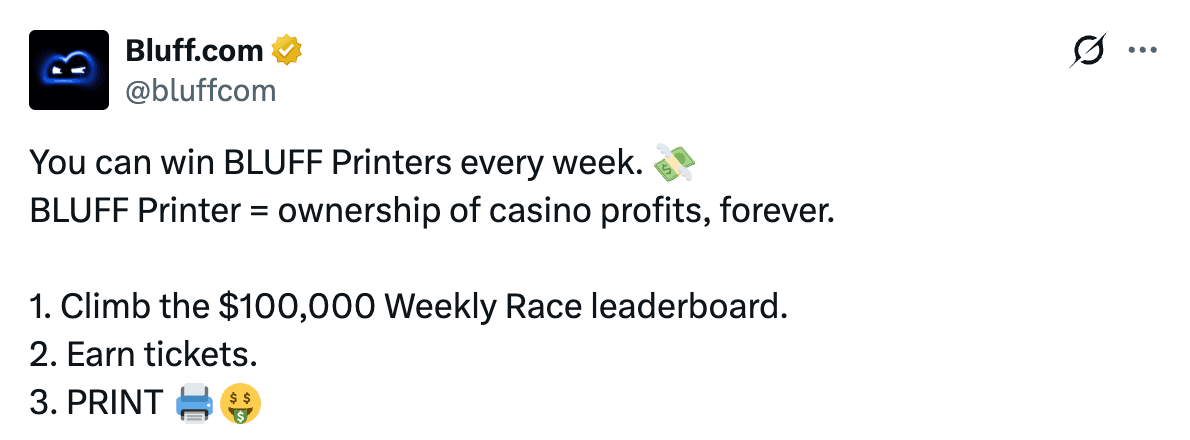
Since launch, Bluff has leaned on rewards it never pins down to keep players wagering. It promotes "Printers" in a weekly race as a claimed share of future profits, with no percentage, contract or terms published anywhere on the site, so the prize stays undefined while the wagering it is meant to drive is real.
Bluff has its $21 million and a base of sign-ups farmed for a token; the wager that it could turn them into players who lose real money doesn't appear to be paying off. The chain says that conversion has barely begun: 743 depositors in 30 days.
The more telling question is what happens when the token launches.
The likely trajectory
Bluff is running a familiar crypto-token playbook on the casino niche: take venture money, manufacture traction with an airdrop and a points race, then launch a token into the attention you have bought. The casino underneath is almost incidental.
The design is likely low float against a high fully diluted valuation: only a small slice of supply trades at launch, while the headline number is priced as if every token already existed. Thin supply meeting real demand prints a high price and makes for a flattering notional valuation.
Then come the token unlocks. Team and investor allocations vest and the Blink Points farmers collect their airdrop; these sell into retail buyers arriving on the narrative while each new release feeds the decline.
Rollbit is the instructive exception. It skipped the template: no venture money, no investor unlocks, a token handed to existing paying customers, and a buyback-and-burn funded by real revenue, reported at around $41.7 million in fees over 30 days at its 2023 peak and visible on-chain. Even so, it trades roughly 75% below its 2023 high.
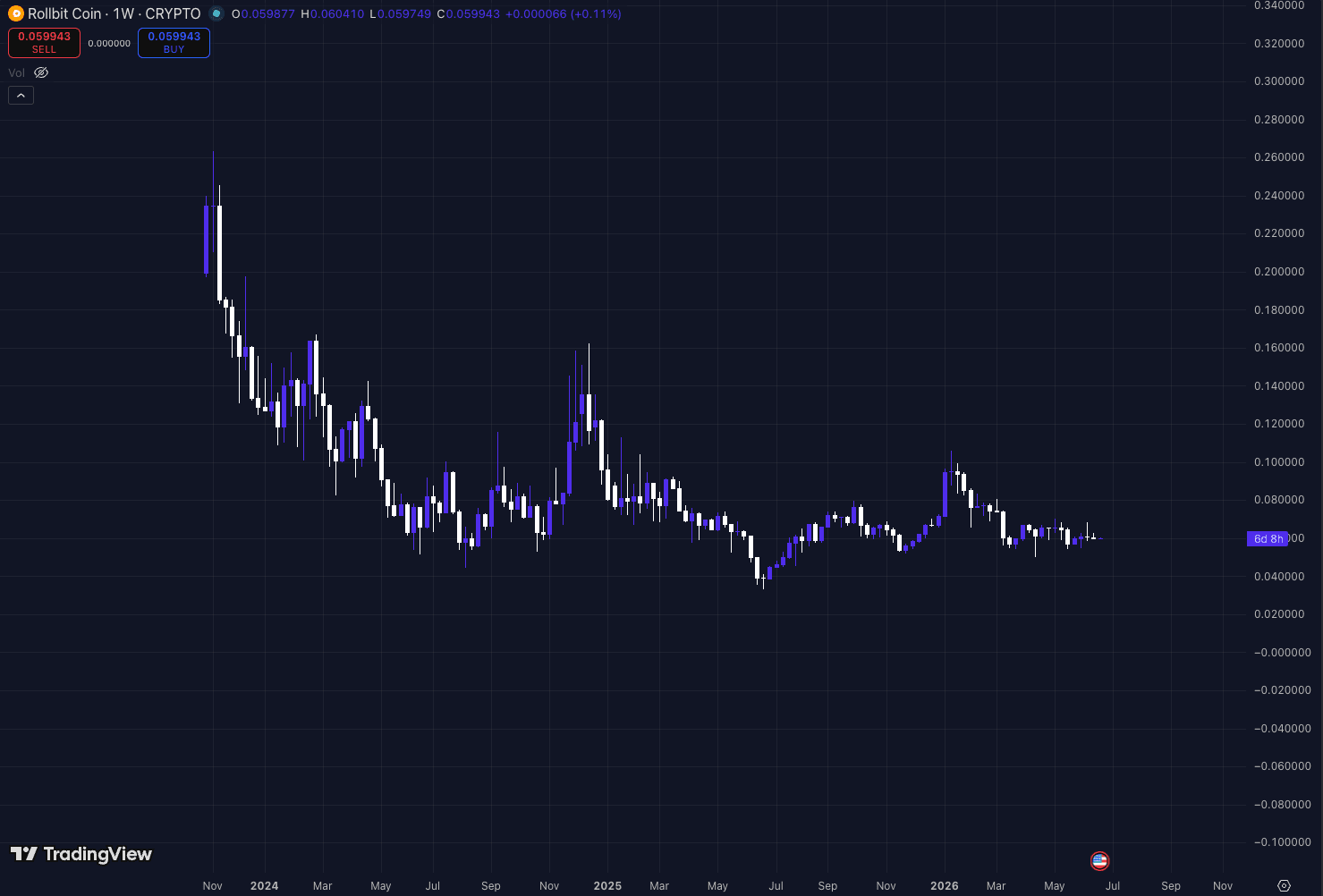
Bluff is configured as the opposite. It carries the venture overhang Rollbit avoided, with investors and team allocations set to vest on the usual low-float schedule, and it has announced no revenue buyback, the lever Rollbit pulled to take supply off the market. With real volume this thin, that revenue would be minimal anyway. Most of the selling pressure would come from that insider supply, with the farmers playing a smaller part.
The strengths that carried Rollbit early are the ones Bluff lacks, but it has every ingredient of the decline.
We can't price a token that doesn't exist yet. What we can say is that Bluff is assembled the same way as launches that didn't end well.
See it for yourself: Track Bluff's real deposits, depositors and wallet balances against 39 other crypto casinos, updated live, on the FairGambling analytics dashboard.
Data and method: FairGambling Research. On-chain figures cover the 30 days to 15 June 2026 (wallet balances same date); deposits are gross inflows, a measured floor.