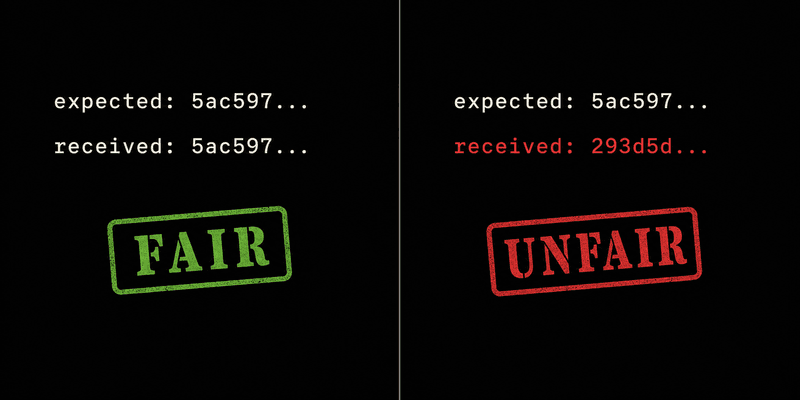



Provably Fair: How to Check That Your Bets Are Fair
Provably Fair games promise verifiable fairness, but what actually puts players' minds at ease goes beyond the math.

· 5 min · 5 min read
If you have played any virtual casino game, it has a Random Number Generator (RNG). This should guarantee random, fair results when gambling online. At regulated casinos, regulators inspect these results to ensure fairness. If a casino fails to provide evidence of fair games, it can face penalties or lose its license.
At crypto casinos, where regulation is less strict and third-party testing is not possible, Provably Fair addresses fairness instead. This lets users verify a result’s fairness through cryptography.
But how does it work, how reliable is it, and how can you start checking results yourself today?
How it works
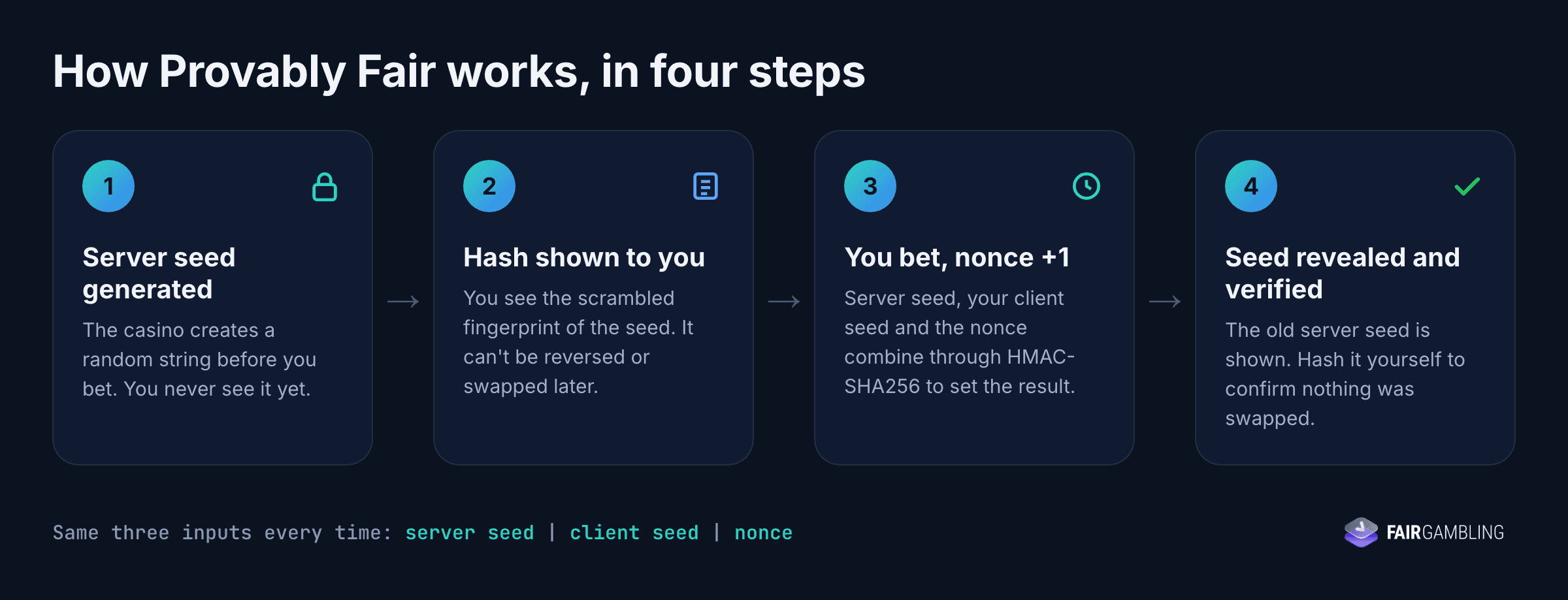
Whether you like playing slots, dice, mines, or crash, you’ll interact with Provably Fair the same way. Before you place a bet, the casino creates a random string called a “server seed.” This will not be visible to you, but it will contain the result of your next go.
You can, however, see the hash of that seed, which is like a scrambled fingerprint of the seed. This is impossible to reverse, so you know it hasn’t been swapped after the result is generated.
As a player, you also receive a client seed. You can set it yourself, or the casino can assign one. You will also get a nonce, which is a number that increases with each bet you place. Each time you place a bet, the game will combine the server seed, your client seed, and the nonce through an HMAC-SHA256 calculation. This calculation will produce the outcome of your spin, roll, or crash multiplier.
Your casino will eventually show you the old server seed, and you can then check the math to see if the result checks out.
Verifying a bet with FairGambling’s tool
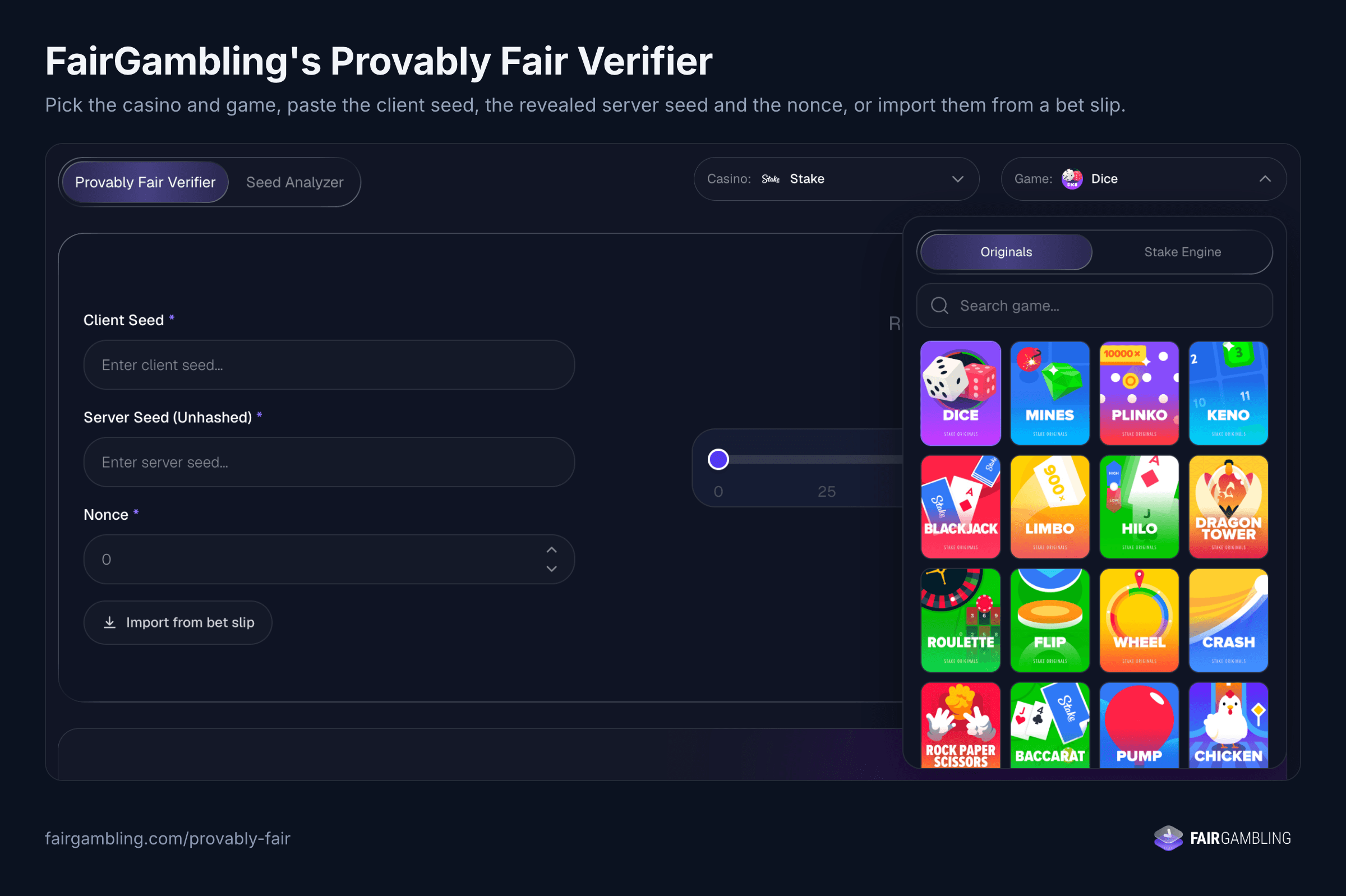
Having an impartial Provably Fair verifier is a crucial tool for telling the real from the fake. We have our own verifier for you to use right away.
Using a Stake Dice bet as an example, here is how to get started.
- Find your seed pair on the casino’s site: On Stake, this lives in the Fairness tab. You need the client seed, the nonce for the specific bet you’re checking, and the revealed server seed (you’ll need to rotate your active seed first if it hasn’t been revealed yet).
- Open the FairGambling verifier for that casino and game: Each verifier is built for a specific casino’s exact formula, since not every site converts the HMAC output into a result the same way.
- Enter the server seed, client seed, and nonce into the tool: No account or wallet connection needed; the calculation runs entirely from those three inputs.
- Read the output: The tool shows the HMAC-SHA256 hash it calculated and the resulting number or roll it produces from that hash.
- Compare the result to your actual bet: If the number the tool produces matches the outcome you saw in the game, the bet was generated exactly the way the casino claims.
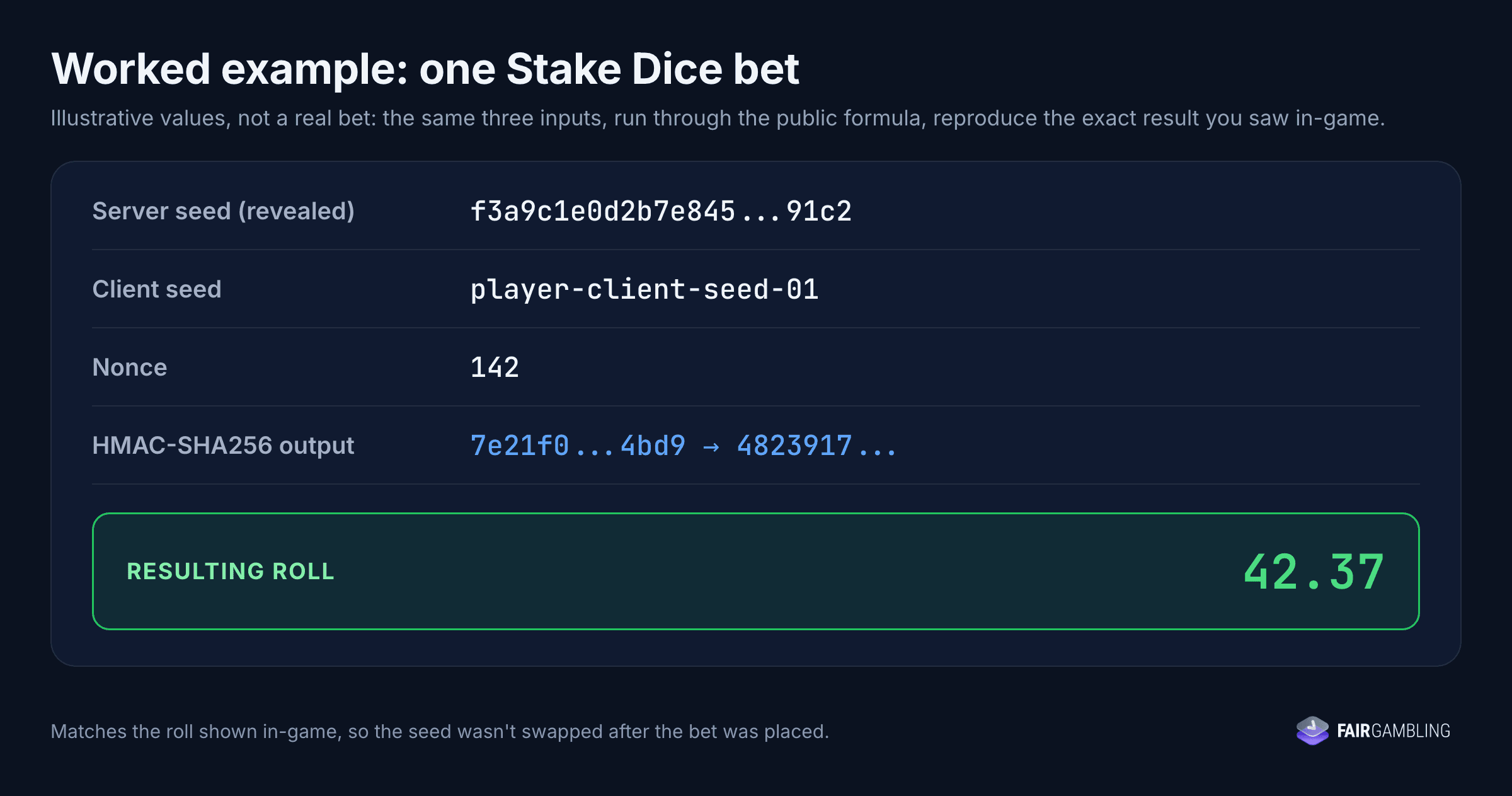
If you want to go one step further, hash the server seed yourself and confirm it matches the hash the casino showed you before you ever placed the bet. That confirms the seed wasn’t swapped after the fact.
This process is nearly identical for Mines, Plinko, Limbo, and Dragon Tower. The inputs are the same three values: server seed, client seed, nonce. What changes is how the resulting hash gets converted into a game outcome; a mine grid needs a different mapping than a dice percentage, which is why FairGambling runs a separate verifier per game rather than one generic calculator.
What Provably Fair proves and doesn’t prove
Casinos have been under fire since the launch of these Provably Fair games because many mislead players about what this proves and what it means for the fairness of the result.
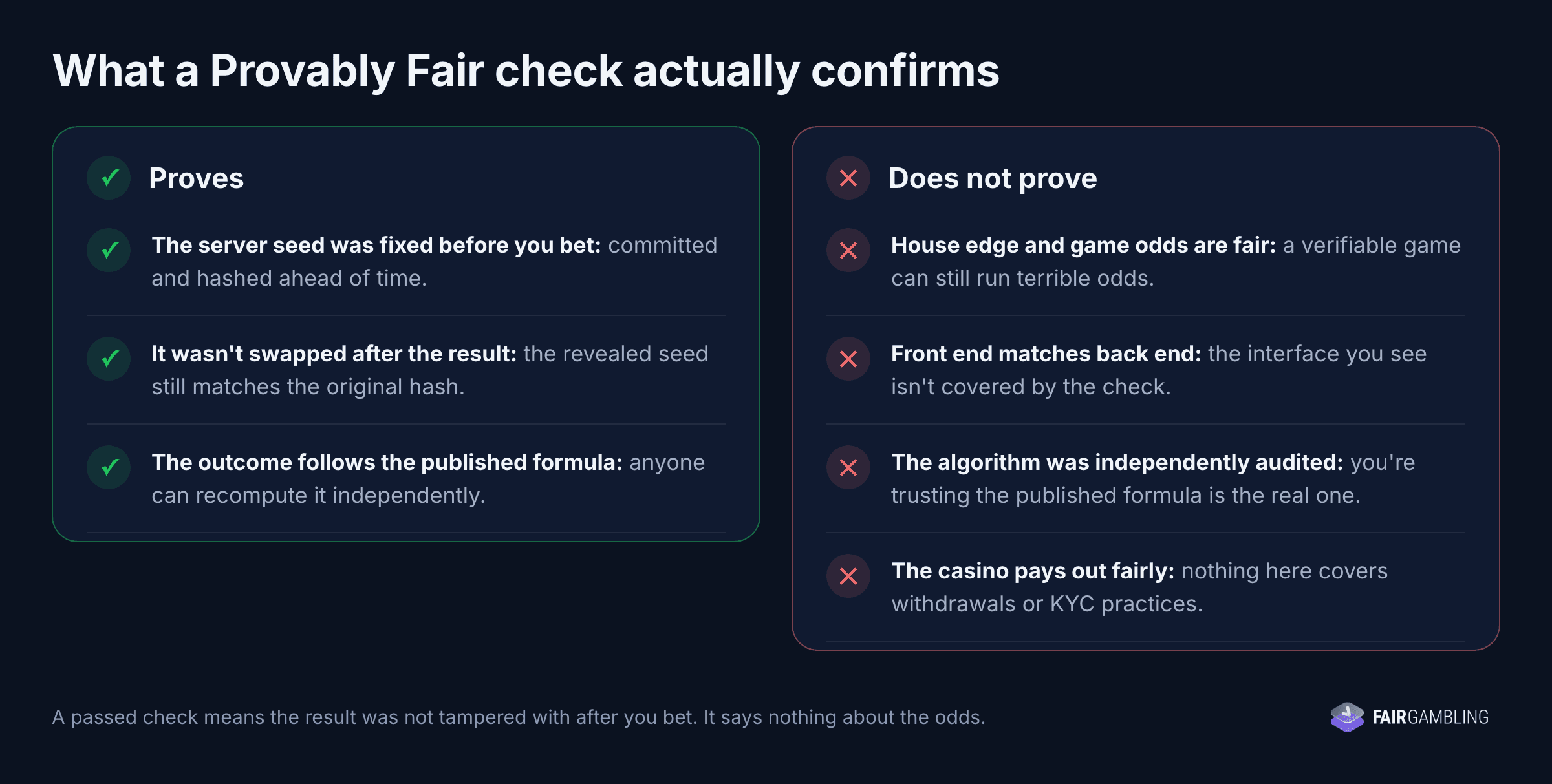
Essentially, a matching hash means the server seed was generated before the result of your bet. This means a casino cannot change the outcome after seeing your bet to cheat players after the fact.
The issue, and the criticism, is that casino-led players believe this proves the game is fundamentally fair, the same way an audited RNG game does.
There are several things it does not prove:
- The house edge is acceptable: The check covers how a result is generated, not what the casino pays for it. Where the game logic is published you can confirm the odds, but the multiplier sits outside the seeds, so a casino can run a 1% edge or a 5% edge, change it tomorrow, and every bet still verifies.
- Front end matches back end: The interface itself isn’t covered by the check. In theory, a front end could misrepresent a result even when the underlying provably fair math is correct. Verifying independently, rather than trusting the in-game “Fairness” pop-up, is the entire point of using a third-party tool.
- The algorithm has been independently audited: You’re trusting that the formula a casino publishes is the formula actually running. FairGambling’s verifiers are built by reverse-engineering and testing against real results, which is a stronger check than taking a casino’s word for it, but it’s still not a certification from a licensing body.
- The casino pays out fairly: Nothing here covers withdrawal practices, KYC treatment, or whether a casino pays out at all. A casino can run mathematically fair dice and still be slow, difficult, or dishonest about cashing out.
What to look for
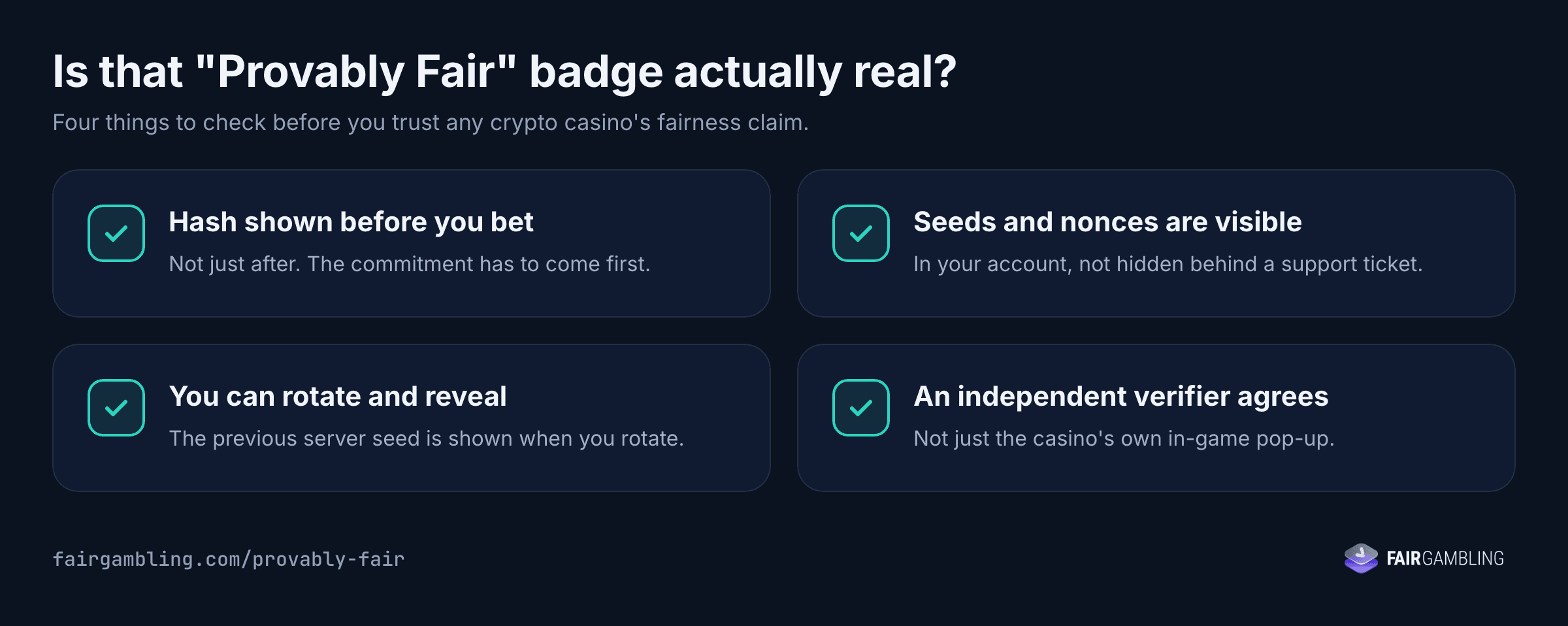
A Provably Fair guarantee is the best you can get from a crypto casino right now. However, you can decide if this guarantee is legit or not by checking for these basics:
- The casino shows you a hashed server seed before you bet, not just after.
- Seeds and nonces are visible somewhere in your account, not hidden behind support tickets.
- You can rotate your seed and see the previous one revealed.
- An independent verifier (like FairGambling’s), not just the casino’s own pop-up, produces the same result.
What you need to know
Provably Fair is a real cryptographic guarantee, but it only gives you part of the picture. It tells you a specific bet wasn’t tampered with after the casino saw it, but nothing about the payout, the house edge, or whether the casino is worth playing at in the first place.
If you can build the five-minute habit of running your own bets through an independent verifier, rather than trusting the in-game checkmark, it will be the difference between actually verifying fairness and just being told you have it.
Frequently asked questions
Can a provably fair casino still cheat?
Yes. Provably fair only proves the result of a bet was not changed after you placed it. It says nothing about the house edge, whether withdrawals are paid, or whether the interface shows you the real outcome.
How do I verify a provably fair bet myself?
Take three values from your account: the revealed server seed, your client seed and the bet's nonce. Run them through the casino's published formula, usually HMAC-SHA256, or paste them into an independent tool such as the FairGambling verifier. If the result matches the roll you saw, nothing was changed after you bet.
Does provably fair mean the odds are fair?
No. Provably fair covers how each result is generated, not the house edge, which lives in the payout. Where the casino publishes its game logic you can confirm the odds, but a verifiable dice game can run a 5% edge or a 1% edge and the check passes either way. Compare the published RTP before you play.
Treat gambling as entertainment you pay for. 18+, and if it stops feeling like entertainment, help exists at BeGambleAware and GamCare.
Mission Statement
Crypto gambling has a transparency problem. We're fixing it.
- On-chain data and original research, not recycled press releases
- Honest operator reviews and news, free from affiliate influence
- Player-first reporting built on transparency and responsible gambling
Editor Picks

The $10M Gap in Winna's Slide Record
First Impressions: Moon.com, Stake's 1,000x Leverage Bet?

Inside Bluff's $21M Raise: White-Label Tech, Withheld Winnings, 743 Players.

On-Chain Transactions Explained: Your Guide to Checking Crypto Transactions On-Chain