Why Is My Crypto Casino Withdrawal Taking So Long? Causes and Fixes
One of the most common complaints about crypto casinos is withdrawal times, with some payouts delayed or blocked entirely. We explain why this happens, the signs of a real problem, and what you can do about it.

· 7 min · 7 min read
Check any casino community forum, Reddit and Trustpilot included, and withdrawal delays come up as the single biggest pain point for players. On our review hub, players mention fast payouts far more often than slow ones.
Most explainers stop at "KYC takes time" and suggest verifying your identity early to avoid it. That's true as far as it goes, and it isn't unique to crypto casinos. But it only tells part of the story.
This piece looks at what's actually happening behind a delayed withdrawal, so players can understand the real causes, avoid the common pitfalls, and spot the difference between routine processing and a casino not playing fair.
So what causes the delays?
Three key practical causes of payout delays at crypto casinos.
KYC/AML holds
This is a common reason payouts are delayed, and it is not unique to crypto casinos. All legitimate casinos have Know Your Customer (KYC) processes or Anti-Money Laundering (AML) procedures in place.
KYC is a practical feature that prevents users from creating fake accounts. Casinos need this for several reasons: to stop players from pretending to be older than they are, to stop banned players from getting around a ban, and to stop someone from impersonating another person for financial gain.
It is also a key license condition. Every regulated casino has to run these checks to keep its license, which means the support agent you're messaging cannot waive them for you, no matter how reasonable your request is.
New players usually need to provide proof of ID and address, such as a driver's license or passport, along with a utility bill. Some casinos also require phone or email verification. Most casinos ask for this at the point of first withdrawal. Some platforms even ask during the sign-up flow, rather than springing it on you at the point of withdrawal.
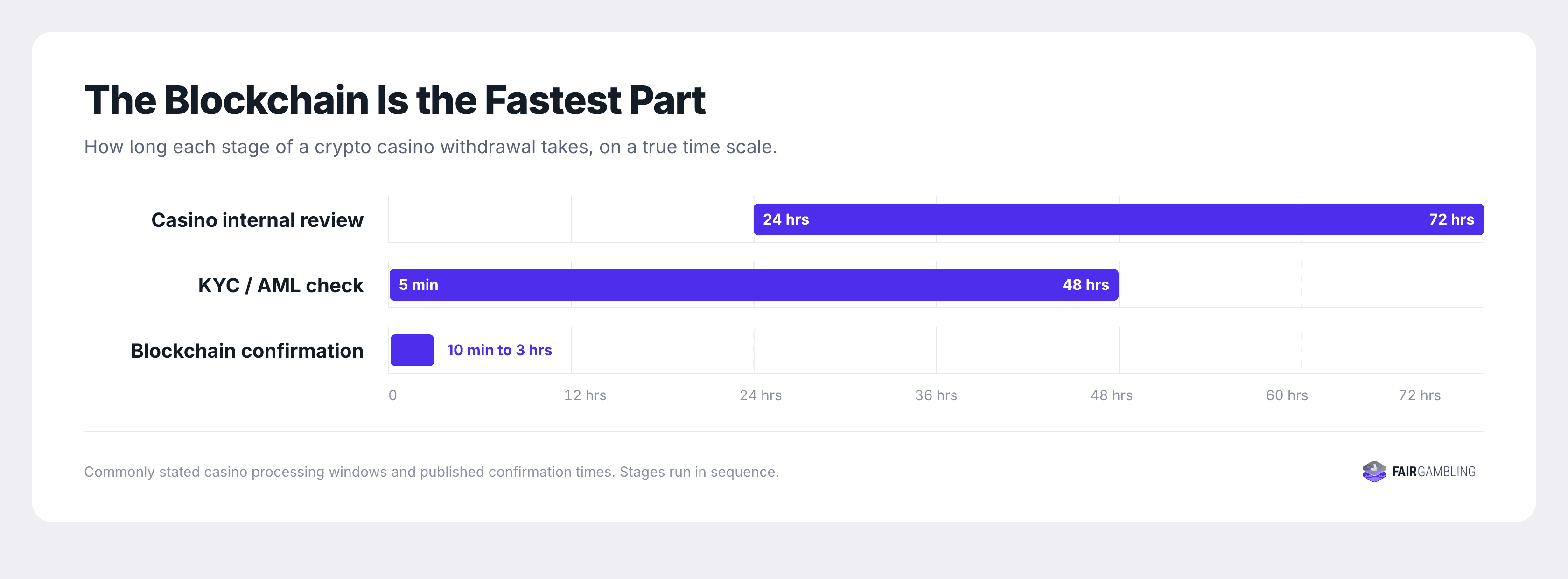
If your documentation is clear and matches who you say you are, verification usually completes in minutes. However, manual review can take a day or more if documents need a second look.
AML protocols attempt to prevent money laundering. This is usually triggered by suspicious gambling activity. The most common trigger is attempting to withdraw in a different cryptocurrency than you deposited with.
Attempting to withdraw in a different crypto than you deposited with is one of the most common AML triggers.
Either check can be triggered at any point when you try to redeem large amounts of money. In most cases, this is a legal compliance requirement rather than a stalling tactic.
Some newer no-KYC casinos skip identity verification entirely. Approach these with caution: you lose a layer of account security for convenience, and their licensing is often difficult to verify. Licensed operators do things differently.
Under the risk-based approach that Curaçao and Anjouan both require, they perform basic checks for every player at registration but only request the full document set when risk indicators appear, such as a large withdrawal, a mismatch with your stated profile, or a deposit from a high-risk jurisdiction. That is a rule they follow, not a judgment about you.
One more account-level hold catches people out: an active bonus.
Some casinos block withdrawals entirely until you clear the wagering requirement. Others let you cash out but forfeit the bonus.
Check your bonus status before you assume the casino is stalling.
Blockchain confirmations
Blockchain confirmations are inherent to cryptocurrency and are essential for transacting safely using blockchain technology. The number of confirmations required before a crypto transaction is considered truly final depends on the chain.
Most wallets and casinos will consider a Bitcoin transaction finalized within 1 to 6 confirmations (taking ~10 minutes each). Faster networks like Tron, Litecoin, and Robinhood Chain will usually achieve transaction finality in minutes.
A confirmation is a block added to the chain containing your transaction. More confirmations means harder to reverse, which is why casinos wait for a set number.
Casinos will not allow you to withdraw recently deposited funds until it is considered final on their end. Likewise, your wallet might not display your withdrawn balance until it clears its own confirmation threshold.
Network congestion and gas fee tiers can slow withdrawals down; for example, a low-fee Bitcoin transaction can sit unconfirmed for hours during busy periods, but they rarely cause the multi-day delays players associate with slow withdrawals.
Liquidity management
One cause players rarely consider is liquidity, which comes down to how a casino batches its withdrawals. Sometimes it needs to convert crypto into fiat reserves first, or from one crypto asset type to another. Sometimes it is waiting on an exchange settlement. Neither is visible from your account page, and neither is something support can speed up.
This is why most casinos quote a 24-hour processing time but warn it can run to 72 hours or more. That upper figure is the worst case: a payout waiting in a batch until a conversion or settlement clears. Weekends and public holidays stretch it further, since these checks slow down outside business hours.
What's normal vs. what's a red flag
Those three causes cover most delays. They don't cover all of them, and some casinos really do sit on payouts longer than they should.
We track payout speeds across the casinos in our rankings, so you can check an operator before you deposit.
Here is how to spot a red flag.
🟢 Normal | 🚩 Red flag |
|---|---|
KYC review on your first withdrawal | No communication after several days with no explanation |
Extra processing time during high-traffic periods (weekends, public holidays) | Verification requirements that keep changing after you've already submitted what was asked for |
A multi-step internal review before funds are released | Withdrawal stuck on "processing" with no transaction visible on-chain at all |
A short delay while the casino batches or converts funds | Support going silent or giving different answers each time you ask |
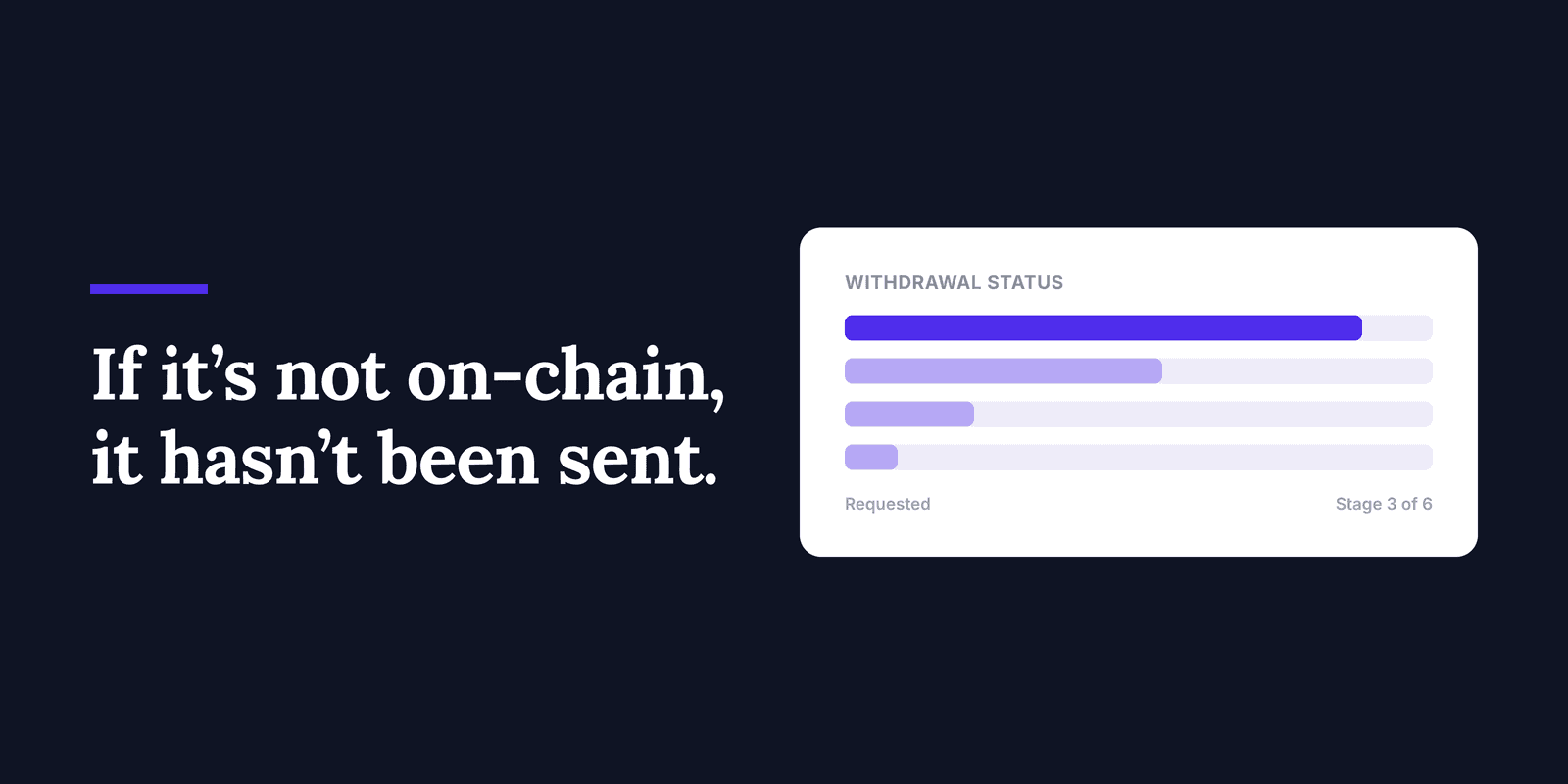
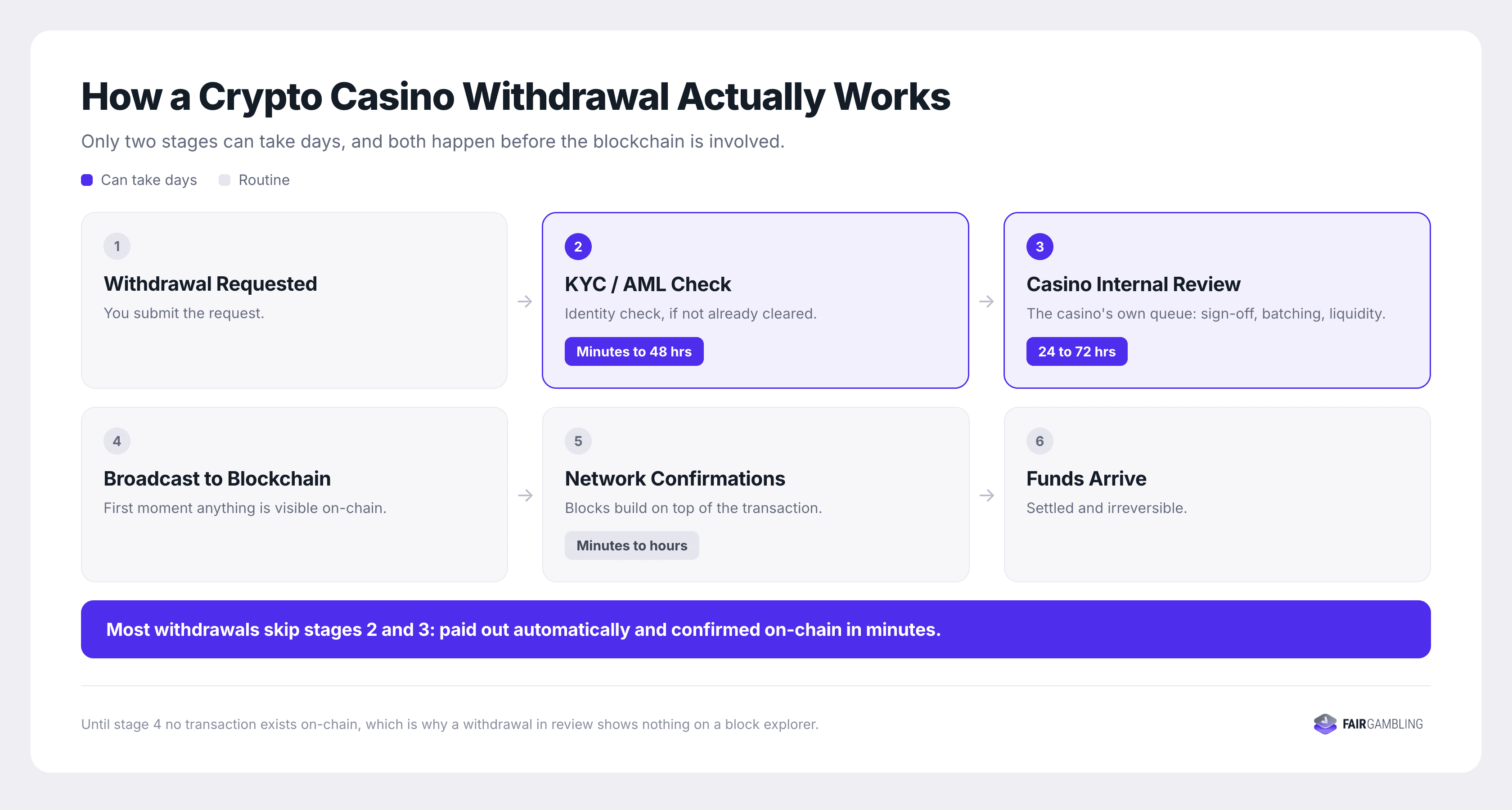
Some of these signs are easy to check yourself; others come down to time. The clearest one is on-chain visibility: if a casino says your withdrawal is "processing" but you can't find any matching transaction on a block explorer (no confirmations, no pending transaction, nothing...), then that's not a normal delay. The transaction hasn't been sent yet.
If a withdrawal shows no on-chain transaction at all and support has stopped responding, that's a red flag.
Time is trickier to pin down since there's no universal standard, but as a rough guide, going more than 5-7 days with no update and no response from support is past the point of "normal processing" for most licensed casinos.
How the crypto casino payout process works
Practical steps to avoid delays
Now we know the reasons and the red flags: what can the user do to avoid delays and get paid without the stress? Here’s what you can and can’t control.
What you control
- Complete KYC before you need it: Players get excited, try to withdraw, then get frustrated by delays when they haven’t verified their identity. This is common practice at casinos, and you want to get it out of the way early.
- Use the same crypto for deposits and payouts: This is sometimes known as “closing the loop." If you try to withdraw a different crypto than the one you used for your deposit, you may trigger the casino’s AML checks.
- Understand confirmation times: If speed matters, then you need to use a fast-confirming coin like USDT on Solana or Robinhood Chain, which will clear quicker than Bitcoin. Each crypto has its own times, and they can slow down during busy network periods.
- Understand your casino’s process: Knowing exactly how withdrawals work at your casino will help avoid any surprises. This includes knowing the withdrawal window. The standard is 24 hours, but this varies, and knowing how long will alert you to any issues or red flags.
What's out of your hands
- Network congestion: The blockchain slows down for everyone during busy periods, not just casino withdrawals. Players can't do anything to speed up the network itself.
- Gas fees and transaction priority: Miners and validators process higher-fee transactions first, so during congestion a casino's withdrawal transaction can simply sit queued behind others for hours.
- Casino liquidity management: Casinos may need to convert crypto to/from fiat or wait on an exchange settlement before releasing funds. This happens on the casino's side and isn't visible to the player.
No amount of preparation avoids these. The only real defense is knowing what's normal, so you can tell the difference between a routine wait and something worth escalating.
What to do if your withdrawal is late
Most withdrawals are quick. When one isn't, the wait is usually the casino's own process rather than the blockchain. Usually a compliance check, a review queue, or a batch waiting on a conversion.
That's routine, and rarely a sign anything is wrong.
Before escalating, check the casino's stated processing window, look for your transaction on a block explorer, and contact support in writing to get a case reference. If none of that produces an answer, escalation is justified.
If a casino has gone quiet, you can file a complaint through our complaints hub. It works best for unpaid withdrawals worth mediating, with your support tickets attached.
Frequently asked questions
How long should a crypto casino withdrawal take?
A crypto casino withdrawal is typically processed in minutes but can take 24-72 hours if subject to internal review, plus blockchain confirmation on top. Bitcoin usually needs 1 to 6 confirmations at roughly 10 minutes each; USDT on fast blockchains typically confirms in minutes.
Why is my crypto casino withdrawal still pending?
A crypto casino withdrawal stuck on "pending" or "processing" with no transaction hash has not been broadcast to the blockchain yet. It is queued inside the casino's own systems, usually behind a KYC or AML review. The chain is rarely the bottleneck; the casino's internal queue almost always is.
How long is too long to wait for a crypto casino withdrawal?
There is no universal standard, but more than 5 to 7 days with no update and no reply from support is well beyond normal processing for a licensed casino. Check a block explorer first: if no matching transaction exists, the casino has not sent the money, whatever support says.
Why is my crypto casino withdrawal taking so long?
A slow crypto casino withdrawal has three usual causes, and you can tell them apart. If the casino has asked for documents, it is a KYC or AML hold. If a transaction hash exists but is unconfirmed, it is the blockchain. If neither, the casino is batching funds itself.
How do I avoid crypto casino withdrawal delays?
Complete KYC before you request your first cashout rather than at the point of withdrawal. Withdraw in the same coin you deposited with, since a mismatch is one of the most common AML triggers. Choose a fast-confirming chain such as Solana or TRON and check your casino's stated processing window.
Treat gambling as entertainment you pay for. 18+, and if it stops feeling like entertainment, help exists at BeGambleAware and GamCare.