Provably Unfair: All the Ways Crypto Casinos Try to Scam You
Server seeds not committed before play, nineteen-clause fine print, fake regulator seals, and $10 billion in play-money “volume.” The tactics have changed, but every one of them works the same way: by hiding the one thing you need to check.

· 10 min · 10 min read
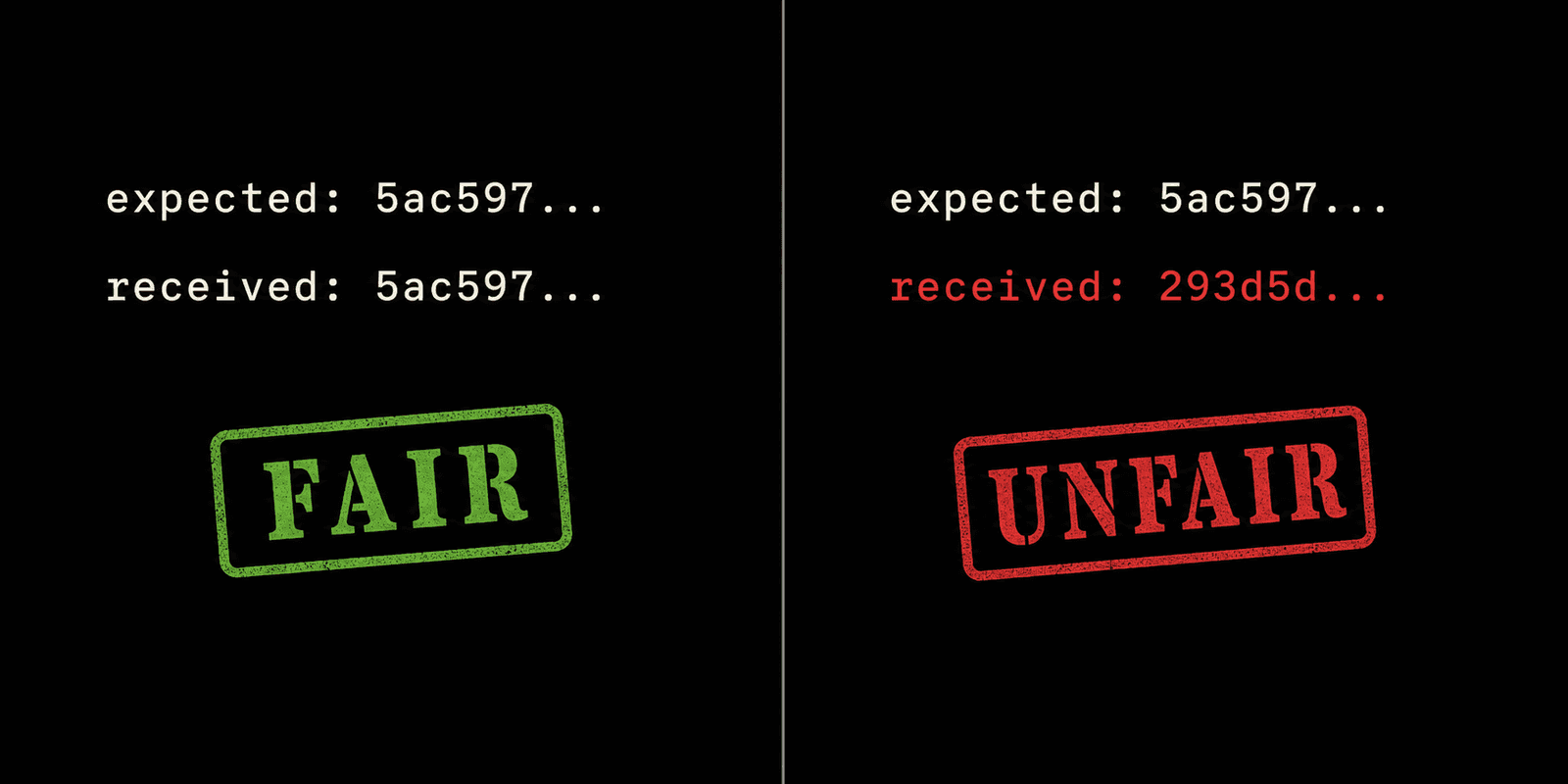
Provably fair is a central sales pitch of crypto gambling. Operators state that there's no need to trust when you can verify yourself. Every dice roll, every seed, all there for anybody to scrutinize.
However, this perception of fairness has left the door wide open for certain operators to try and bend or even break the rules, hoping that nobody will think to check.
Most of the time, the crypto gambling business model works as advertised. However, the same openness that lets a player verify a $10 Plinko drop can also allow a determined operator to disguise unfair practices. An unverifiable system, a frozen balance, or fictional user activity can be presented with that same language of transparency.
This guide will explore the gap between what a crypto casino claims and what it will actually allow you to check yourself.
When “Provably Fair” Isn’t
Provably fair rests on one principle: the casino commits to a result before you bet, using inputs it can’t quietly change afterward. If that principle is broken at any point in the chain, the 'verification' process goes out the window.
In fact, that’s the specific allegation now before the Tobique Gaming Commission against Winna, operated by licensee GG Gaming S.R.L. A player is seeking $7.3 million back after losing it across 62 wagers, one win, 61 losses, on an invite-only version of Winna’s “Slide” game over two days in May.
Further reading: The $10M Gap in Winna's Slide Record
While losing streaks aren't exactly uncommon in gambling, the complaint actually argues something different. It alleges that the private build used a client seed derived from a public 2023 Bitcoin block and a nonce fixed at zero, leaving the server seed as the only variable, and the operator never publicly committed to it in advance.
The losing streak is unusual, but it does not by itself prove manipulation. If the technical findings are accurate, they describe a system in which the house could theoretically see the result associated with a server seed before assigning it to the player, with no way for the player to know whether that seed had been chosen honestly.
Winna's own team appears to have acknowledged the issue, according to the complainant who posted screenshots quoting the operator's owner. The screenshot shows the owner responding to the suggestion that a fixed, uncommitted seed could work in the house's favour.
When I put it to him [Winna, the operator owner] that a fixed client seed meant they could have handed me a bad seed pair, his own answer was: "which i guess is true."
— Complainant
Winna has not publicly addressed the technical evidence. Its legal response to the regulator, filed on deadline, raised a procedural question about who was authorized to file the complaint, without engaging the cryptographic records requested.
ProvablyFair.org independently reviewed Winna’s live implementation and reached the same conclusions.
Winna’s API returns records for all 62 disputed bets, but the result field is empty for 61 of them. The single winning record contains only a bare “6,” while targets and seeds are absent for all 62. None of this proves manipulation occurred. But as of 17 August 2026, the pre-bet commitments and server-seed generation logs that could settle the technical question had not been made public.
Win the Bet, Lose the Payout
Rigging games is a somewhat sophisticated method of running an unfair casino. The simpler route, of course, is simply to withhold payment to winners in the first place.
The mechanism is usually a bonus-abuse clause broad enough to catch anyone. FairGambling’s review of crypto casino Bluff counted 19 separate clauses defining “bonus abuse” in language wide enough to sweep in ordinary cautious play, low-volatility games, instant cashouts, what the terms call “repetitive minimal exposure betting.”
Clause 11.28 is the widest:
“Where Bonus Abuse is suspected, the Company reserves the right to void any associated winnings, including winnings indirectly derived from such play.”
— BluffC
The breadth is the concern. The terms list both instant cashout patterns and low-volatility gameplay as conduct that may be considered bonus abuse.
One player told FairGambling a $400,000 payout was refused after a short winning session, with Bluff citing “lossback abuse” without specifying which rule had been broken.
Bluff maintains it never acts on suspicion alone and that any action follows a review of account and gameplay records, but confirmed that winnings “indirectly derived” from suspected abuse can be forfeited under its terms as written.
One disputed payout isn’t proof of a pattern, but the over-wide scope of the clause makes such a pattern possible.
Let’s take a look at Bluff’s competitor, Shuffle, to see how it handles bonus abuse.
“We reserve our right to remove any bonus from inactive accounts and accounts that we determine at our sole discretion to be intentionally exploiting a Bonus in bad faith.”
— Shuffle
Both clauses address bonus abuse, but the quoted Shuffle clause limits its stated remedy to removing the bonus. Bluff’s clause says associated winnings may also be voided.
The difference between a casino you can trust with a win and one you can’t is often written in exactly this kind of fine print.
Bluff (Clause 11.28) | Shuffle (Clause 10.4) | |
Clauses defining "bonus abuse"
| 19 separate clauses | 1 sentence |
Triggering conduct
| Low-volatility gameplay, instant cashout patterns, "repetitive minimal exposure betting," or any play the company "in its sole discretion deems non-recreational" | "Intentionally exploiting a Bonus in bad faith" |
Standard of proof | Suspicion: "Where Bonus Abuse is suspected…" | Operator determination of bad faith |
Remedy | Void winnings, "including winnings indirectly derived from such play" | Remove the bonus under the quoted clause |
Identity Checks, Deployed Selectively
Identity checks are a normal part of casino compliance, but operators differ on when full verification occurs.
To test how that process worked at Bluff, FairGambling deposited real funds without completing identity verification. The only age control shown before deposit was a self-confirmation checkbox. Bluff confirmed that this was deliberate, saying full KYC is required before withdrawal or when deposits reach $10,000.
Bluff told FairGambling that this process was consistent with its Anjouan license and risk-based AML program.
Whatever the compliance rationale, it creates a clear asymmetry for players: they can deposit before completing full KYC, but they cannot withdraw before completing it.
None of this is a scam in itself. But player reports consistently describe identity checks that land only when someone wins big and tries to cash out, while smaller withdrawals, even those above the threshold the license supposedly requires, sail through unchallenged.
When Verification Delays a Freeze
The same asymmetry can become a stalling tactic against someone else’s victims, too. When a Coldcard hardware-wallet exploit reportedly drained nearly 30 BTC, 17 BTC was bridged through THORChain and converted into 229.72 ETH, about $445,000 at the time, before being deposited at crypto casino Duel.
According to Galaxy Digital research head Alex Thorn, both the victim and an independent researcher supplied Duel with the transaction trail within minutes.
A Duel representative initially asked for a police report before it would act. Team member Korra later offered to freeze the funds if the victim signed a message from the compromised wallet, supplied an affidavit, and provided the transaction trail. The funds left before a freeze was applied. Duel later identified the account holder and said it could assist law enforcement.
Insisting on police involvement can protect users from false claims, but it can also delay action when funds move in minutes. For players, the same friction becomes a problem when verification appears only after money is trying to leave.
Borrowing Legitimacy It Didn’t Earn
On 12 February 2026, the Curaçao Gaming Authority issued a warning about trumpbet(.)cc, saying it was “neither authorized nor licensed” by the authority. The regulator said the site had used its logo and Digital Authorization Seal to mislead players. Trumpbet(.)cc claimed a “fully licensed structure” and said it had operated “since 2017.”
Asia Gaming Brief linked trumpbet.cc to a network of near-identical sites, including trumpcasino(.)click, trump777(.)bet, trumpsino(.)digital, and five others that used the same template and licensing claims.
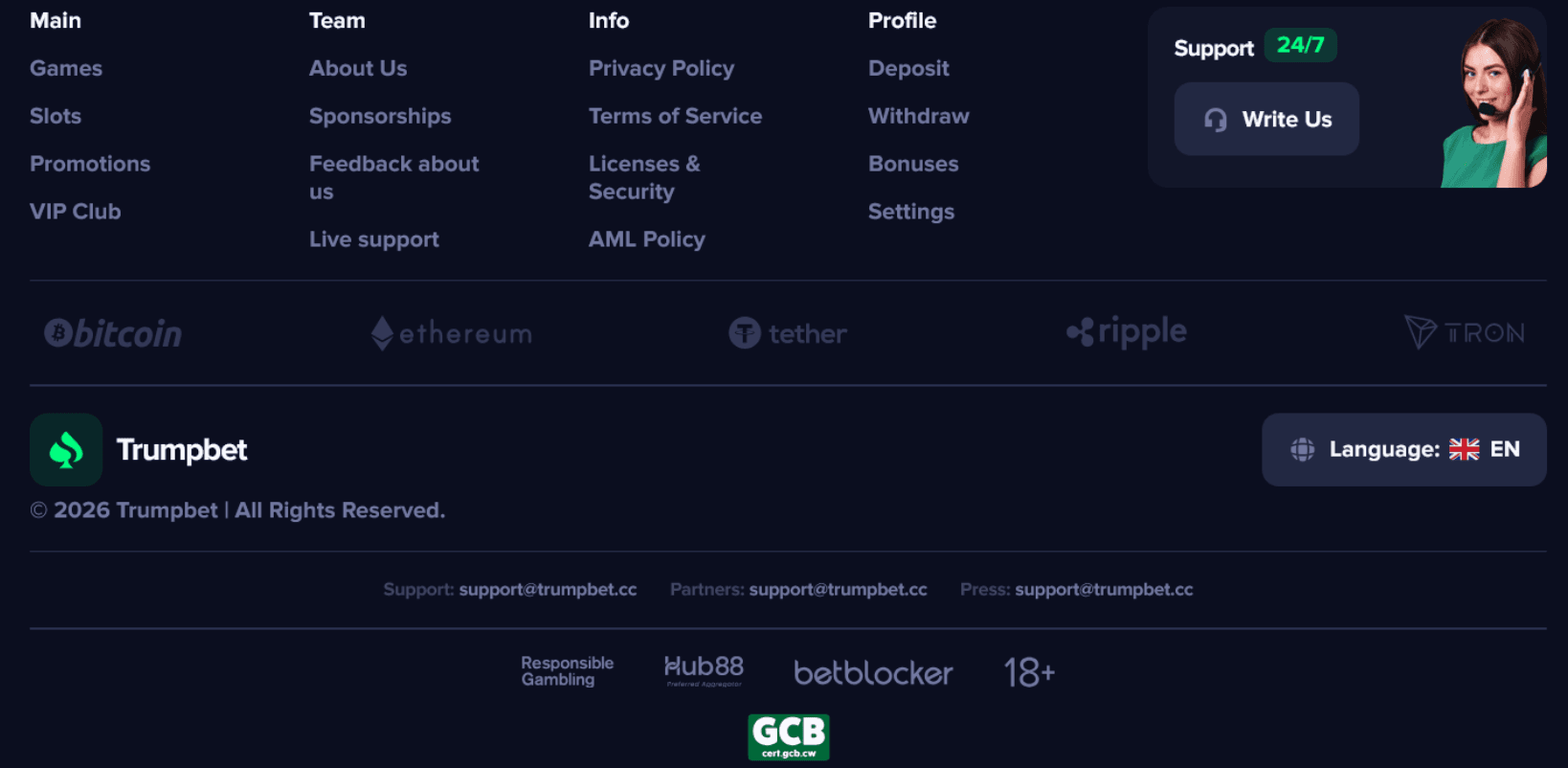
The fix is simple: Curaçao maintains a public license registry, and a seal that doesn’t resolve there isn’t real, no matter how official it looks pasted in a footer. If you can't click the seal in the footer, it's likely a scam.
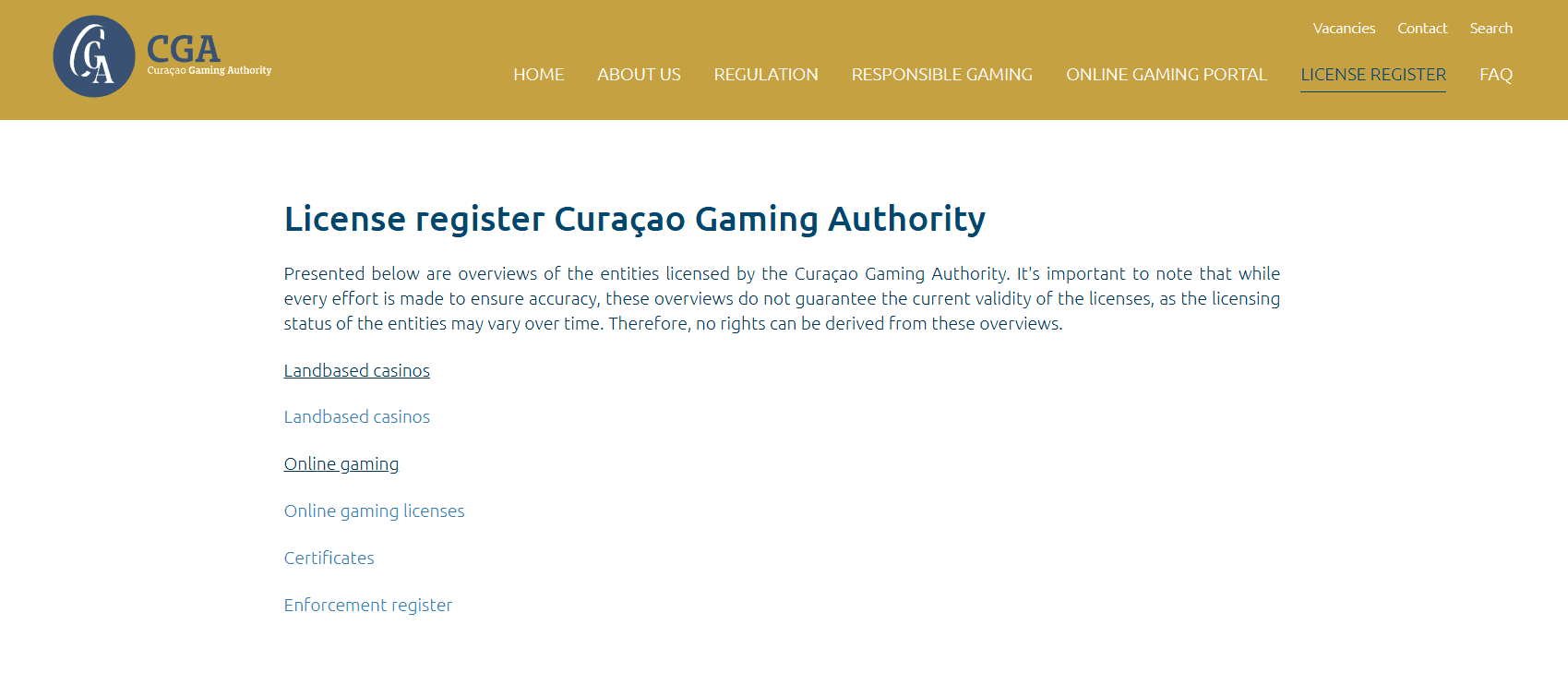
Further Reading: How to Check if a Crypto Casino is Licensed (in two minutes)
Raise, Farm, Then What?
Finally, one unfair practice that seems increasingly popular among unscrupulous operators targets not a withdrawal, but a token.
In 2024, the Dutch Fiscal Intelligence and Investigation Service began investigating alleged fraud around ZKasino. The agency said victims worldwide had invested more than $30 million in cryptocurrency after being told their funds would be returned within 30 days. In 2025, the Dutch Public Prosecution Service said messages between suspects and the design of the smart contract indicated that returning the funds had never been the intention. The criminal case remains an investigation, not a final conviction.
A less direct version begins with the numbers used to sell a casino before a token even exists. An operator can raise money against reported activity, use a points program to build an audience for a possible airdrop, and present play-money betting as evidence of demand.
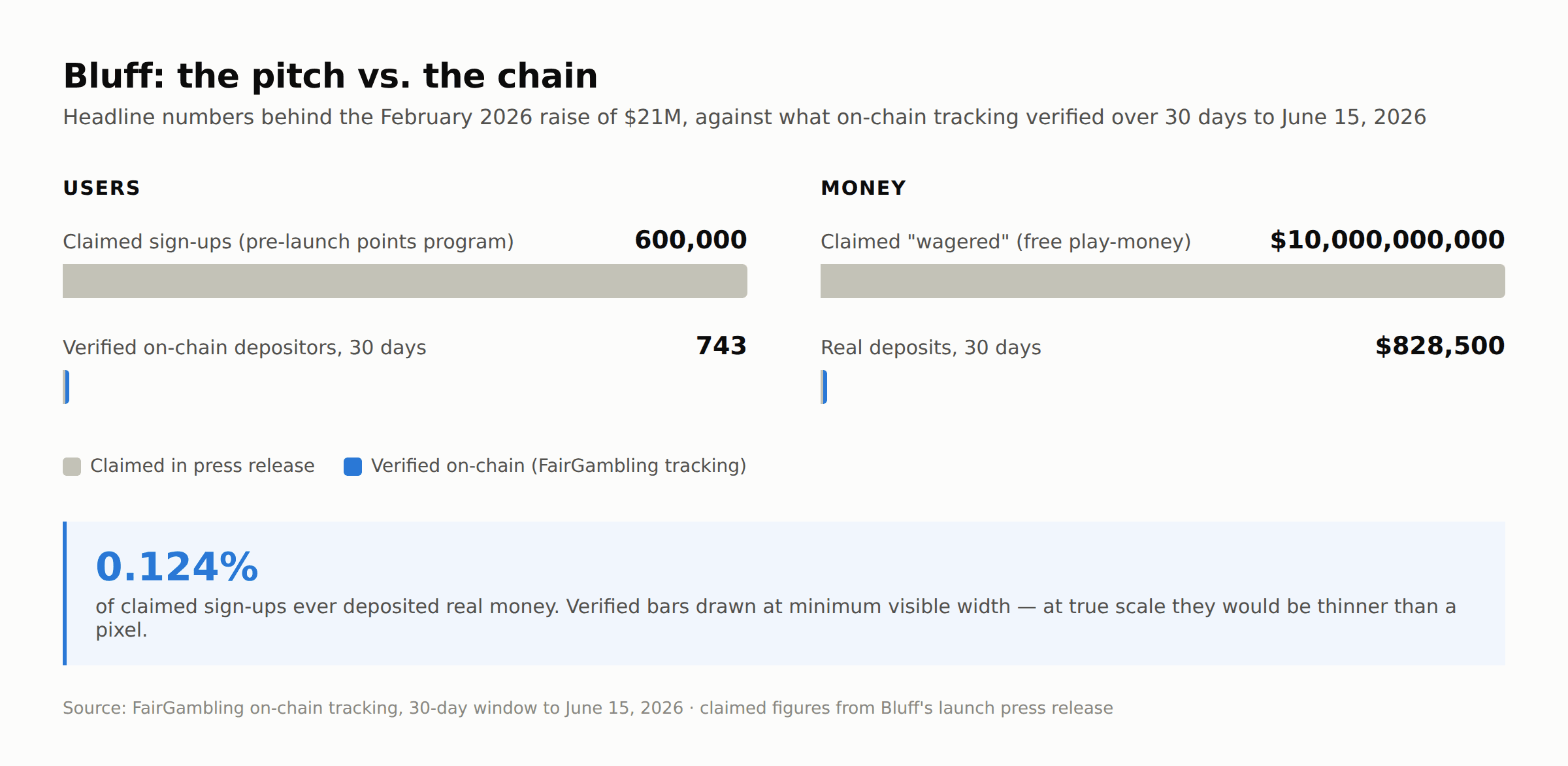
Bluff is a clear example of the gap between reported activity and real-money play. It announced a $21 million raise in February 2026, led by 1kx, after reporting 600,000 sign-ups and $10 billion “wagered.”
Those figures came from Bluff’s pre-launch points program. Users received a daily play-money balance and earned Blink Points toward a possible future $BLUFF airdrop, with another 2,000 points available for each referral. The activity took place before Bluff opened real-money play on 27 January 2026.
FairGambling’s on-chain tracking measured a different category of activity. During the 30 days through 15 June 2026, about 743 unique wallets deposited a combined $828,500 across three tracked chains. That placed Bluff 37th among the 40 casinos tracked during that period.
The figures are not a direct conversion rate. A wallet is not necessarily one person, and a 30-day depositing-wallet count cannot be compared directly with lifetime sign-ups. The gap still shows why “users,” “bets,” and “volume” need a clear definition before they are treated as evidence of real-money demand.
Credit Where It’s Due
Not every operator hides the record. In April, Stake extended provably fair verification to more than 1,200 third-party games on its Stake Engine platform, publishing every possible result and its probability at stake-engine.com/fair. Open-source verifiers now reproduce results for Stake, Shuffle, BC.Game, Roobet, Duel and others without touching the casino's own tools, which is the difference between a real check and a self-issued one.
Shuffle publishes a license number that resolves on the Curaçao regulator's site, and during FairGambling's test it hard-blocked UK visitors. Bluff detected the same location but let the tester click through and deposit. Bluff, for its part, answered every question on the record and stood behind its terms as written, which is more than Winna did when asked for its seed logs.
None of this puts an operator above scrutiny. It shows that meaningful differences often sit in the exact wording of the terms and in how the operator applies its controls when money is at stake.
The One Thing They All Have in Common
An uncommitted server seed, a nineteen-clause abuse policy, full KYC required only when money is leaving, a stolen regulator seal, and play-money activity presented as traction. Five different problems share one structure.
Each puts a material fact outside the player’s ability to check cleanly: whether a seed was fixed before the bet, which rule can void a win, what verification will be required at withdrawal, whether a license covers the exact domain, or what a reported activity figure actually measures.
That is the argument for independent verification. A blockchain can show what moved between identified wallets and when. It cannot prove every claim a casino makes, but it gives readers a record that marketing cannot rewrite.
The operators worth trusting are the ones whose claims, rules, and records still hold up when somebody checks. A missing record does not prove fraud. It shows exactly where verification stops.
Have a tip on an operator behaving badly, a game that cannot be verified, a payout that never arrived, or a clause that does not add up? We take tips confidentially.
Treat gambling as entertainment you pay for. 18+, and if it stops feeling like entertainment, help exists at BeGambleAware and GamCare.