


On-Chain Transactions Explained: Your Guide to Checking Crypto Transactions
Most players know crypto casino transactions happen "on-chain," but they might not know what that means. We are here to help.


· 6 min · 6 min read
Although one of crypto's core concepts is anonymity, that doesn't mean transactions aren't recorded. For most cryptocurrency transactions, the data is recorded on a blockchain that can be easily checked by anyone via a block explorer.
Many players never bother to access these records, though.
They play, they win or lose, and they move on. Players should know what is recorded and where, so they can track their crypto budgets in and out of a casino, and have a record in case something goes wrong.
So, what is "on-chain"?
In simple terms, "on-chain" means "on a blockchain." For those new to blockchain, it is a digital ledger where assets are tracked, transactions are timestamped, and everything gets permanently recorded.
When you make an on-chain transaction, the blockchain records it. In the context of crypto casinos, it tracks your deposits and withdrawals.
For what you need to know, consider two things. The first is your wallet address, a public identifier that works as an account number. The second is a transaction hash, which is a unique ID for the transaction you have made.
Although it's publicly available, it doesn't reveal personal information. This is where blockchain pseudonymity comes in, and it's why so many people opt for crypto over fiat.
Tracking your transactions
The transaction hash (often labeled "TXID" or "transaction ID" in your account history) is the key to tracking your transaction.
You need to paste that into a block explorer for your relevant chain. Depending on which chain you made the transaction on, this will be different. Some popular examples include:
Here you will be able to find the record of your transaction. It will include the amount, the timestamp, the wallet addresses involved, any fees paid, and the status of the transaction.
What you see here is what your casino sees when you make a transaction.
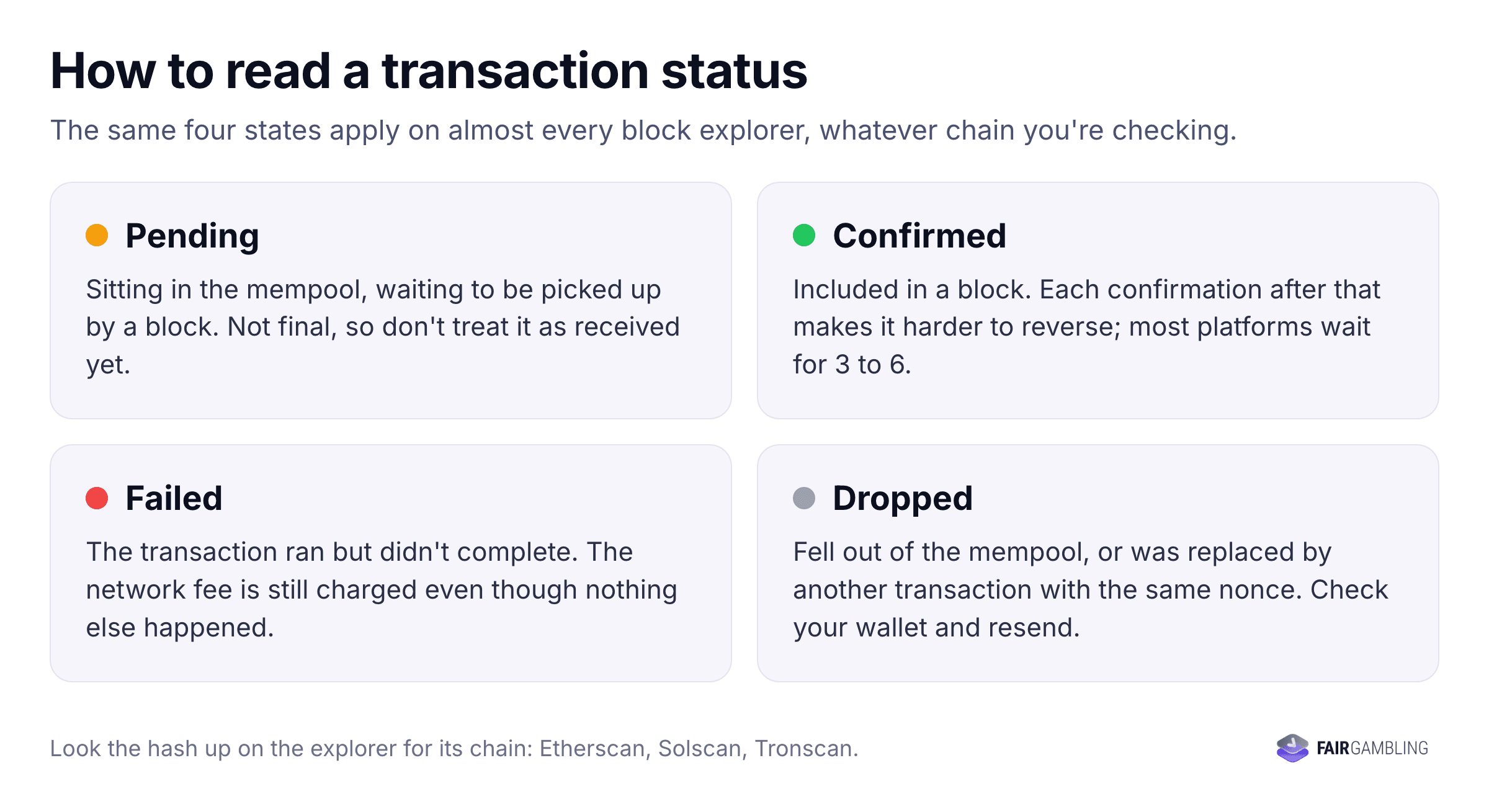
Okay, so you have found your transaction, and you need to know what your transaction status is. This is what the status indicators mean:
- Pending/unconfirmed: The transaction has been submitted but hasn't been included in a block yet. It's sitting in a queue (the "mempool"), waiting.
- Confirmed: It's been included in a block. Each additional block added after it counts as another confirmation, and more confirmations mean it's progressively harder to reverse. Most platforms wait for a handful of confirmations (often 3 to 6) before treating a deposit as final.
- Failed/reverted: The transaction was processed but didn't complete successfully, usually when a transaction involves smart-contract interactions. Note that on most blockchains, the network fee is still charged even when a transaction fails; you paid for the attempt, not the outcome.
- Dropped: The transaction never got confirmed and fell out of the queue, or got replaced by a newer one.
Don't confuse on-chain and Provably Fair
On-chain verification and Provably Fair are two key terms at online casinos that players conflate. This is a mistake, as they are two different processes that verify two different parts of the casino gameplay process.
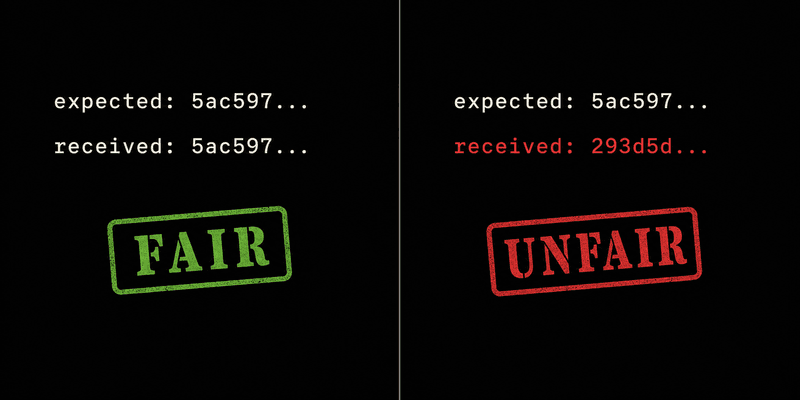
Provably Fair is a cryptographic method that lets you verify a game's outcome hasn't been altered after it's determined. This process uses a hash system and can be checked by the casino itself or via a third-party verifier. It does not live on a blockchain and cannot be tracked on a block explorer the same way a transaction would be.
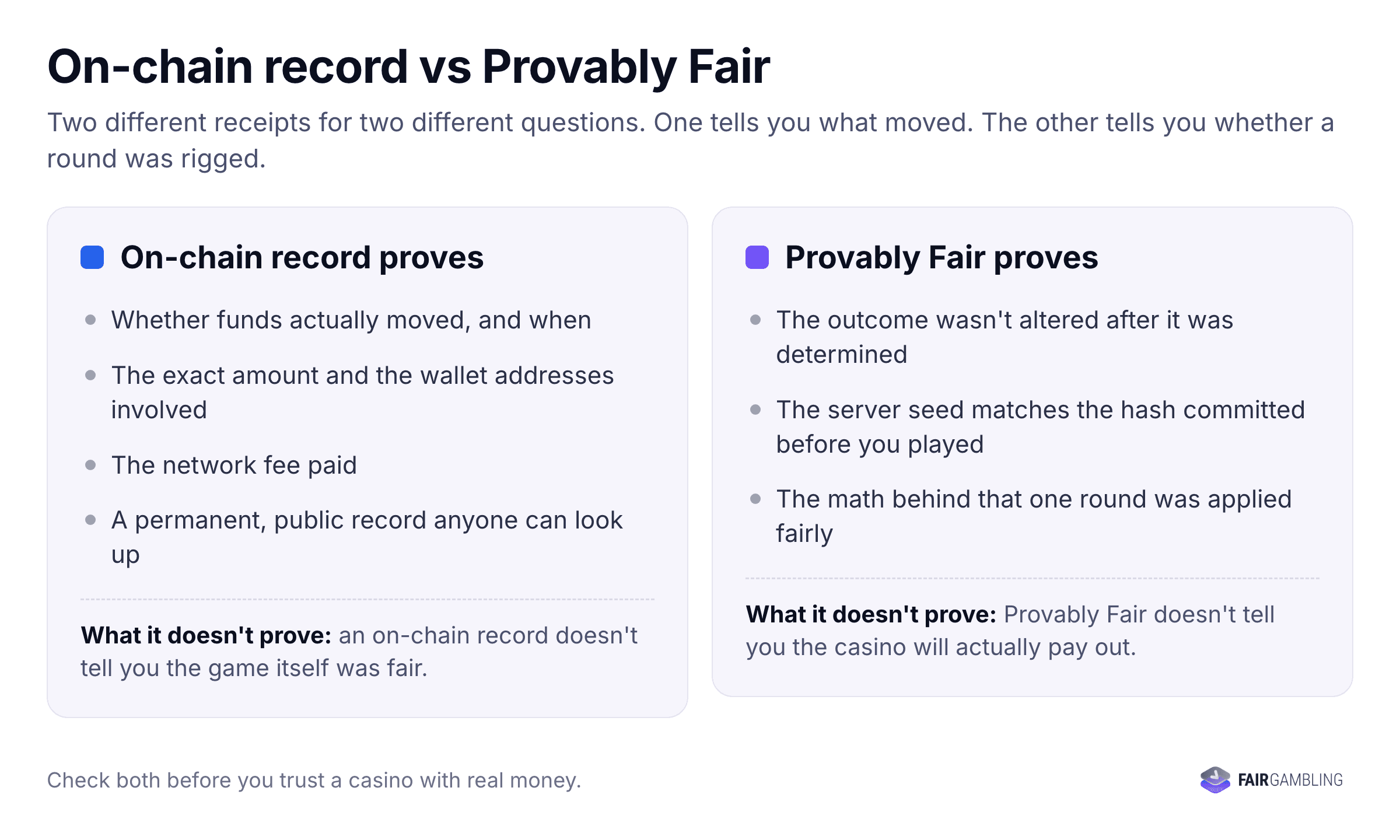
They promise two different things. On-chain provides reassurance that a crypto transaction was tracked; Provably Fair ensures a spin, roll, or bet had an untampered outcome. Provably Fair isn't perfect, but it is the best way to trust outcomes once your crypto is in a casino.
Why you might want to pull your transactions
Most players only open a block explorer once something has gone wrong. There are three good reasons to do it before then.
A withdrawal the casino says it sent
The casino marks a withdrawal as complete, your wallet shows nothing, and support tells you to wait. Ask for the transaction hash and paste it into the explorer.
Confirmed, to your address: the money left the casino. If your wallet still shows nothing, check you are on the right network and token. Pending: it is still in the queue. No hash at all: nothing has left the casino yet, whatever the account page says.
Keep the hash and a screenshot of the explorer page; support cannot argue with either. The usual causes of a slow payout are in our guide to withdrawal delays.
Knowing what you have really spent
A casino's account page shows your balance and, if you dig, a list of deposits. It will not tell you what you have put in across three casinos and two chains since January. Your own wallet's explorer page will.
Everything you sent to a casino's deposit address is a deposit. Everything that came back from its payout wallet is a withdrawal. Add up each side and the gap is what gambling has cost you.
Some players run this once a month as a budget check. It also gives a straight answer to the question every player gets asked: are you up or down?
Your record is also your tax record
Many countries, including the UK, Canada, Australia and Germany, do not tax winnings for ordinary players. Others do. The US counts them as income at their dollar value on the day you receive them. Spain taxes net winnings, and the Netherlands makes you declare wins from any casino without a Dutch license.
Even where the win is tax free, the coin can be taxed when you later sell or spend it, measured from its value on the day it arrived. Your withdrawal's timestamp fixes that value, so pull your withdrawals once a year for your tax preparer.
This is not tax advice. Rules change, and a professional who knows your country beats any guide.
Your on-chain checklist
Ready to start on-chain tracking? Use the checklist below as a reference for how to do it efficiently now and in the future.
- Check the block explorer, not just the in-app status: Your transaction hash is the real record; the in-app status is just the casino's summary of it. No transaction hash? The withdrawal hasn't been processed on-chain yet.
- Use the right chain's block explorer: A general search won't pull up transaction-level detail; you need the explorer built for that specific blockchain.
- Wait for multiple confirmations on larger amounts: A single confirmation is a good sign, but more confirmations make a transaction progressively harder to reverse.
- Provably Fair and your transaction record aren't the same thing: One verifies a game outcome wasn't altered; the other verifies money actually moved.
- Track the USD value of winnings on the day you receive them: That's your tax basis, not whatever the crypto is worth when you eventually cash out.
Staying on top of on-chain with FairGambling
Before you go, check out the FairGambling analytics page. It has a list of transactions tracked in real time, so you can see how a wallet address and a transaction hash typically look.
FairGambling has tons of resources to make crypto gambling easier. Check our guides and industry research to learn more about the industry.
Frequently Asked Questions
How Do I Check a Crypto Casino Transaction On-Chain?
Copy the transaction hash (TXID) from your casino account history and paste it into the block explorer for that chain, such as Etherscan for Ethereum, Solscan for Solana or Tronscan for TRON. The explorer shows the amount, timestamp, wallet addresses, network fee and whether the transaction is pending, confirmed, failed or dropped.
How Many Confirmations Does a Crypto Casino Deposit Need?
One confirmation means your transaction is in a block. Every block added after it makes the transaction harder to reverse, so most casinos wait for several confirmations, often 3 to 6, before they treat a deposit as final. Until then the funds can show as pending in your account even though the explorer already lists the transaction.
Is an On-Chain Record the Same as Provably Fair?
No. An on-chain record proves that money moved: the amount, the addresses, the fee and the time, all on a public blockchain. Provably Fair is a separate check, run by the casino or a third-party verifier, that proves a game result was not altered after it was decided. A deposit can be on-chain while the game is not Provably Fair.
Treat gambling as entertainment you pay for. 18+, and if it stops feeling like entertainment, help exists at BeGambleAware and GamCare.
Mission Statement
Crypto gambling has a transparency problem. We're fixing it.
- On-chain data and original research, not recycled press releases
- Honest operator reviews and news, free from affiliate influence
- Player-first reporting built on transparency and responsible gambling
Editor Picks

The $10M Gap in Winna's Slide Record

First Impressions: Moon.com, Stake's 1,000x Leverage Bet?

Inside Bluff's $21M Raise: White-Label Tech, Withheld Winnings, 743 Players.
Provably Fair: How to Check That Your Bets Are Fair