Europe Makes Casinos Refund Gambling Losses. A Curaçao Ruling Just Showed Who Gets Left Out
European courts void contracts with unlicensed casinos. A Saudi who lost $7.8 million tried that in Curaçao and got the bill instead.


· 9 min · 9 min read
For five years, European courts have been ordering online casinos to do something casinos never do: give the money back.
An Austrian who lost 25,518 euros on a site unlicensed in their jurisdiction sued and got every cent back because the contract was illegal from the start. Reports put eventual losses reclaimed across Europe at 1 billion euros. In March, Curaçao's appeals court upheld recognition of one of those Austrian judgments.
So when a Saudi player who lost $7.8 million on a Curaçao-licensed casino brought the same argument to the island's courts, he was not reaching. Online gambling is prohibited in Saudi Arabia, even more absolutely than in Austria. If the contract was illegal, the money was never the casino's to keep, right?
No. In June, the Court of First Instance of Curaçao dismissed every claim against Tixi Multimedia B.V., the company behind BetAndYou and CasinoAndYou, and handed him the casino's legal bill.
But the same courtroom has shown it will make casinos pay. Refunds run on two things: the machinery behind the player, and the conduct of the casino. This player had neither.
$7,821,632 claimed. Dismissed in full - with costs against the player.
The Argument That Wins in Europe
The legal theory sounds backwards: in loss-recovery cases, it is the player who invokes illegality, not the casino.
The argument runs: "The operator had no license to serve my country, so the gambling contract was illegal and void from the start. A void contract means the casino never had a legal basis to keep my deposits. Everything I lost must come back."
In Austria, that argument is settled law. In 1 Ob 229/20p, the Supreme Court held contracts with operators outside the state monopoly absolutely void and ordered losses repaid. The logic even runs in reverse: in 2024, the same court made a player return winnings to an unlicensed site.
Germany reaches the same result under Section 134 of its Civil Code. In April 2026, the European Court of Justice cleared the road in C-440/23: EU law does not preclude Germany's prohibition, contractual nullity or restitution claims. The Advocate General’s opinion in C-530/24 points the same way, with a licensing-procedure carve-out.
Malta has been the operators' reliable shield. Its 2023 law tells Maltese courts not to enforce these foreign judgments. An ECJ Advocate General found the provision incompatible with EU recognition rules, and the European Commission has an infringement procedure running.
Curaçao went the other way. On March 10, the Joint Court of Justice enforced an Austrian refund judgment against Raging Rhino N.V. Its answer: "Recognition of the Austrian judgments does not conflict with principles and values considered fundamental in the Curaçao legal order" (para. 2.12, translated).
Recognition is not collection. One German player was still waiting on more than 372,000 euros. In C-716/24, another creditor found no Curaçao accounts to freeze; money moved through affiliates instead, according to the referral.
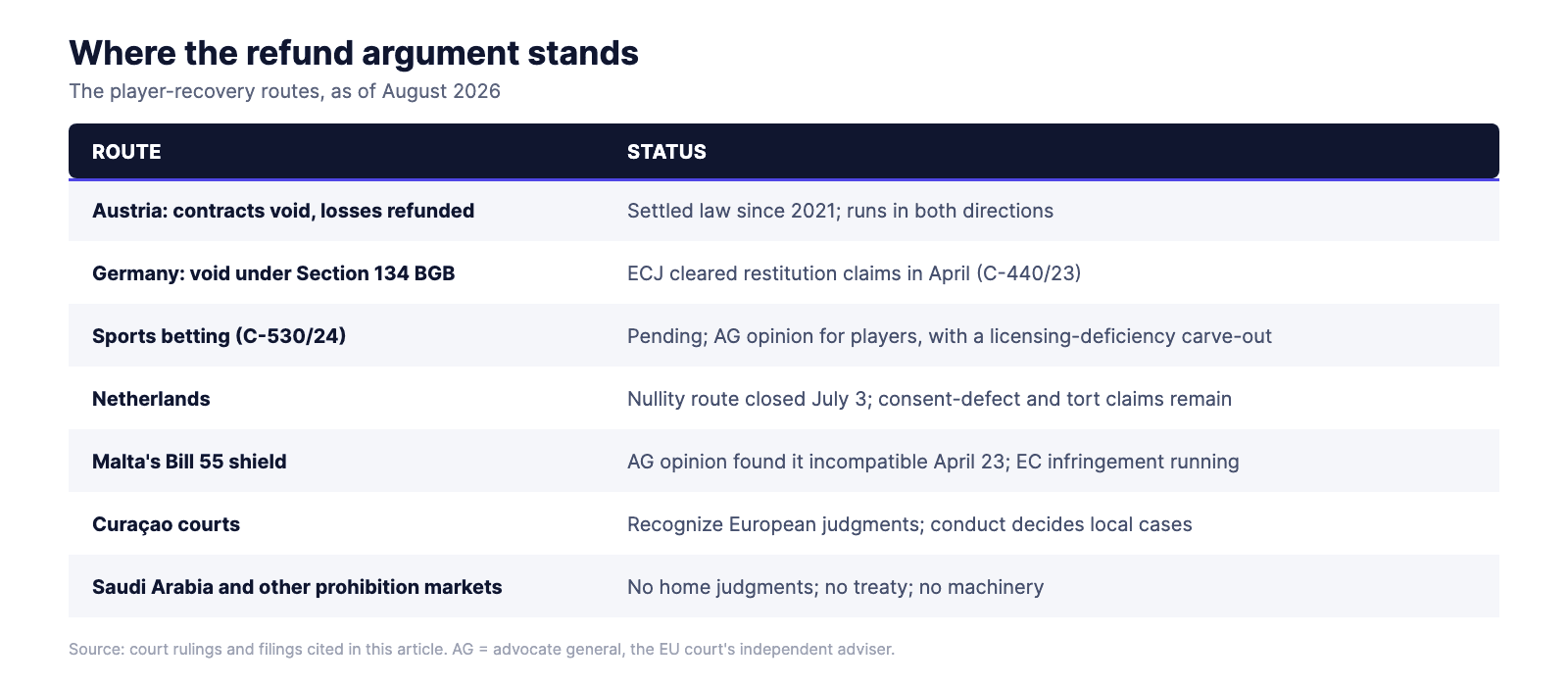
Still: the argument holds, Europe's top court has cleared it, and Curaçao's judges will recognize its judgments.
Which set up the question this case answered: what happens when a player arrives with the same argument and none of that machinery?
Four Years, Closure Requests, and Missing Documents
The judgment's fact section reads like a case study in how offshore gambling actually works.
The player registered in 2021 and confirmed he was in a jurisdiction where online gambling was permitted. He was in Saudi Arabia, where it is not.
Eighty-six days in, he wrote: "Close my account forever and don't open again." Two days later, the casino offered self-exclusion for one month, six months, or a year. Permanent closure was not on the menu. He took the year.
The exclusion lapsed in mid-2022. After his mother died, he said depression drove him back to gambling; by May 2023 he was playing again. The casino heard nothing about his health until 2025.
In June 2023, he reported substantial losses and again asked for closure. The casino requested color photos of his ID documents. He never sent them, despite more closure requests in January, February, and March 2024.
The account stayed open. In 2023, after requesting cashbacks, he wrote: "Hi I deposited more than 2 million," and demanded a 20% bonus, at least $200,000. He also complained the casino "only takes money without caring for VIP customers." The judgment never reconciles that with the $7.8 million he later claimed as losses.
In March 2025, the casino learned he had been diagnosed with depression and was taking medication. It closed the account and stopped deposits the same day. Nine days later came the formal liability notice.
He sued within the year, arguing the casino should never have taken him as a customer at all.
86 days from signup to "Close my account forever." The account outlived the request by nearly four years.
What the Court Held
The claim ran on two tracks, and both failed.
The first was the European theory: gambling is prohibited in Saudi Arabia, so the contract was void and the money is refundable. The court said the player "insufficiently substantiated why the mere circumstance that online gambling is prohibited in Saudi Arabia would render the agreement concluded between the parties void or voidable under Curaçao law."
The court did not rule that home-country illegality can never void a gambling contract. It ruled that this player did not explain why it should.
The second track was duty of care. Tixi held what the judgment calls a Gaming Control Board Curaçao license. Its direct license dates to Nov. 22, 2024; before that it operated under a sublicense of the old master license. The judgment does not say which license covered which losses.
The platform offered self-exclusion, deposit and loss limits, warnings and marketing opt-outs. The player had used self-exclusion in 2021 and knew it existed. The court found the ID demand before permanent closure legitimate, and the years of ignoring it the player's own doing. The asymmetry, i.e., millions accepted without document checks, while closure waited on color ID photos, was not a ground he pleaded.
At paragraph 4.8, citing a 2016 Amsterdam Court of Appeal decision, the court said that if an operator takes sufficient measures against unlawful participation and addiction and the player disregards them, "the consequences fall on his account".
The legal costs order came to about $6,900.
The Same Court Made Another Casino Pay
Here is why none of this should be read as a court reflexively protecting its island's industry.
Weeks before Tixi, the same court ruled against LFG Gaming N.V., operator of Heybets.io, per Dutch reporting. SBGOK, a Dutch player interest foundation, had taken over the claim of a Filipino player who lost $162.2k.
The court found problem-play signals, unmet permanent closure requests, and bonuses used to draw him back in. It awarded $144k and held LFG and its former master license holder responsible.
In January, the mirror case: Stake's Medium Rare N.V. defeated a player who said his deposit frequency, session lengths and rapid recycling of withdrawals should have signaled addiction risk. The court disagreed.
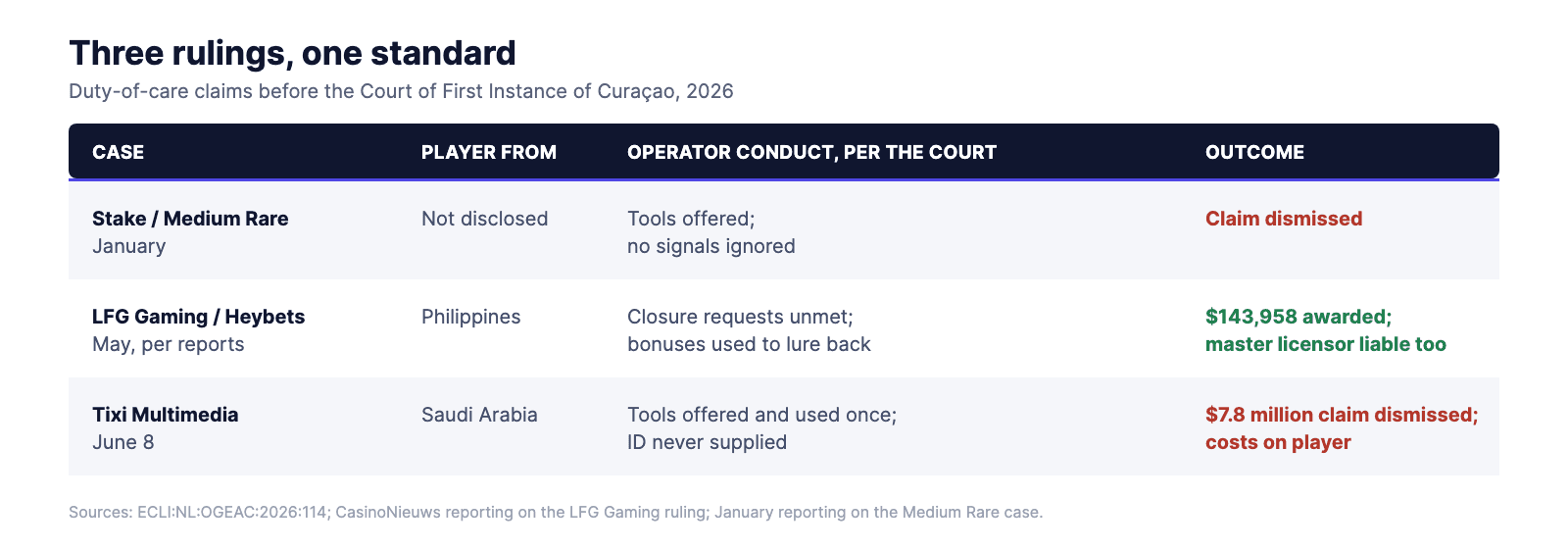
Put the three rulings in a row and the standard comes into focus. Ignore closure requests and bait a player back with bonuses, and you pay. Offer working tools he declines to use, and you keep the money. Inside the courtroom, conduct decides.
Outside It, Machinery Decides
What conduct cannot explain is why an Austrian's 25k euros come back while a Saudi's $7.8 million does not survive the pleading stage.
The Austrian arrives with a domestic judgment and Curaçao recognition. The Saudi has no home judgment, no treaty, and a registration checkbox saying he was somewhere legal. These are not the same argument in two courtrooms.
Even inside Europe, the machinery is uneven. On July 3, the Dutch Supreme Court held pre-legalization contracts with unlicensed operators are not void, closing the invalidity route for what claim foundations say are more than 100,000 Dutch players while leaving other routes open.
The sharpest irony sits in the player's home law. Saudi Arabia's 2023 Civil Transactions Law declares gambling agreements void, with restitution on nullity. On paper, the Vienna logic exists there too. Whether it would carry a Riyadh courtroom is another question. The Anti-Cyber Crime Law targets promoters of gambling sites, not bettors.
London's High Court offers the closest precedents from the mirror direction: casinos suing Gulf players over unpaid debts.
A third track runs in US courts, where state loss-recovery statutes produced Kentucky's $300 million PokerStars settlement and now underpin a class action naming Harp Media B.V. over Bovada's websites.
Why Crypto Casinos Are Challenging Targets
BetAndYou is a hybrid: a fiat casino that, per casino directories, also accepts some two dozen cryptocurrencies. The judgment is silent on how this player moved his millions; this is notable because Saudi banks block gambling merchant codes and the state blocks the sites themselves, per Freedom House; the realistic rails are e-wallets, intermediaries, or crypto.
For crypto-native casinos, every pressure point in this story has a structural answer.
The checkbox does more work. No-KYC signup plus a VPN means the operator can choose never to verify where a player sits; it simply holds his confirmation that he is somewhere legal. The Tixi ruling shows why that matters: the court put the consequences of a false confirmation on the player.
The paper trail thins. Crypto deposits are irreversible, generate no chargebacks, and pass no card processor or bank that could block, flag, or later document the flow. Self-custodied deposits tell a court far less.

And the treasury is harder to reach. The C-716/24 creditor found no local bank accounts to freeze. A crypto casino's reserves may instead sit in self-custodied wallets that move nine figures in minutes. There is no European Account Preservation Order for a hot wallet. Recognition-versus-collection approaches a dead end.
The counter-move: per industry reports, Curaçao's regulator issued mid-2026 crypto guidance covering wallet screening, a mixer ban, and segregation of player funds. Identifiable player-fund wallets are precisely what would make a future judgment collectable against a crypto operator. Whether licensees implement it, and whether anyone checks, is open.
Where This Goes
Two forces are now pulling in opposite directions, and the next two years will show which is stronger.
The refund machinery is tightening. Malta's shield is under attack from the ECJ and Brussels. Curaçao's new gambling law, in force since December 2024 though the Tixi facts largely predate it, writes player-protection duties into the license. And reference cases preview a model that could scale: a foundation taking assignment of a player's claim and litigating it.
But pressure lands hardest where operators are reachable, ergo companies with bank accounts, processors and assets a court can find. The response is structural. Licenses migrate toward registers that publish little; newer operators cluster under Anjouan. Treasuries migrate on-chain, where preservation orders cannot follow. The customer relationship migrates to the checkbox.
So the honest forecast is both at once: more refund requests, and more operators built so refunds cannot touch them.