Play Money, Real Gambling: Roblox Is Just the Start
Sweepstakes casinos, Robux sites, loot boxes, and social casino apps all claim they fall outside gambling law with no purchase or no real prize. Courts worldwide have found otherwise…

· 12 min · 12 min read
"There is no such thing as a free lunch." "If you're not paying for it, you are the product." "If you can't spot the fish at the table, you're it."
You might roll your eyes at these clichéd old expressions you first encountered in your childhood and early adulthood from a parent, teacher, or a smirking home game poker shark as they underpaid your allowance or scooped your last chips towards them.
The expressions retain their merit. Whether it's economics, gambling or finance, there is generally a mutual transfer of value of some kind, sometimes rendered unknowingly, when a product or service is offered for free by a for-profit entity.
In this article, we look at a wildly popular industry that goes by a number of innocuous names. Call it play-money, social gaming, in-game currency trading, simulation casino, or just good ole' free-to-play (F2P) gaming—whatever you want. You'll find its operators all singing the same chorus:
"This is not real gambling, because there is nothing of value to win."
Not so fast. Why then are sweepstakes players predicted to spend $3.5 to $4.5 billion in 2026 on coin purchases, according to Eilers & Krejcik figures and others?
Players across the sector have converted that currency into cash through redemptions, skin marketplaces, crypto withdrawals and chip trades.
What Is the Play-Money Economy?
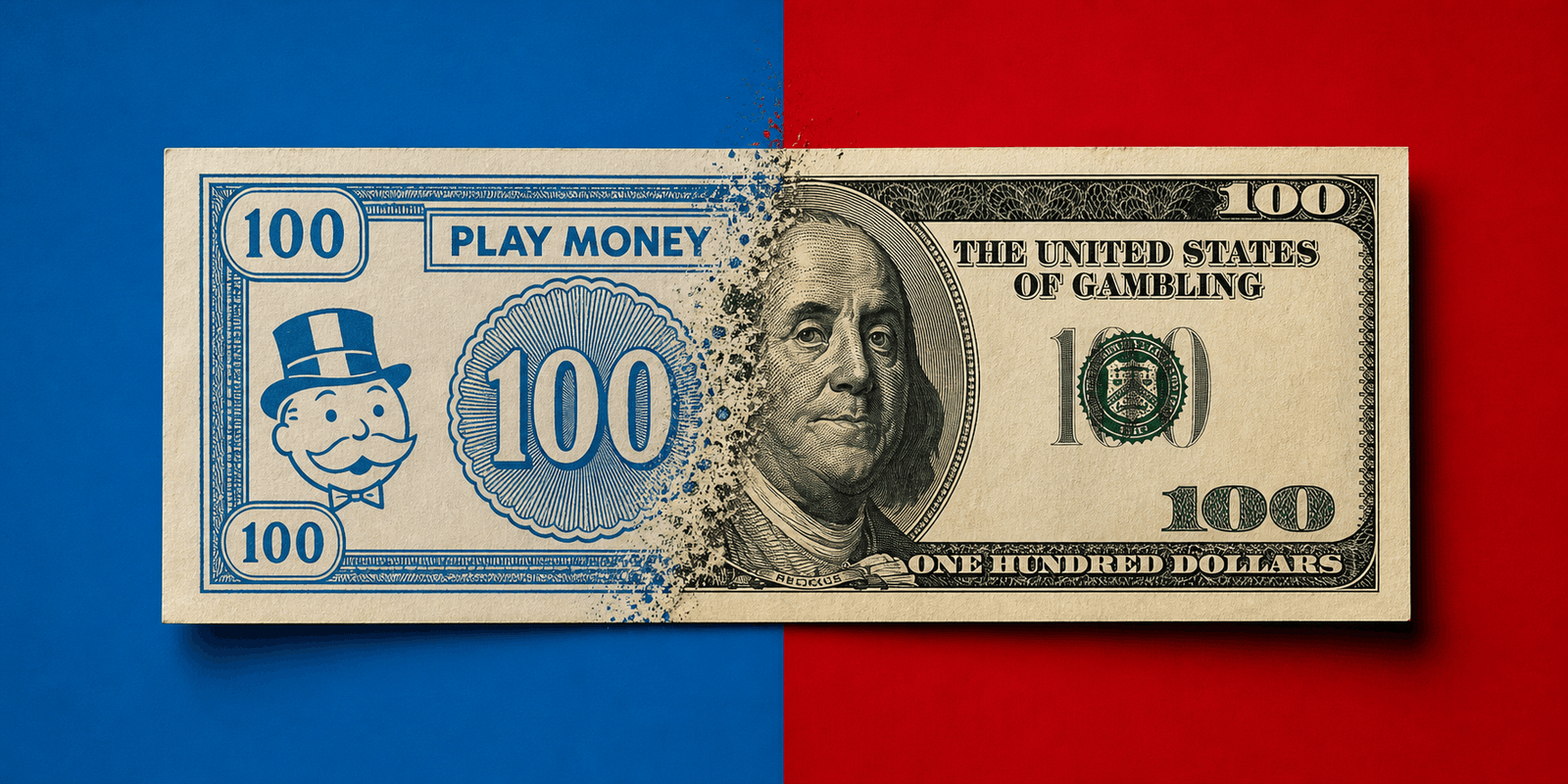
The play-money economy is the set of games and apps that offer casino-style play in a currency the operator says is worthless, and claim exemption from gambling law on that basis.
It spans everything from sweepstakes casinos in some jurisdictions, to social casino and card game apps, Robux gambling sites, loot boxes, in-game casinos, and more. Some crystal ballers estimate the "play money paradox" will reach as high as $19 billion by 2033.
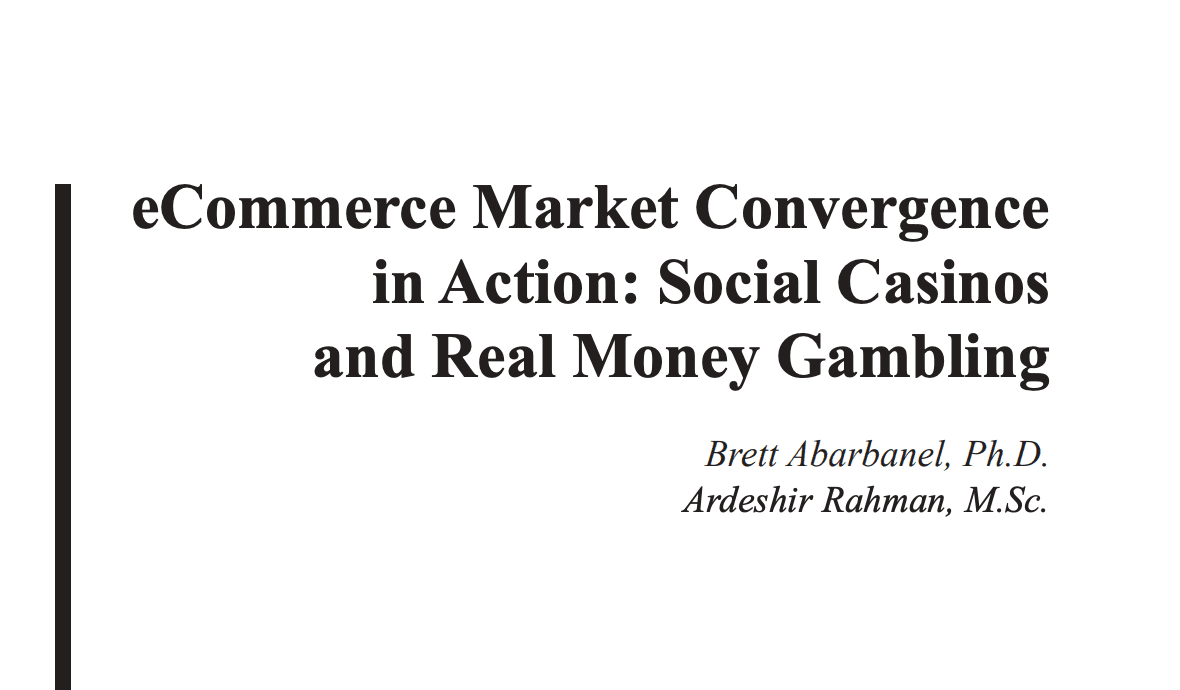
And this is nothing new. A 2015 study by tenured gambling expert Dr. Brett Abarbanel and others found that social and real gambling had been converging for years and predicted it would continue to do so in the future.
In this future that we're now experiencing, what is play-gambling, and how is it different from real gambling?
Play Money vs Real Money Gambling
Much like the Howey Test for securities, long the cryptocurrency industry's kryptonite in the U.S., the claim rests on a three-part assessment.
Gambling in most jurisdictions requires all three criteria to be met at once:
- Consideration. You pay to take part.
- Chance. Randomness decides the outcome.
- Prize. You can win something of value.
Remove one leg, at least on paper, and the product falls outside the statute.
Sweepstakes casinos target the first: spins arrive as a free promotion attached to a gold-coin purchase, so nothing is technically bought. A second currency, sweeps coins, redeems for cash. Loot boxes, social casino apps and virtual-currency games target the third instead, declaring winnings valueless and non-transferable in the terms of service.
The paperwork can be accurate. A licensed operator running a free contest with no purchase attached, like the in-flight pick'em contest DraftKings ran with Delta, sits on the legal side of the same structure. The disputes begin when the valueless currency turns out to have a huge market.
Who Gambles Most With Fake Money?
A 2025 study by MarketCast found that women are the dominant demographic in the play-money and free-to-play gaming sector, contrasting sharply with real-money gambling platforms, which skew heavily male.
Around 73% of female gamers explicitly report playing free games compared to only 46% of male gamers. Females have a strong preference for casual mobile applications, social casino titles, and free-to-play slots or bingo, where players can enjoy social interaction and pass the time without absorbing any financial risk.
Data from Ampere Analysis and Newzoo further confirms that while men are more likely to purchase premium upfront games on consoles or PCs, women overwhelmingly favor smartphone-based, free-to-play environments.
In the United States alone, there are 5 million more female mobile gamers than male mobile gamers, creating a female-majority foundation for play-money apps.
Why People Gamble With Play Money
Three factors show up repeatedly when people gamble with play-money:
- Real gambling is banned or inaccessible where they live.
- The games sit inside platforms they already use.
- The play-money label removes age gates and licensing friction.
The jurisdiction motive shows up in the products themselves, none more clearly than with sweepstakes, also known as workplace or private lotteries.
The second factor is distribution. Few people go looking for these products. A social casino app sits in the same store as every other mobile game, a Robux site accepts the login a player already has, and a gambling stream shows up in the feed they already scroll.
Real-money casinos pay to acquire a player who must then register, verify, and deposit. Play-money operators inherit an audience already logged in.
The third factor is what the label removes: A licensed operator carries age verification, deposit limits, self-exclusion and a regulator to answer to. A product that declares its currency worthless carries none of them, which is what makes it cheap to launch and frictionless to enter.
The same absence that lets an operator skip licensing is exactly what allows a 14-year-old to stroll on in.
The Rise of Sweepstakes
Sweepstakes casinos thrive because most US states ban online casinos. The sweeps model is a workaround sold to players who cannot access the licensed version, and it's been growing its market for years.
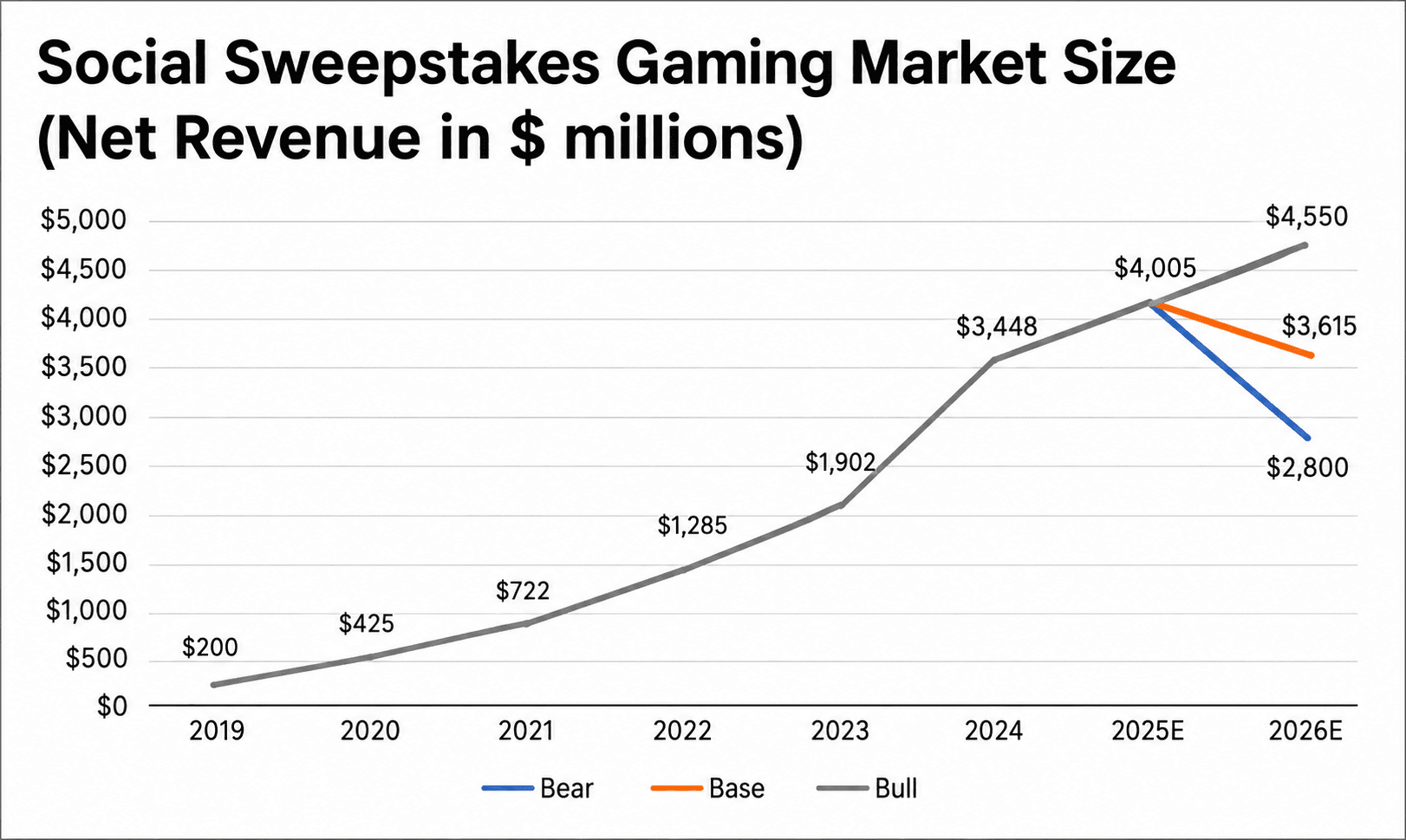
Source: EKG Line Substack
Per data from The EKG Line, the social sweepstakes market has multiplied roughly twenty-fold between 2019 and 2025.
For other venues, the mechanics of chance drive spending on the currency, and the currency eventually drives real revenue.
Which Platforms Host Play-Money Virtual Currency Gambling?
The most-flagged venues by regulators are Roblox's third-party casino sites, sweepstakes casinos, Valve's loot boxes, social casino apps descended from Facebook games, GTA Online's Diamond Casino, Minecraft pay-to-win servers, and Pokémon GO.
At least two corners are crypto-native: Stake's sweepstakes arm Stake.us, and the Robux sites paying out in crypto.
Venue | Examples | Chance mechanic | The exit to real money | Enforcement* |
|---|---|---|---|---|
Sweepstakes casinos | Stake.us | Slots, blackjack in sweeps coins | Cash redemption by design | LA suit 2025; multi-state bans and C&Ds |
Roblox third-party casino sites | BloxFlip, RBLXWild, Bloxmoon | Slots, crash, case battles | Crypto withdrawals | UKGC blocks, Dec 2024; sites returning |
Valve loot boxes | Games like CS2, TF2, Dota 2 | Randomized skin drops | Steam Community Market | NY AG suit, Feb 2026; Brazil ruling, Jun 2026 |
Social casino apps | Big Fish, Slotomania, Bingo Blitz | Virtual-chip slots and poker | Chip black market; chips ruled a "thing of value" | $155M settlement, 2020; WA AG suit, 2026 |
In-game gambling | GTA Online Diamond Casino | Chips bought with GTA$ (buyable with real money via Shark Cards) | No cash-out; blocked in 50+ countries | Country-level blocks since 2019 |
Pay-to-Win (P2W) servers | Minecraft | Crate keys | Server and third-party trades | None by governments; Mojang EULA only |
Pokémon GO paid randomness | PokéCoins to paid incubators | Paid incubators speed random egg hatches (eggs not bought directly) | Account and rare-catch resale (grey market, violates ToS) | Brazil ruling, Jun 2026 |
* Data as of August 6, 2026.
How Does Fake Money Become Real Money?
Virtual currency converts to cash through four primary routes:
- Built-in redemption: Sweeps coins cash out by design.
- Marketplace resale: Skins and items sell on open exchanges.
- Third-party casinos: Robux or in-game currency goes in, cryptocurrency comes out.
- Black-market trades: Currencies the operator says cannot move, moving anyway.
The fourth route has already been tested in court.
Big Fish Casino's terms stated that its chips had no monetary value, but the app included a chip-transfer mechanism and a secondary market that developed around it. The Ninth Circuit ruled in Kater v. Churchill Downs back in 2018 that the chips were a "thing of value" under Washington law. Churchill Downs and Aristocrat later settled for $155 million without admitting liability.
Skins raise the same question at a larger scale. New York Attorney General Letitia James sued Valve on Feb. 25, 2026, describing its loot boxes as "quintessential gambling." Her office cites a Counter-Strike skin market worth over $4.3 billion in March 2025 and one AK-47 skin that resold for more than $1 million, with Valve's own marketplace as the resale venue. Valve has moved to dismiss.
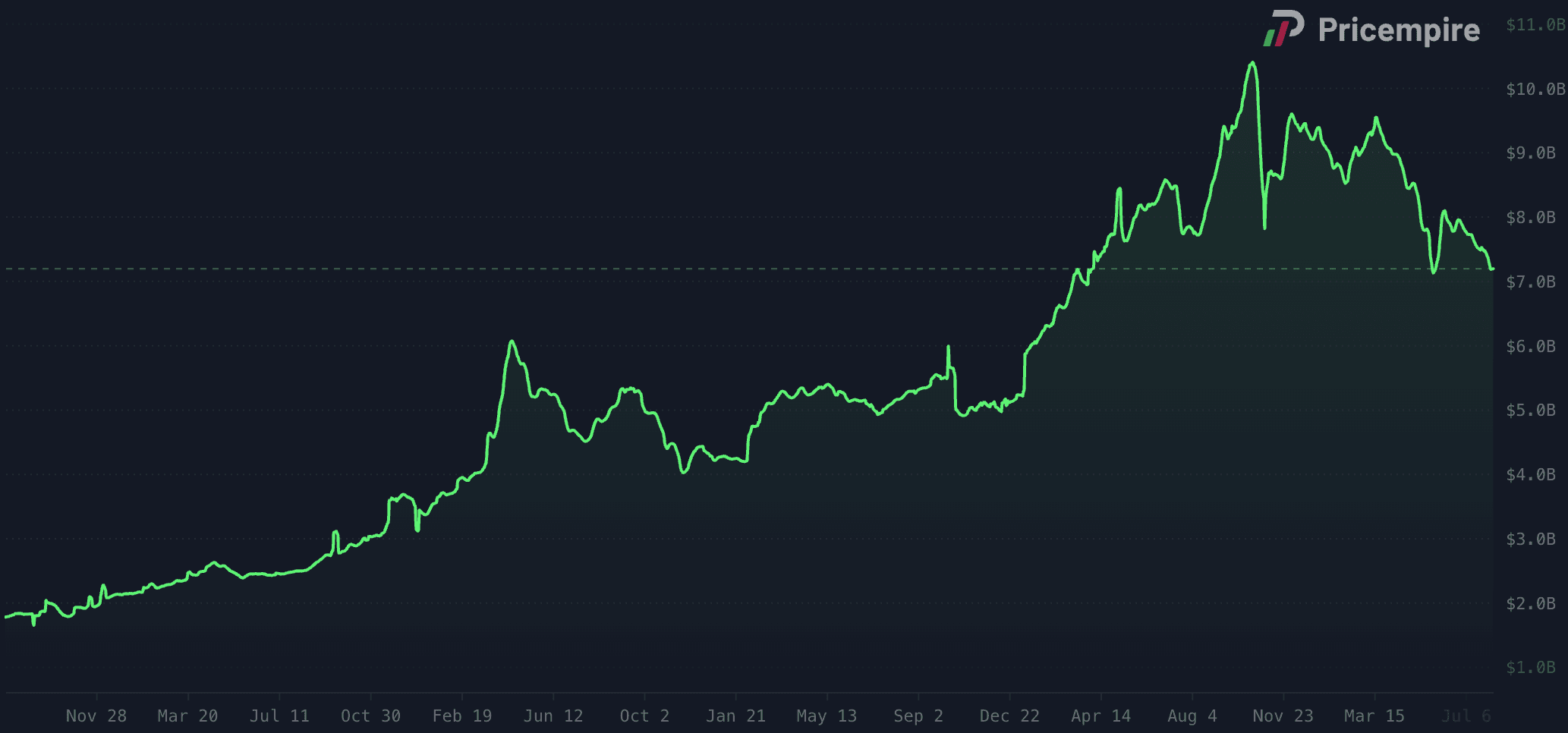
The same CS skin market is now valued at over $7 billion, just 17 months later, per data from Pricempire. Some of the most expensive skins are now valued at upwards of $100k.
Do Children Gamble on Play-Money Platforms?
Children gamble across this sector in documented numbers.
A 2018 CAMH study of 10,035 Canadian high-school students found that teens who played free social casino games gambled for money at higher rates, and that 37 to 50% of those who did both showed problem gambling signs, against roughly 10% of young gamblers who skipped the free games.
In 2026, the clearest records come from the Robux sites, the sweepstakes model previously covered and the gambling-stream audience.
Regulators and reporters have documented underage play across the sector. New York State Senator Joseph Addabbo, who chairs the state Senate's gaming committee, has warned that an email address is enough to enter a sweepstakes casino, citing research that children introduced to gambling by age 12 are four times more likely to develop a gambling problem.
Virtual currency rarely carries a real age check, so a game login or an email address can be enough to reach casino-style play, and investigations have found accounts belonging to 14- and 16-year-olds spending five figures.
Roblox Hits Regulatory Roadblocks
Sky News found in December 2024 that three Robux casino sites, BloxFlip, Bloxmoon and RBLXWild, drew 2.8 million monthly visitors, accepted Roblox logins and paid out in cryptocurrency. BloxFlip's data showed a 14-year-old who had gambled $66,000 and a 16-year-old whose account recorded $222,000.

A 3M-subscriber Roblox YouTuber advertised BloxFlip to an audience of roughly 8- to 13-year-olds, while a 14-year-old influencer was reportedly offered an affiliate cut of his underage followers' wagers.
Roblox said in reply to the Sky News investigation that it prohibits gambling and takes steps to disrupt such sites, which are not authorized by the platform.
Gambling Streaming
Streaming reaches a similar mass audience, particularly among Gen-Z young adults between 18 and 27, who make up roughly 44% of esports wagers.
Twitch banned unlicensed casino streams in 2022, leading the streams to move to competitor Kick, where sponsored streamers broadcast six-figure sessions and viewers earn "channel points" and even Stake rewards by simply watching.
These channels serve as the front lines in the increasingly toxic battle between online casino giants like Stake and Duel.
Participants in Jamie Torrance's research compared those points to slot-machine reward schedules, per his account in May 2026. The UK Gambling Commission's 2025 survey found half of young people knew in-game items can be bet on external websites.
The list goes on and on.
Who Supplies the Play-Money Operators?
Sweepstakes operators rarely build their own games. They license slots from studios that also supply real-money casinos and wrap them in a dual-currency layer, with geolocation, identity checks, and RNG certification from the industry's usual vendors.
Los Angeles put that overlap on a court record. City Attorney Hydee Feldstein Soto sued Stake.us on August 28, 2025, in what her office describes as the first US civil enforcement action against a sweepstakes casino.
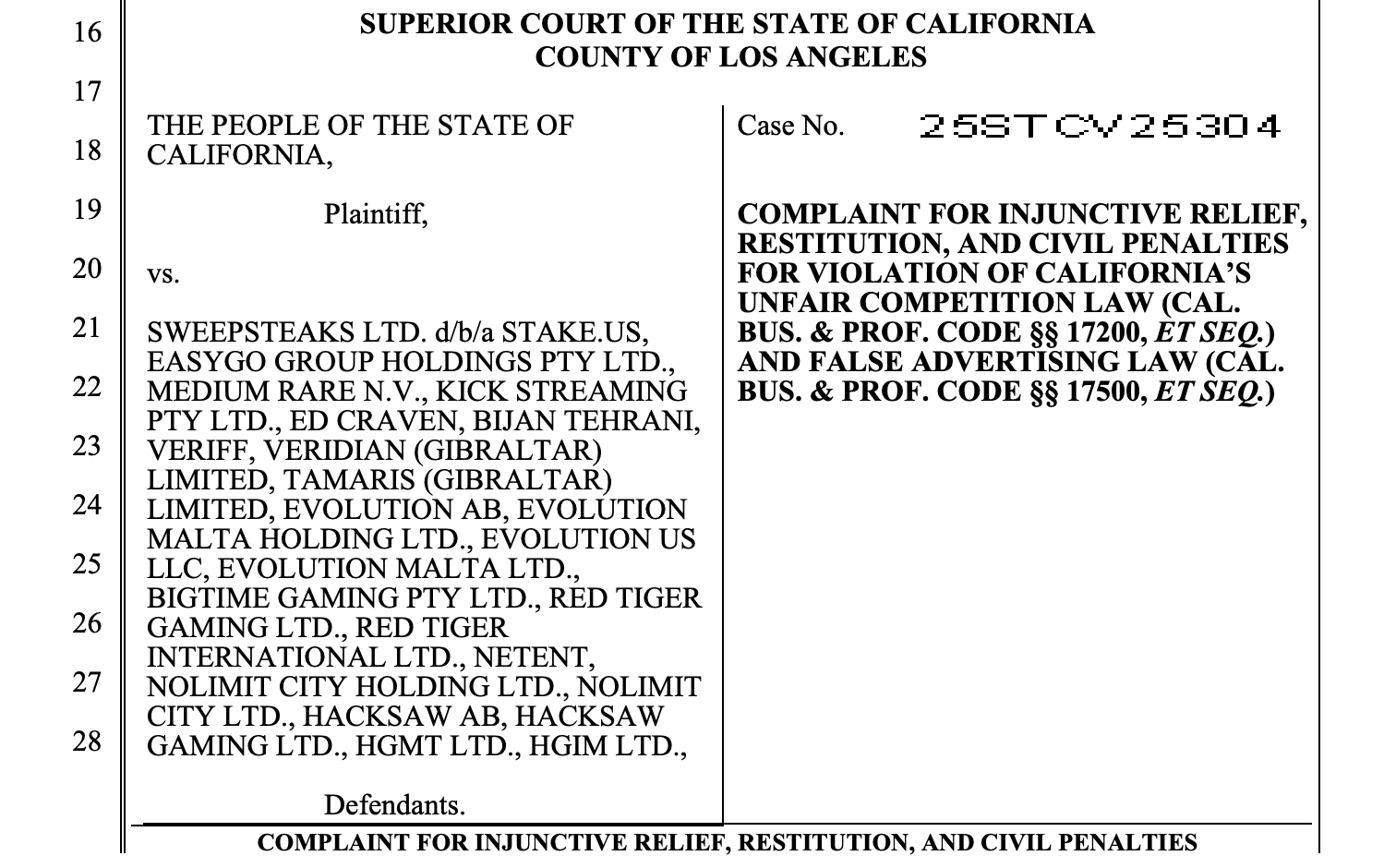
The complaint names three categories of defendant alongside the operator:
- Game studios. Evolution and four subsidiaries, Big Time Gaming, NetEnt, Red Tiger and Nolimit City, plus Hacksaw Gaming.
- A compliance vendor. Veriff, the identity-verification provider.
- A streaming platform and its founders. Kick Streaming and its co-founders.
The suit alleges Stake.us replicates Stake.com's interface and catalog to operate outside California's gambling statutes, and puts Stake's 2024 gross revenue at roughly $4.7 billion.
The allegations are untested; the defendants have not been found liable. We recently reported that Stake.us now holds over 2,000 casino games and 30 originals after only four years of operation.
Suppliers have begun adjusting. Pragmatic Play, which the suit does not name, withdrew its content from the US sweepstakes market in Sep. 2025, and California's AB 831 would extend liability for sweepstakes gaming to suppliers directly.
Enforcement Success Against Play-Money Gambling
Authorities are now battling simulated gambling operators on five fronts:
- State lawsuits against operators and, increasingly, their suppliers.
- Federal complaints to the FTC over product design.
- Foreign court rulings, with Brazil the furthest ahead.
- App-store scrutiny aimed at the distribution layer.
- Platform bans on gambling streams and third-party sites.
Notable wins by authorities:
The Kater ruling and its $155M settlement changed Big Fish's product, and Washington's attorney general is now suing Playtika on a similar theory.
New York also put its foot down, sending cease-and-desist letters to 26 sweepstakes sites in June 2025.
Fairplay and NCOSE filed an 86-page FTC complaint against Roblox in May 2026, which the company disputes. Earlier, a federal judge had already let a negligence claim over the Robux casinos proceed in 2024.
Brazil leads new wave while industry self-regulation struggles
Brazil has gone the furthest of all countries, shocked by the astronomical gambling volume produced by the 2026 Fifa World Cup.
In June 2026, a children's court ordered 11 companies, including Apple, Google, Valve and Tencent, to pay roughly R$298 million (~$59M) over loot boxes offered to minors, per Licks Attorneys. Within weeks, Brazilian players reported Pokémon GO's paid incubators had stopped working.
In July, Brazil's Justice Ministry gave Google and Apple five business days to explain how their app stores verify ages and screen unauthorized betting apps, per the ministry's notice.
GTA Online makes the same point in reverse: Rockstar region-blocks its in-game Diamond Casino in more than 50 countries with gambling bans, per reporting from 2019, and Australian players lost access in July 2026, per PC Gamer. Players in blocked countries route around it with VPNs.
Closures rarely crush the market, though, despite what the immediate media fallout may suggest. The Robux casinos shut down within 36 hours of the Sky News investigation, and successors were operating by May 2026.
What to Check With "No Value" Games?
The answer is simple. Ignore the label and ask three questions.
- Does the operator hold a gambling license from a named regulator?
- Does the age gate verify anything, or just ask?
- Does the currency have an official exit to cash?
A licensed casino answers yes, yes, yes, and carries the obligations that follow. A free promotion answers no, no, no, and costs nothing.
The sector in this article answers no, no, and "unofficially," the worst available combination: real money in, real gambling mechanics, but no protection attached to either.
The courts in Seattle, New York, Los Angeles and Brasília will continue to check whether the "no value" fiction survives contact with a price tag. In the rulings so far, it has not.
Treat gambling as entertainment you pay for. 18+, and if it stops feeling like entertainment, help exists at BeGambleAware and GamCare.