Why Inflation Turns Everyone into a Gambler
Casino searches in Argentina skyrocketed as inflation raced toward 300 percent, then fell with it. Exploring what dying money does to the logic of a bet.


· 8 min · 8 min read
In July 2023, anyone in Buenos Aires holding 100,000 pesos had a decision to make. Keep the notes for a month, and inflation running above 6 percent monthly would take a massive cut. Or run them through an online slot with a 96% RTP (return to player, the share of wagers a game pays back over time) and lose 4 percent in expectation, with chances at an outcome that changes everything.
Holding cash used to be the prudent choice and the slot the reckless one. With prices more than doubling over the prior year and the pace still accelerating, the gap between those two choices narrowed to almost nothing; and of the two, only the slot told people its long-run price in advance.
This is a story about what dying money does to the logic of a bet.
The Wallet Became the Bet
John Maynard Keynes watched Europe's currencies rot after the First World War and wrote down what it did to people: as inflation proceeds, "the process of wealth-getting degenerates into a gamble and a lottery". He meant it as a description of social decay. For a household inside a currency collapse, it is also a plain description of the options: once money loses value fast enough, every way of holding it becomes a wager.
At 10 percent monthly inflation—roughly Argentina's pace in late 2023—cash under the mattress loses 68 percent of its purchasing power in twelve months. Feeding the same 100,000 pesos through a 96% RTP slot costs 4,000 pesos a month in expectation, or 48,000 over the year before inflation is counted. The house edge is real, but next to the inflation tax, it is the smaller of the two fees.
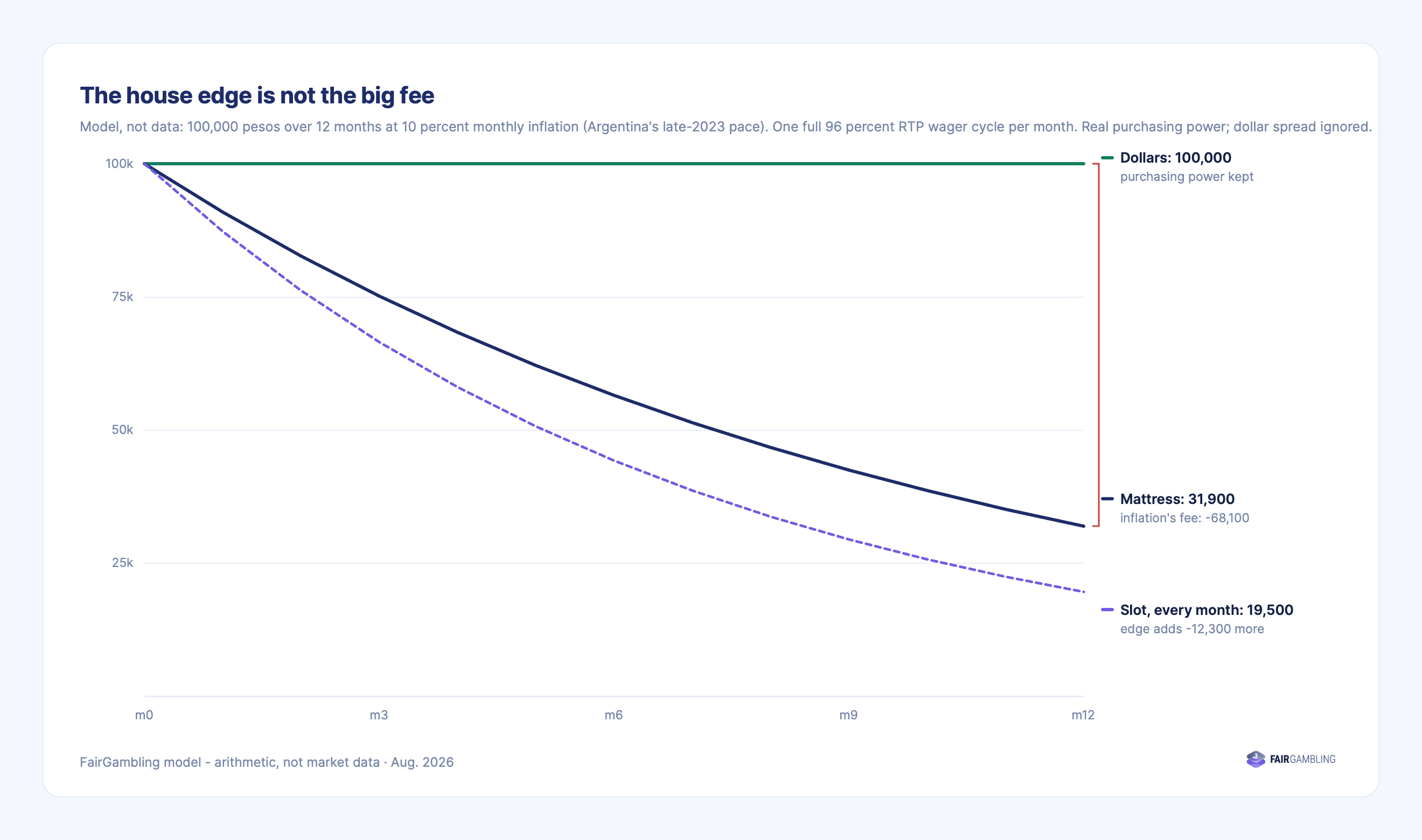
To be precise about what this does not say: gambling is not a hedge. But a population is not being irrational when it treats the house edge, attached to a chance at a life-changing multiple, as a tolerable price in an economy charging 10 percent a month for holding its money.
We did not find a prior study making this comparison directly (a posted house edge against the monthly inflation tax on cash), so treat the framing as ours. The nearest academic cousin is a working paper titled "The Inflation Gamble", in which the authors find that households respond to high inflation by rotating into lottery-like speculative assets, chasing the purchasing power they can no longer save.
The Panic Shows Up in the Search Bar
You can watch the logic take hold in real time. We pulled Google Trends series for four collapsing currencies and set them against the inflation record. Search interest is a defensible proxy: a 2023 study in the Journal of Behavioral Addictions matched betting-related search volume against the UK regulator's operator data and found correlations up to 0.95 with active players.
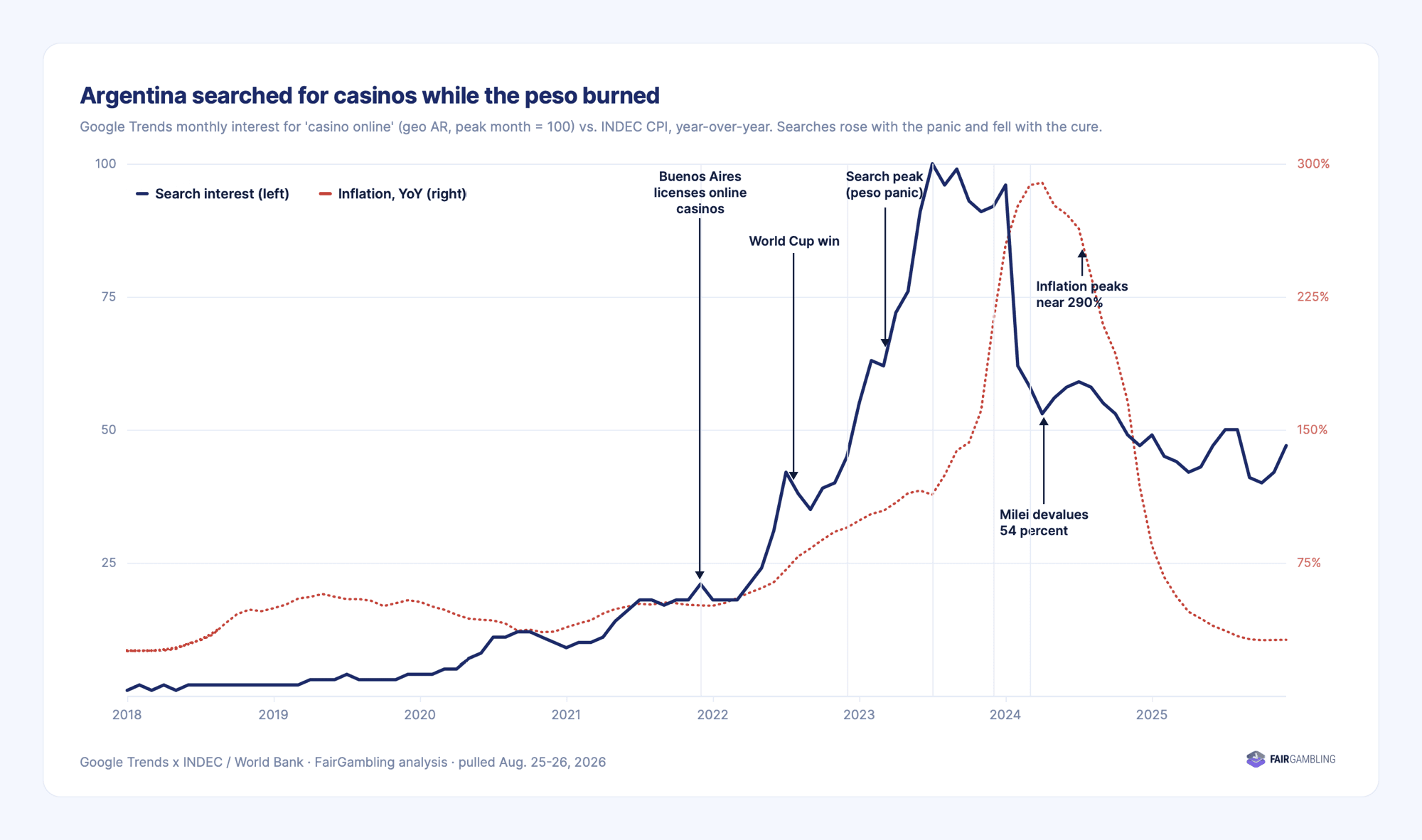
Argentina is the clearest case. Searches for "casino online" climbed drastically between 2018 and July 2023, peaking in the exact window when the peso went into free fall—from the post-primary panic of August 2023 to the 54 percent devaluation that opened Javier Milei's presidency that December.
Then the curve did something the usual explanations cannot produce. Buenos Aires had launched its regulated online casinos in December 2021; smartphones kept spreading; the platforms kept advertising. Every structural force pointed up. Instead, as monthly inflation collapsed from above 25 percent to low single digits, search interest fell by half.
Turkey tells the same story in a market where online casinos are illegal outright. Sports betting has a tightly state-controlled legal channel; casino play does not. Casino searches are up thirteen-fold since 2016, through the lira's collapse, and authorities ordered access blocked to some 233,000 illegal gambling sites and domains in 2024 alone.
Zimbabwe's betting searches rose from a near-zero base in 2014 by roughly 150-fold on Google's index, a multiple the low base inflates. The biggest year was 2024, the year the ZiG, which is the sixth attempt at a national currency since 2008, was devalued 43 percent months after launch.
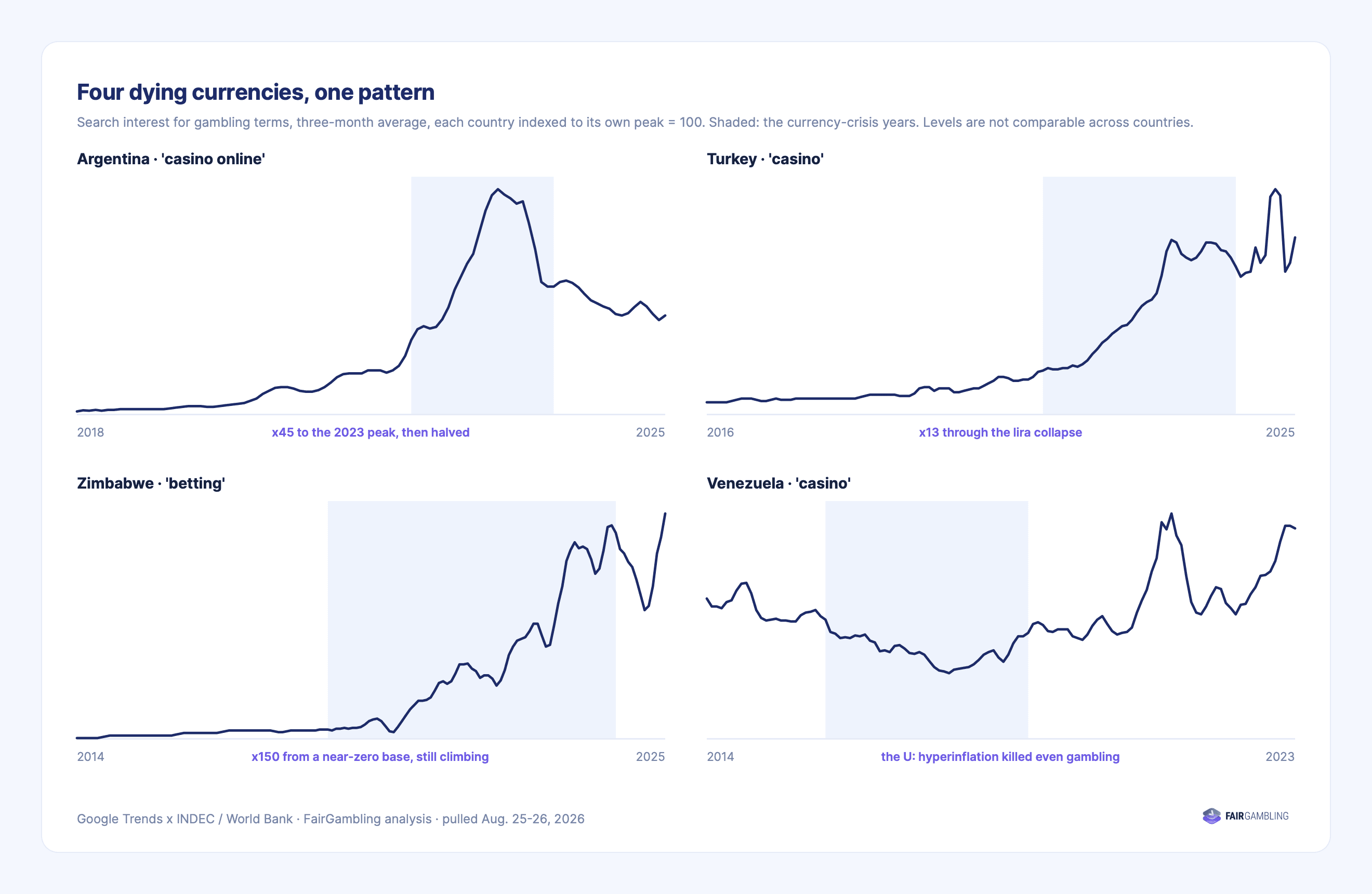
The pattern isn't just a modern phenomenon.
In 1923 Berlin, gambling clubs multiplied faster than police could close them... shut one, a history of the inflation years records, and five opened the next evening. Stefan Zweig remembered the year everyone "who could read and write traded, speculated and profited", the year “Berlin was transformed into the Babylon of the world”.
In 1994 Russia, with the ruble coming off 840 percent inflation, the MMM pyramid pulled in an estimated 10 to 15 million people before it evaporated.
Yet the pattern has never been formally tested: a study of gambling's macro drivers across 78 countries in the World Leisure Journal, published in 2024, stops in 2019 and was never designed to catch a currency collapse. Its most relevant finding points the same way though: lottery spending rises in downturns even as casino spending falls. Under stress, people reach for the cheapest long shot.
A Dying Currency, Not a Dead One
If inflation simply manufactured gamblers, Venezuela would have been the industry's greatest market. Through peak hyperinflation the country's gambling infrastructure died with the bolívar: more than 80,000 lottery points of sale shrank to fewer than 2,000, by an industry estimate given to AFP. "The devaluation of the bolívar made them disappear from the country," a lottery vendor told trade press. There is no point running a game whose prize evaporates before it can be spent.
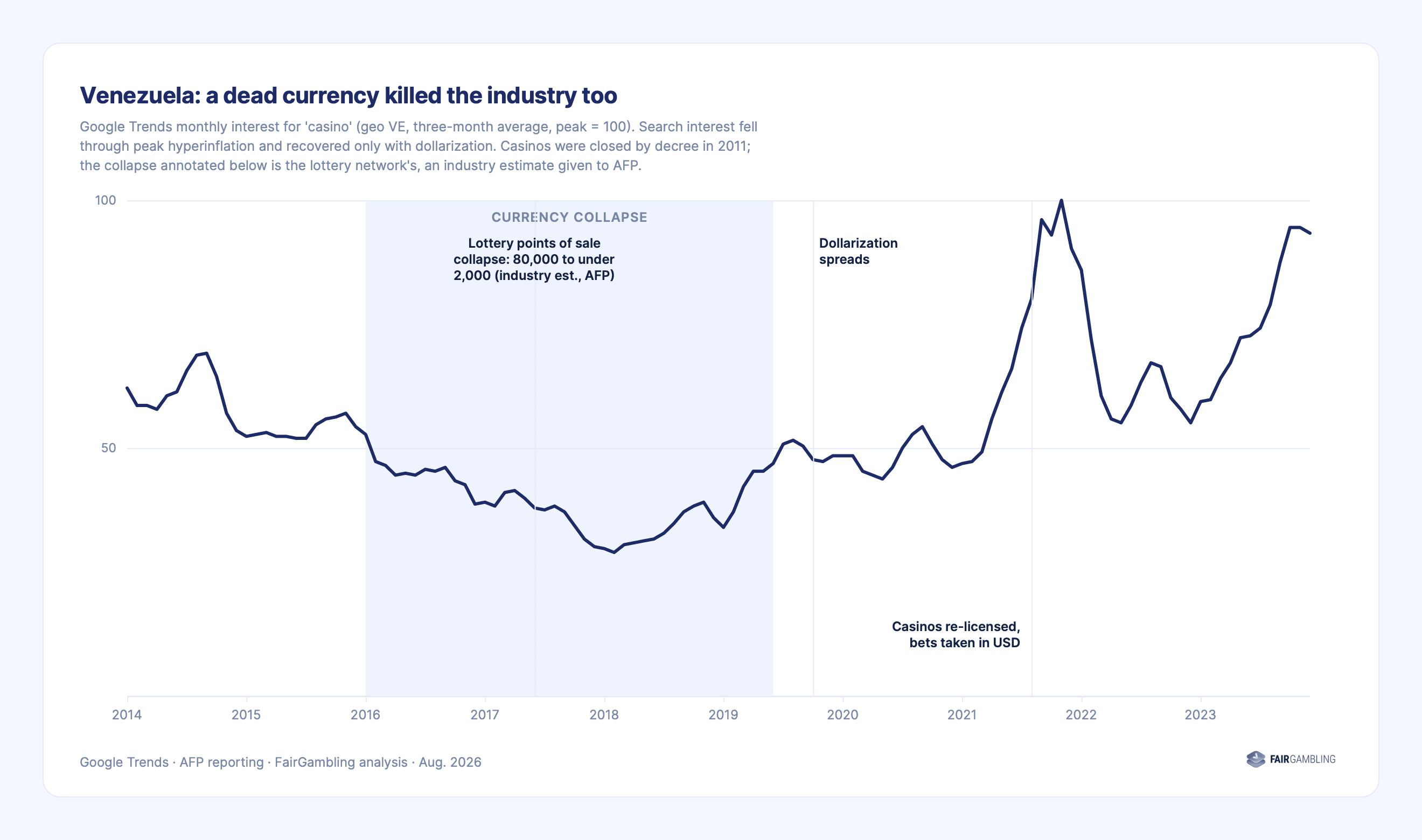
The revival came only when the dollar did. Casinos, closed by decree since 2011, were granted roughly 30 new licenses in 2020-21, and the tables that reopened took their bets in US dollars, not bolívars. Lotteries returned, selling $5 tickets against $500,000 prizes.
That sets the boundary of the whole phenomenon: the gambling boom belongs to the panic phase, while money still buys a stake but will no longer hold one. Once a currency actually dies, it takes the casino down along with everything else.
The Dollar Door
Look closely at the revived markets and a second pattern appears: gambling and dollar substitutes grow along the same rails. Caracas pays its prizes in them. In Turkey in July 2026, prosecutors alleged that a single network had moved 76 billion lira of illegal betting flow across more than 100,000 transactions, with proceeds converted to the stablecoin USDT to carry them out of the lira, according to Turkish press reports of the investigation.
In Argentina, Chainalysis measures stablecoins at 61.8 percent of all crypto volume, against a 44.7 percent global average.
Crypto casinos sit where those rails cross. The casinos we track on FairGambling Analytics took $49.5 billion in deposits from 8.8 million wallets in the year to Aug. 27, 2026. This is an industry denominated, almost by construction, in dollar-pegged money.
After 2008, when the Iceland krona lost half its value and the banking system failed, a population-based follow-up study found gambling participation rose roughly 11 percentage points, with lottery and scratch games (the cheapest long shots) growing the fastest. Problem gambling did not significantly increase.
In an ordinary rich-country squeeze, the impulse runs the other way: through Britain's cost-of-living years, the Gambling Commission's tracking found most gamblers didn’t change; among those who did, cutters outnumbered raisers roughly five to one—24 percent against 5 percent in the final 2023 wave.
Put simply, when money merely gets tight, people bet smaller; when money itself stops working, they reach for the long shot.
The Impulse Has Been Productized Before
Britain saw all of this in 1956 and labelled it "savings".
Inflation was eating postwar deposits, and Harold Macmillan's answer was Premium Bonds: a savings product that pools its interest into a monthly prize draw while the deposited money stays redeemable in full. Harold Wilson, then Labour's shadow chancellor, told the Commons in April 1956 that Britain's solvency now apparently depended on "a squalid raffle". In the same speech, he put his finger on exactly why the product would work:
"There is little incentive to save at 4⅕ per cent if prices are rising as they did last year by 4½ per cent."
Wilson lost the argument. Premium Bonds are today one of Britain's most popular savings products. £127.7 billion was stashed in Premium Bonds by the end of 2024. As UK inflation peaked at 11.1% and prize rates were raised in response, NS&I paid record prizes: £5.19 billion in 2023-24, double the year before.
The substitution runs the other way too. When Nebraska allowed prize-linked savings accounts, a Journal of Financial Economics study found casino activity, measured by cash withdrawals at casinos, fell at least 3 percent in the counties that got them, against comparison counties.
And the demand shrinks when the currency heals. Argentina's search curve has already bent: interest sits at roughly half its 2023 peak, tracking disinflation month for month. The decline arrived with no campaign and no crackdown, but with a currency that held its value.
Closing Thoughts
Read as a whole, gambling interest carries information about currency confidence: in Argentina it climbed ahead of the worst inflation prints and subsided with the cure. Whether it can work as a real indicator is a testable question. Central-bank researchers already test inflation nowcasts built on search data.
Nobody in this story is broken. A shop clerk in Buenos Aires, a bettor in Harare, a messenger boy in 1923 Berlin. Each did the math their money forced on them, and the math kept returning the same answer: keeping the cash was the one bet guaranteed to lose.
The next currency crisis will test the pattern out of sample. The more interesting question is who builds the peso world's Premium Bond before the next currency collapse.
Treat gambling as entertainment you pay for. 18+, and if it stops feeling like entertainment, help exists at BeGambleAware and GamCare.