


Crypto Casino Retention: When Loyal Players Are the Last Ones Out
Some crypto casinos kept their players this year. Others lost them by the thousand. But the stat everyone quotes, the returning share, is the least reliable way to tell them apart. So we rebuilt the analysis around the numbers that can move: the wallet counts.


Crypto is a fickle business. New coins pop up all the time. Some rise to the top and become a mainstay; others lose their buzz and drift away. As crypto gambling sites grow in the crypto scene, a similar trend is visible.
For the biggest players, for example Stake and Shuffle, staying power doesn't seem to be much of an issue. Over the last 365 days both sites hold returning shares in the high 80s, with Rainbet and Roobet just behind them.
Many of the smaller or up-and-coming sites show drastic drops in activity over the same window. So what separates the big players from the bottom of the pile, and what stops players from coming back?
Before we can answer that, let's take a look at the numbers involved in retention tracking.
What this number is, and is not
Our "Returning vs New Wallets" tracker measures, for each 30-day bucket, the share of depositing wallet-days that come from addresses that have deposited before, against those depositing for the first time. Two words of caution come built into that sentence.
First, it is a returning share, not a retention rate.
Retention asks: of the players who were here last month, how many came back? Our share asks a different question: of the crowd here right now, how many are familiar faces?
Those sound similar, but they are not the same.
A casino in a growth boom fills the room with first-timers and the share falls, with loyalty unchanged. A casino whose marketing has died stops adding first-timers and the share climbs, with loyalty unchanged. The percentage moves whenever the mix of the crowd moves, and the mix moves for reasons that have nothing to do with anyone coming back.
Second, the counts are wallet-days, not unique players.
An address that deposits on five days counts five times. That weights the whole stat toward the most frequent depositors, which is why the tracker's 365-day total shows 20.8M for Stake while the site's unique deposit-wallet count is far lower.
The tracker therefore functions better as a mixed gauge. The loyalty signal, such as it is, lives in the bars, not the line: when the count of returning wallets falls period after period, players are genuinely going missing.
This is the standard we apply everywhere below, to both the losers and the winners of the retention game.
The window trap, starring Stake
Stake is a clear illustration of why the share alone misleads.
Its 365-day figure sits at 83.2%, near the top of the tracker. Look only at the last 30 days and the share drops into the low 70s, low enough to sit among the worst on the board for that window.
Read on its own, that would look like a platform in decline. The counts say the opposite.
Stake's returning wallet-days grew 17% from the September bucket to the last full one, and the partial current bucket is tracking at an annual high. What collapsed the share was the other bar: new wallet-days roughly quadrupled across the year, from 155k a bucket to more than 600k.
Stake isn't losing its regulars. It's drowning them in first-timers, which is the kind of problem every operator on this list would take.
The lesson applies beyond Stake, and it cuts both ways. A falling share can be a boom. A rising share can be a funeral.
The real test of whether a casino is genuinely improving or declining is whether its own returning wallet counts move over time. The percentage is just a footnote to that test.
The clearest real decline
If a casino cannot keep players coming through the door, the writing is on the wall from a business point of view, and the upshot is lost funds for players who stayed loyal. Two casinos show the strongest evidence of that in their counts.
Spartans
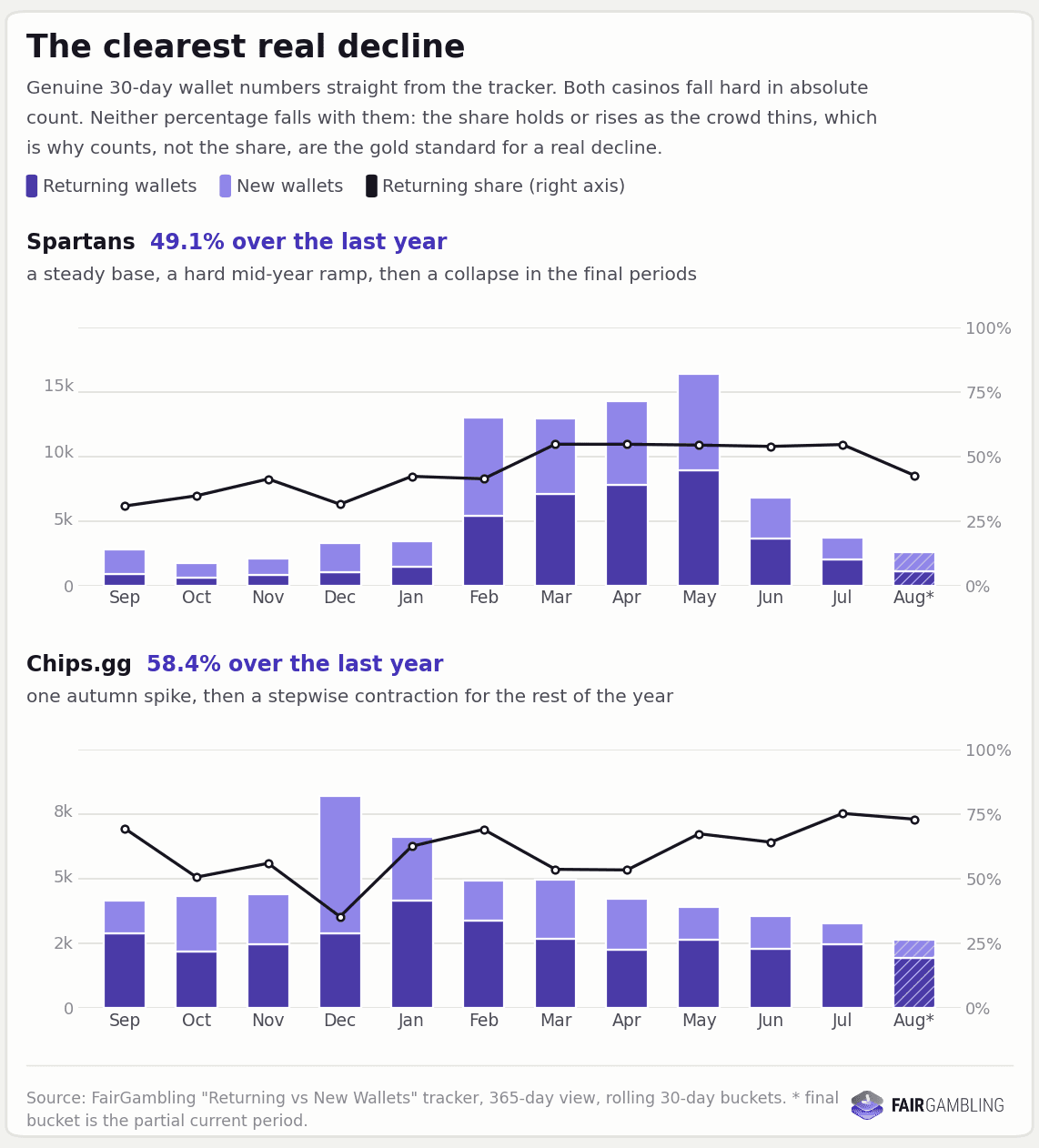
Spartans is the clearest case. Its 365-day returning share of 49.1% is the lowest of any casino we track, but the honest version reveals itself when examining the bars closely.
Activity built steadily through the winter, ramped hard from February, peaked in the May bucket at nearly 16k wallet-days, and then collapsed: down 58%, then 46%, then 29% across the final three periods, an 84% fall from the peak.
The percentage, notably, did not fall with it. The share held near 54% through most of the collapse and only dipped in the partial current bucket. The crowd shrank but its mix barely moved.
The timing of this drop lines up with negative publicity.
Despite being a new 2026 casino, Spartans built a negative profile fast: various sources have accused the site of running a scam, with large withdrawals left pending for weeks, unpaid leaderboard and affiliate payouts running into five and six figures, growing site instability, and an operator that stopped responding.
On-chain investigator ZachXBT went further, alleging ties between Spartans and Gurhan Kiziloz's BlockDAG operation and pointing to a wider pattern of fraud.
What makes the timing so damning is that only weeks before, in May 2026, the site was being praised for paying out huge leaderboard prizes, right around the peak in its own wallet chart.
The good press and the collapse allegations sit almost on top of each other, as they often do. The site is still live, but between the qualitative reports and its own wallet counts, this looks like significant user loss for Spartans.
A footnote on that 49.1%: Spartans is young, and young casinos always carry a heavy load of first-timers. The number that condemns Spartans is not the percentage. It is the shrinking bars.
Chips.gg
Chips.gg follows a similar but milder pattern, and it is the case that best shows why the percentage can't be trusted on its own.
Its returning wallet-days fell 33% across the year, a gradual, stepwise contraction after one spike in the December bucket, and its totals fell in eight of the last nine periods. Its returning share, over the same stretch, went up, from the low 50s into the low 70s. Fewer players, more of them regulars.
Read as a retention rate, that rising share would look like improving loyalty. It is the opposite: it is the signature of a casino contracting toward its core player base.
The story behind it is milder than Spartans' too. Reports through late 2025 and into early 2026 described high rollers hitting delayed or blocked withdrawals while deposits and play stayed open, sometimes pinned on hot wallets that simply weren't funded to cover big cash-outs.
On top of that, leaderboard results were invalidated after streamers left the platform, affiliate and creator payments went unpaid, and some accounts were banned and their funds seized over "exploit" accusations never backed by public evidence.
We have now seen this pattern twice: a casino's actual wallet activity falling away, shortly after a run of complaints and negative publicity.
A recent downturn
Rather than a sustained decline across the year, sites like Acebet and 22Bit show growth followed by a drop in the most recent stretch.
.png&w=3840&q=75)
Acebet
Acebet's 365-day returning share is 53.0%, among the lowest on the board, and it is a number that undersells the site's own year.
Acebet only appears in the tracker from November 2025, then grew almost every period into a May peak of nearly 13k wallet-days, with returning wallets climbing the whole way. A young casino in a growth phase carries a low share by arithmetic as opposed to any misconduct.
The live story is the last three periods: totals fell from 12.9k to 12.3k to 9.6k to 8.4k, and new depositors fell every one of those periods. Returning wallets dropped a third in the July bucket before ticking back up in the partial current one. That is a real downturn in the counts, concentrated exactly where the complaints are.
The complaints themselves span TrustPilot, X.com, and news articles, all sharing similar experiences: players who win big are often banned, and those who withdraw their winnings have blocked payouts, citing breaches of terms and conditions as the reason. These are some of the most common complaints at casinos, so it's usually not wise to pay heed to the odd report.
In Acebet's case, the volume makes them hard to dismiss, and last week the blue-ticked gambler Papai Klaus publicly described the same experience, which will do nothing to reassure would-be return wallets.
Whether the last three periods mark the start of a longer slide or a bad but temporary stretch is exactly what we will be tracking in next month's installment.
22Bit
22Bit's share sits at 52.2%, and here the percentage is almost pure noise.
The tracker shows a long, low, flat run (including small activity from autumn 2025, before the brand's stated January 2026 launch, likely a soft-launch period), then a sharp two-period spike in May and June driven overwhelmingly by new depositors, then a 51% pullback in the partial current bucket.
The annual figure is mostly a record of that one campaign. No clear scandal or complaint cluster is linked to the platform yet; the likelier explanation is that an initial promotional wave has ebbed, as early players move on once the rewards subsided.
With limited brand trust and a smaller footprint than the established players it competes with, we would expect this to stabilize rather than spiral, unless a new campaign resets the clock.
Historical incident, one year on
It is not all over for a casino that has fallen foul of industry accusations, though recovery isn't guaranteed either. Here are four casinos with a dated incident behind them, and what their counts actually show a year on.
This is where the bars and the line disagree most: two of the four verdicts flip depending on which one you follow. We follow the bars.
.png&w=3840&q=75)
1win
Back in November 2024, a breach exposed somewhere between 96 and 100 million user records, including names, phone numbers, emails, and hashed passwords, which later circulated on forums alongside reports of blackmail attempts targeting affected users. A Kazakhstan criminal investigation and market blocks in several countries followed, and that regulatory cloud hasn't fully lifted.
The counts today, though, are the strongest recovery on this list. After a chaotic first half, including a February bucket flooded with 121k new wallet-days that crushed the share to 36.6%, 1win's returning wallets have climbed for four straight periods and now sit at an annual high of more than 104k, with the share at its yearly peak too.
The choppy chart invites an unresolved verdict. On the current counts, it is healing.
Cloudbet
Cloudbet's issue is less a single scandal than a recurring habit. Big winners have repeatedly found themselves subject to "integrity review" holds lasting weeks or months, and successful sports bettors are often capped at unusually low maximum stakes. Although it should be noted that complaints have since been removed.
Cloudbet has the advantage of longevity, having operated since around 2013, and longevity flatters a returning share all by itself: an old casino has a deep pool of past depositors to draw on.
That depth makes its rising recent shares look like the cleanest recovery story on the list. The counts describe a round trip instead: totals climbed from 8.6k into a February peak of 12.6k, then gave nearly all of it back, ending around 8.1k, close to where the year began.
The rising share in the recent windows comes from new wallets thinning out, not from the base growing. Not a decline, but not an improvement story either.
BC.Game
BC.Game carries one of the largest, most publicly documented incidents on this list.
In 2024, Curaçao entities tied to the brand were declared bankrupt over unpaid player claims totaling somewhere between 2 and 2.5 million dollars, with individual claims running into six and seven figures. Licensing shifted to an Anjouan entity not long after, and a 2025 report suggested the original ruling might be reversed, though its status remained disputed into this year.
The counts show a contraction, with an important nuance.
BC.Game's year is wildly volatile, with huge spikes in the December and April buckets, but the trend line through the noise points down: returning wallet-days have roughly halved from the autumn, and the July bucket was the year's low before a 22% bounce in the partial current one.
The percentage figures stay reasonably healthy throughout. It rises from 57% to over 80%, which suggests the players still showing up are disproportionately loyal ones, but the platform is serving a shrinking pool of them, not a growing one.
A contraction rather than a collapse, then, and a genuine decline all the same.
Qzino
Through mid-2026, threads on Bitcointalk and Trustpilot described closed accounts and confiscated funds, with the casino's justification shifting: first a vague Terms of Service clause allowing it to act "without reason," then cheating and collusion accusations once the complaints went public.
Qzino's returning share climbed from 28% to 71% across the year, which at first glance reads as a recovery worth watching. It is the metric at its most misleading, and the case deserves a slow walk-through. Qzino launched into the tracker in late 2025 and grew explosively into a May peak near 20k wallet-days.
Since then, the totals have fallen three straight periods, down 10%, then 19%, then 28%, while new wallet-days collapsed from 9.7k to 3k. The share climbed from 28% to 71% precisely because the site stopped attracting first-timers.
The "recovery" was a post-boom decline wearing the percentage as a disguise.
The 95% illusion
Which brings us to the tallest number on the tracker, and the one most worth taking a closer look at.
Rollbit posts the tallest returning share we track: 95.1% over the year, touching 97% in recent buckets, despite holding only a 0.65% market share.
.png&w=3840&q=75)
The tempting read is to crown it the outlier winner and credit its product design, However, Rollbit's new wallet-days fell from about 3.1k a bucket to 1.4k across the year, a drop of more than half, and its returning wallet-days fell 22%, sliding in nearly every period. Total activity is down almost a quarter before the partial bucket even starts.
The share climbed as all of this happened, for the same reason Qzino's did: when a casino stops adding first-timers, the regulars become the whole room. A 97% returning share at a shrinking casino doesn't suggest its players are particularly loyal but rather that fresh faces are few and far between.
Rollbit's remaining core is real, frequent, and clearly well served by that rewards engine, and that is worth something. But "the best retention in crypto gambling" belongs to casinos that keep their regulars and keep adding new ones.
The real winners
When we take a look at these figures to a different standard, then the winners look different.
.png&w=3840&q=75)
- Rainbet is the year's genuine champion: returning wallet-days up 120% from September to July, totals roughly doubled, and a share that rose from 80.7% to 90.2% while it grew. Growing the base and the share at the same time is the one combination the metric can't fake, and Rainbet is the only casino on the board that did it at scale.
- BetPanda, a much smaller operator at 0.61% market share, is the quiet second: returning wallets up 31%, activity stable within a narrow band all year, share drifting up from 83% to 88%.
- Stake belongs on the podium for the reason the percentage tried to hide: a returning base 17% bigger than a year ago underneath the industry's biggest new-player boom. Roobet at 86.5% and Shuffle at 87.8% round out the healthy top tier, with counts to match.
One pattern deserves stating plainly: clean reputations don't decide winners.
Rainbet, BetPanda and Rollbit all carry the same recurring complaint patterns as the strugglers: bans and restrictions after wins, KYC demands that surface only at cash-out, multi-accounting accusations with thin evidence, and friction that scales with the win size. Rollbit's Trustpilot scores sit in the 1.6 to 2.4 range, lower than Acebet's.
Complaints clearly matter; Spartans and Chips.gg show how a reputation event shows up in the counts, but they are not destiny. What separates the winners is whether the pipeline of new players keeps running while the complaints roll in.
Elsewhere on the board
Three shorter notes, all count-checked.
Duelbits remains our textbook promotion case, and the fresh data confirms it: the May bucket shows new wallet-days spiking to 19.4k and the share cratering to 47.8%, a marketing push landing, not loyalty collapsing, with the share snapping back above 80% once the wave passed.
Coincasino shows the sharpest recent break on the tracker outside Spartans: a strong spring, peaking near 39k wallet-days, then three periods falling 26%, 61% and 33%. Its healthy-looking 84.2% annual share is doing exactly what BC.Game's does, describing a shrinking room politely.
Winna has rolled over: a strong surge peaked in the spring buckets and totals have now fallen three periods running.
The playbook for higher retention
The methods for keeping players, on the face of it, seem to be about treating them right so they return, but it is messier than you might think.
Do complaints and user issues cause player loss? The Spartans and Chips.gg charts say yes. Are they the nail in the coffin? The winners for retention say no.
However, that is not to say that reputation does not matter. Casinos still need to deliver value to players to acquire new players and maintain the returning ones.
Based on what we have gathered from our research, the best methods for high performance are as follows:
- Honor withdrawals and drop the opaque restrictions that surface only after a win.
- Engage with independent mediation rulings rather than sitting on them and hoping the complaint fades.
- Treat high rollers as an asset worth protecting, not a risk worth stalling.
- Invest in rewards that are transparent and can be claimed frequently, rather than locking value away in a delayed VIP ladder.
- Keep the acquisition pipeline running. A casino living entirely off its regulars will post a beautiful returning share right up until the room is empty. If your percentage is climbing while your bars are shrinking, the percentage is lying to you.
- Accept that brand equity is what buys a second chance after a scandal, a lifeline that most smaller operators simply don't have. Hence, the other points on this list should be at the forefront of those operations.
Methodology
- Source: FairGambling's "Returning vs New Wallets" tracker, 365-day view, pulled Aug. 26, 2026. A wallet is a depositing from-address; "new" is its first tracked deposit day, "returning" any later day. Counts are wallet-days, so an address depositing on five days counts five times.
- What the share measures: the mix of the current crowd, not the rate at which past players come back. It falls during acquisition booms and rises during acquisition droughts, independent of loyalty.
- Decline and improvement calls: made on each casino's own returning wallet counts across consecutive periods, not on the share. A rising share alone is not improvement; at Qzino, Cloudbet and Rollbit it marked the opposite.
- Buckets: twelve rolling 30-day buckets, labeled by the month they end in. The final bucket is the partial current period and is hatched in every chart.
- Limits: promotions flood a bucket with new depositors and drag the share down (Duelbits, May); young casinos carry structurally low shares and old ones structurally high, so we do not rank them against each other on the percentage. Casinos are compared only within the same window at the same time.
- What's next: this is the revised Part 1 baseline; future installments track the 90-day and 30-day windows against it, with the counts behind every verdict.
Treat gambling as entertainment you pay for. 18+, and if it stops feeling like entertainment, help exists at BeGambleAware and GamCare.
Read more

Trainwreck, Drake, and the $50M Question: Are Crypto Casinos' Record Wins Real?
By Andrey Sergeenkov · 19/08/2026 · 20 min read

Inside Bluff's $21M Raise: White-Label Tech, Withheld Winnings, 743 Players.
By FairGambling Research · 23/06/2026 · 12 min read
Let's Talk About Duel
By FairGambling Research · 26/05/2026 · 11 min read