Trainwreck, Drake, and the $50M Question: Are Crypto Casinos' Record Wins Real?
Crypto casinos settle bets in their own software, so the biggest wins cannot be verified. The proof stops at screenshots and video.

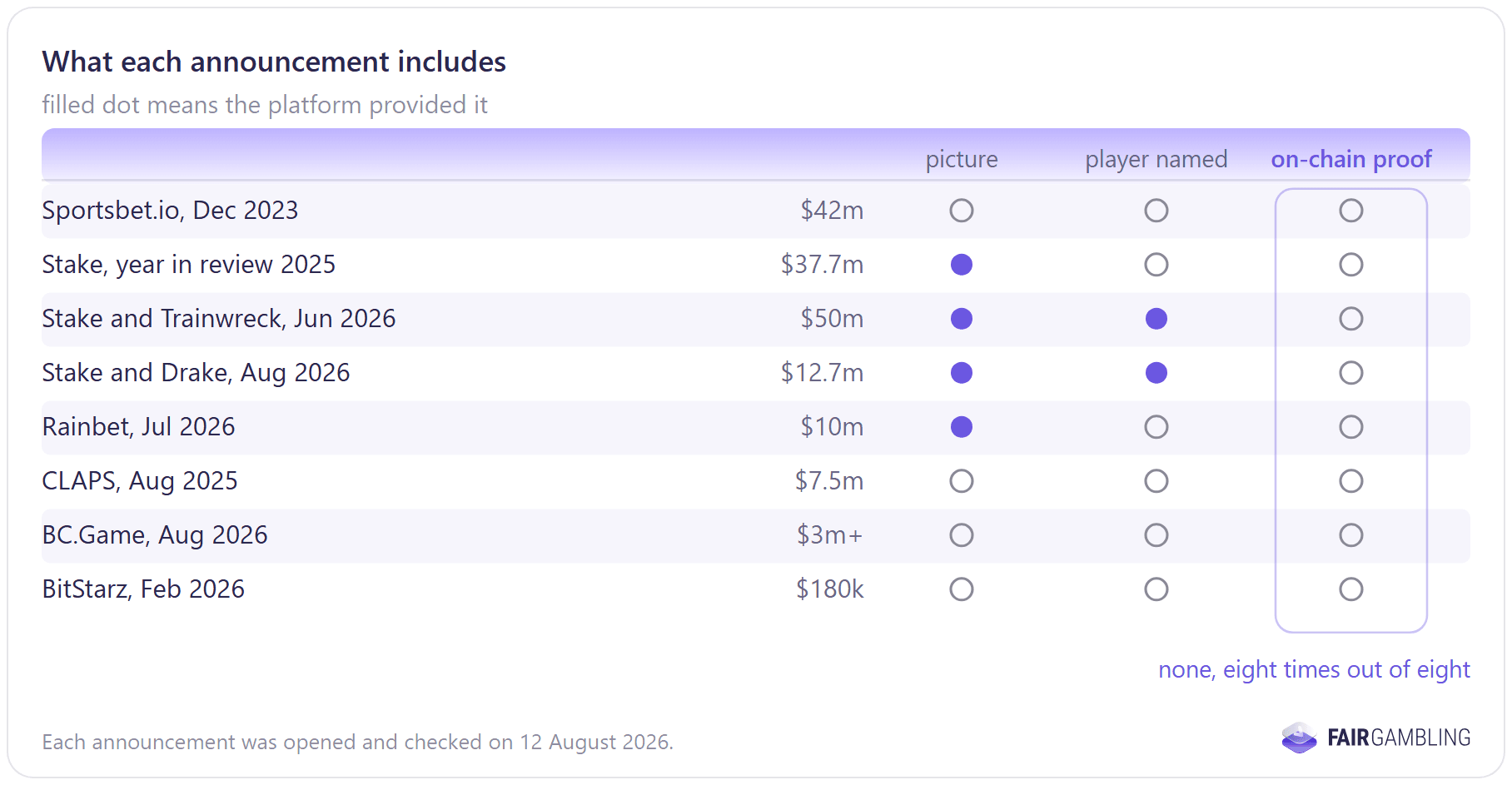
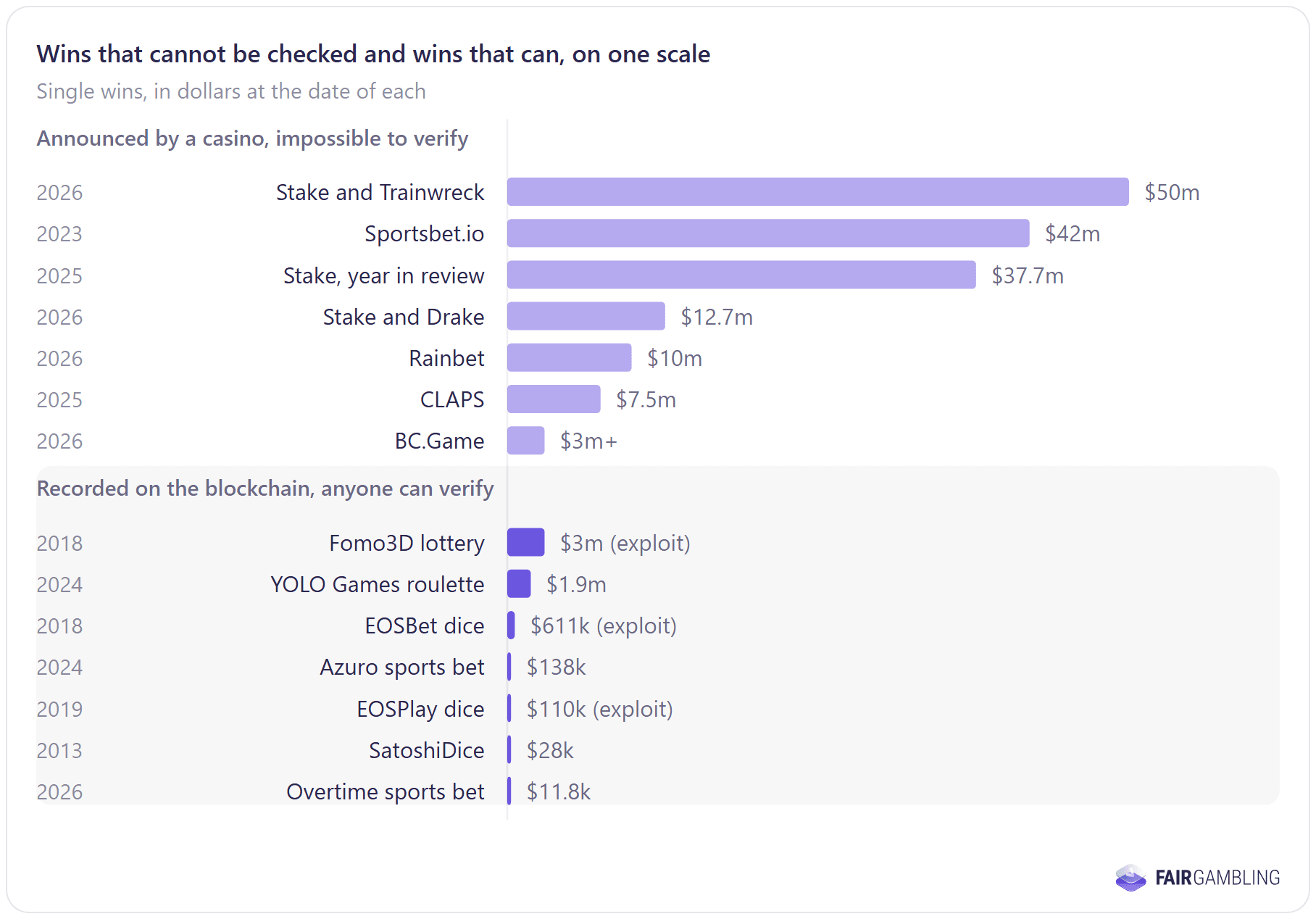
Eight big-win announcements from crypto casinos over the past three years promise $163m. Not one of them comes with proof a reader can check, partly because of the way the platforms are built and partly because of what the operators choose not to publish.
On 6 August 2026, the casino Stake posted a video of a Drake win on the slot Ganja Snail on X. The post drew 1.6 million views. The attached screenshot is the bet slip, and it puts the stake at about $127,000, the multiplier at 100 and the payout at $12.7m.
Those figures cannot be checked from the outside. They exist only as a picture of the casino's own interface, and the platform attached nothing that would allow the payout to be confirmed independently. Readers noticed first. One asked under the clip whether Drake had really played the games or Stake had simply run a promotion with him, and the reply below it read: "it's not gambling when you're on the payroll, it's a commercial with dice".
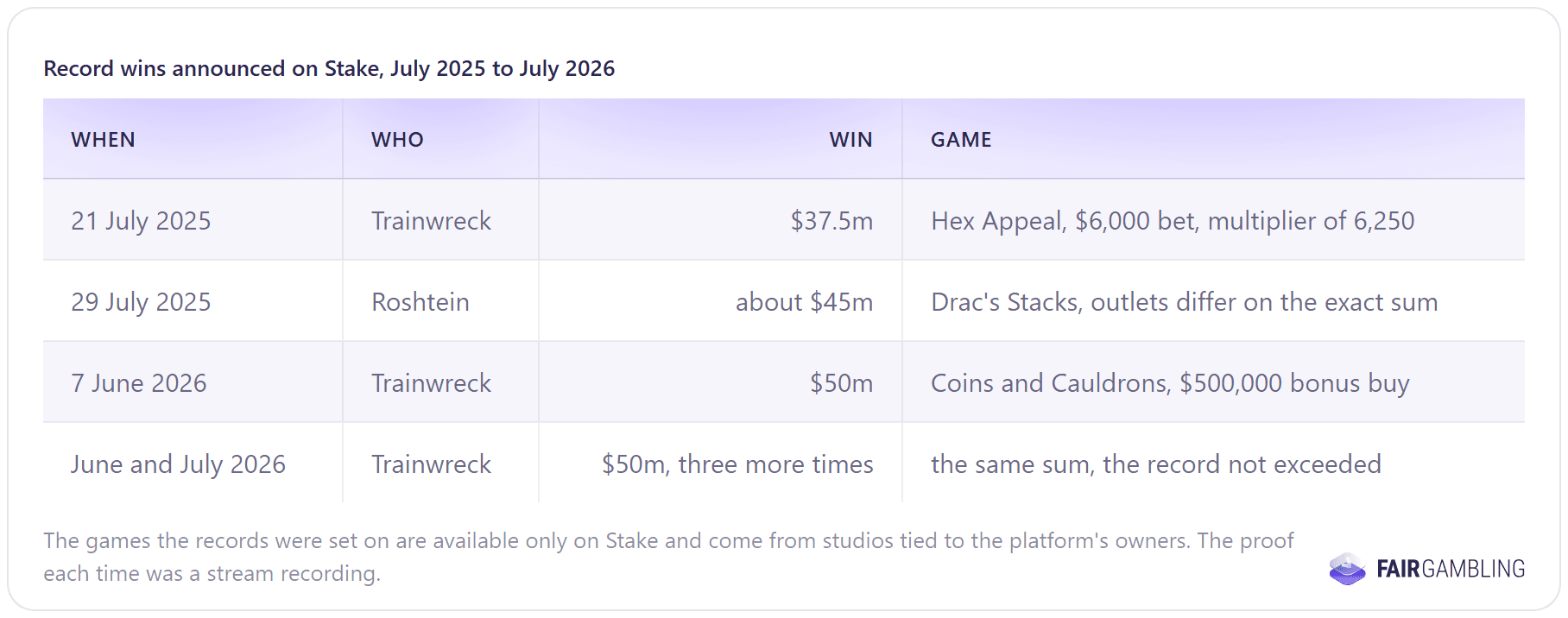
Between July 2025 and July 2026 the world record for an online slot win was updated three times, each time on Stake. The latest record of $50m was set by Trainwreck in June 2026, and he then won the same sum three more times without ever exceeding it.
A player at another casino cannot open the same slot and watch how it pays across a long run of spins, and a researcher cannot compare how often a streamer wins big with how often ordinary players of the same game do.
On 7 June 2026 Stake posted on X: "$50,000,000.00 MAX WIN ON STAKE! A new world record @Trainwreckstv", along with a recording of the play. The platform attached nothing anyone can open and check.
Why a crypto casino win cannot be checked from the outside
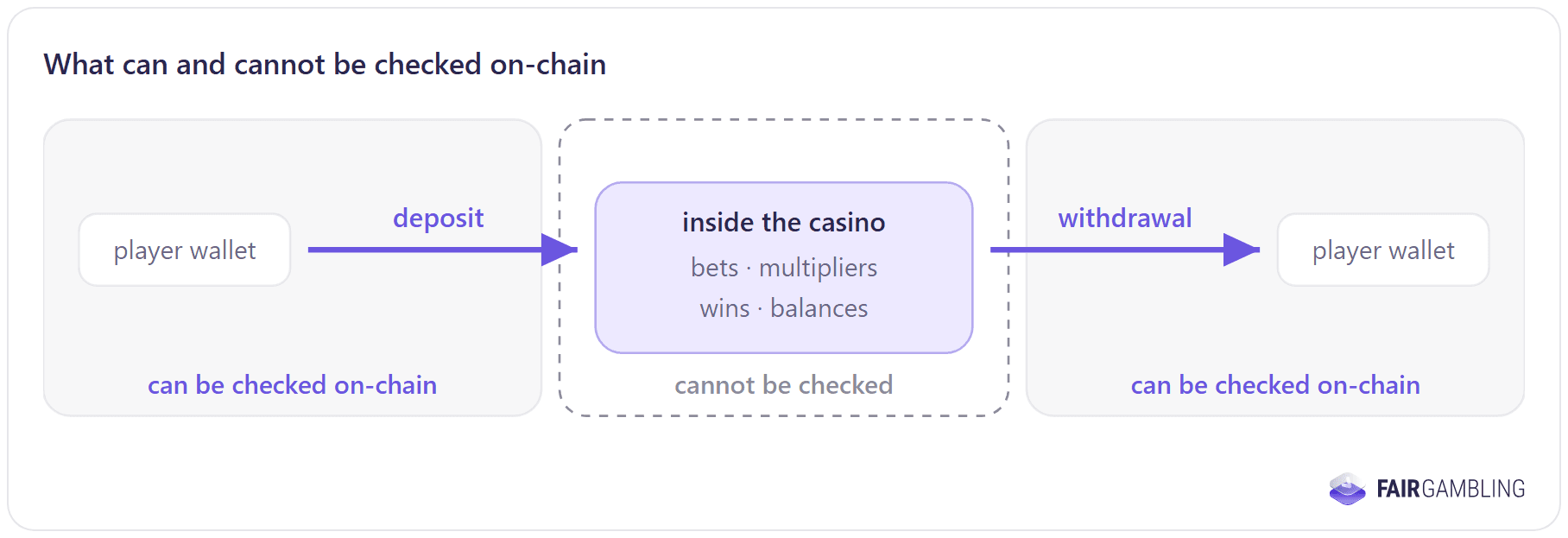
Player money sits in the company's own accounts and the company settles bets inside its own software. Only the deposit and the withdrawal reach the outside.
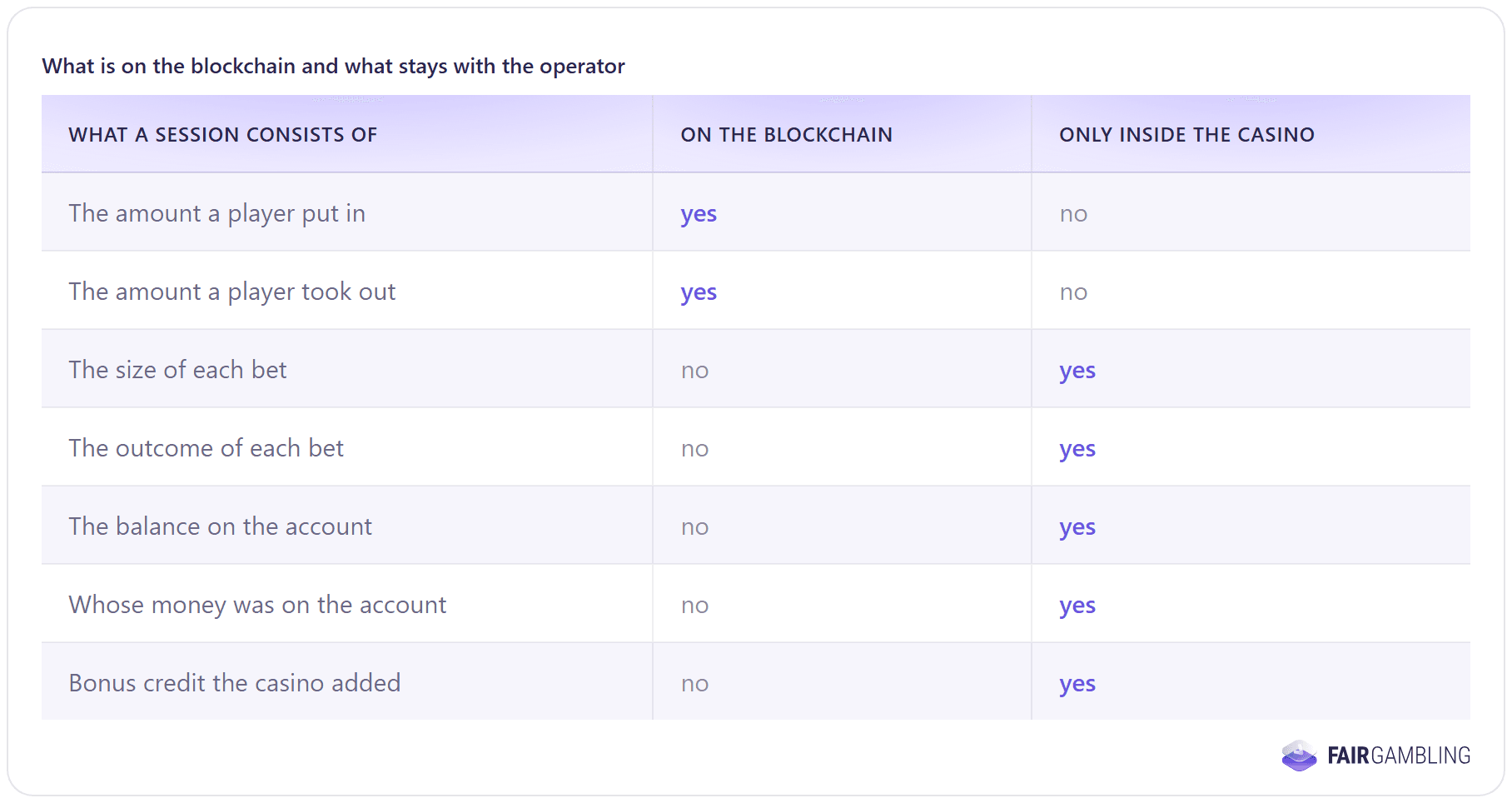
A player sends crypto to an address the casino issued to him and from then on handles a number in his account inside the site. When he wants his money back, the platform sends him a transfer. Both of those transfers land on the blockchain, the shared record of every crypto transaction that anyone can open. The bet, its outcome and the account balance never reach it, because they live inside the operator's closed software.
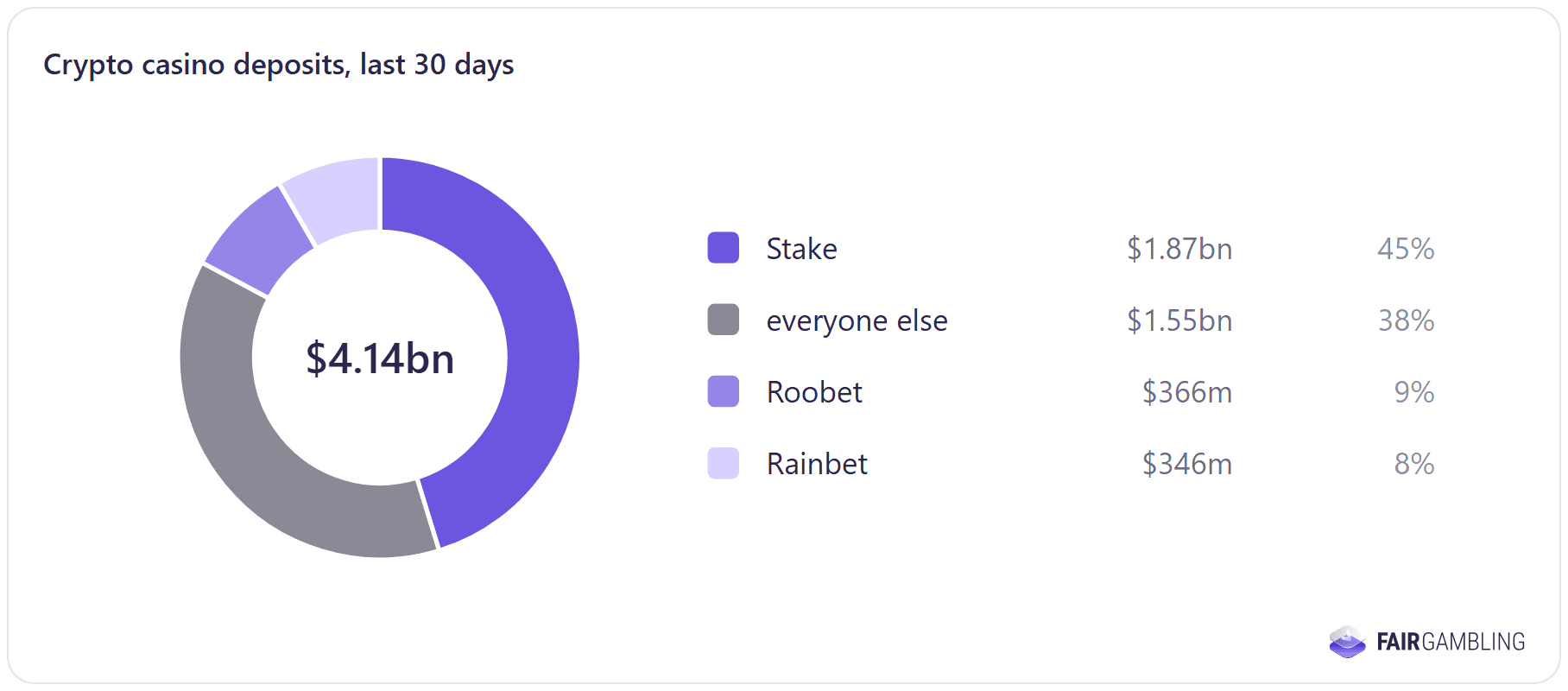
The money that goes into the industry can technically be counted to the dollar. Nobody outside it can check a single result of play. FairGambling's own tracker follows 269+ hot wallets across 41+ casinos and counted $38.2bn of deposits over the last twelve months. In the last thirty days one platform took 45% of the flow.
No such statistics exist for the bets. Stake and its competitors run a provably fair mechanism, which lets a player check that the outcome of his own bet was not swapped after the fact. It covers only the platform's in-house games such as Plinko and does not work for the slots where the records happen. The keys for such a check are held in the player's account, and only he can reveal them. An outsider cannot verify somebody else's win even in the games where the mechanism works.
How much casinos pay streamers to play
A fee agreed in advance, at the top reaching six figures for one stream. In some cases the platform also supplies the money to gamble with, to be presented to viewers as the streamer's own.
One of the influencers paid to play, the streamer xQc, described his terms on air on 5 March 2026, answering another streamer who asked how much his deal with Stake was really worth: "It can be ten minutes, could be five hours. I get $200k flat." The exchange is on video. He went on to say that he could spin dollar bets for the whole hour and keep $190,000 of the fee.
The most detailed document on this economy was published by a YouTuber going by Mr. Hand Pay. On 20 August 2025 he put out a 45-minute video in which he plays back a recording of his phone call with casino representatives. He made the recording legally, since his state requires the consent of one party only.
He describes the terms on the recording like this: "About a year ago, just over a year and a few months ago, I was offered millions of dollars, right? Pushing like almost three, it was a lot of money for an online casino deal with sweeps-based Pulsz and McLuck. And they wanted me to play with house money." By his account the conversation then turned to how this would be put to viewers:
"And I said, 'Okay, well, I'll play with house money, but can I tell my followers I'm playing with house money?' And they said, 'No.' ... And they said, 'I want you to tell them you're playing with real money.' I was like, 'You want me to lie to them?' And they said, 'Yes.'"
On the recording of the call an employee of the platform puts the same idea more gently: "we can segregate the money into our accounts and still have it be [authentic]".
Similar claims are being made in court. A class action in Virginia accuses Stake.us of running an illegal gambling operation, and among the conduct it describes is Drake and Adin Ross failing to disclose that they were playing with house money. The defendants have not admitted liability. On 30 July 2026 Judge Leonie Brinkema granted Stake's motion to compel arbitration and stayed the case.
How these deals are put together, and how to work out what any streamer is playing with, is set out in our guide to casino streamers and real money.
What a streamer's wallet shows when the casino pays in crypto
Sometimes it shows where the money he gambles with comes from. In the one known case 30,000 ether passed through the wallet, worth about $80m at the prices of those months, and more than half of it came from the casino the streamer was promoting and then went back to the same place.
The result of a bet is hidden inside the casino's software, but transfers between wallets are public. If a casino pays a streamer in crypto to his personal wallet, those payments are visible to anyone. That is what happened with the slot streamer known as AyeZee, whose wallet has carried a public label since players went through it on a slots forum in December 2021 and concluded that he was gambling with casino money. Etherscan, the explorer most people use to look up an Ethereum address, labels that wallet "AyeZee: Copium Wallet". Etherscan adds such labels itself from community submissions, and the page is open to anyone.
We pulled all 393 operations of the wallet. Money went out to one casino and came back 195 times, a quarter of the returns inside a day and half inside three days. Between February 2021 and December 2022 $46m arrived from Rollbit's own wallet and $63m went back out to his account there, the gap topped up from Binance. At the end the wallet held 0.6 ether.
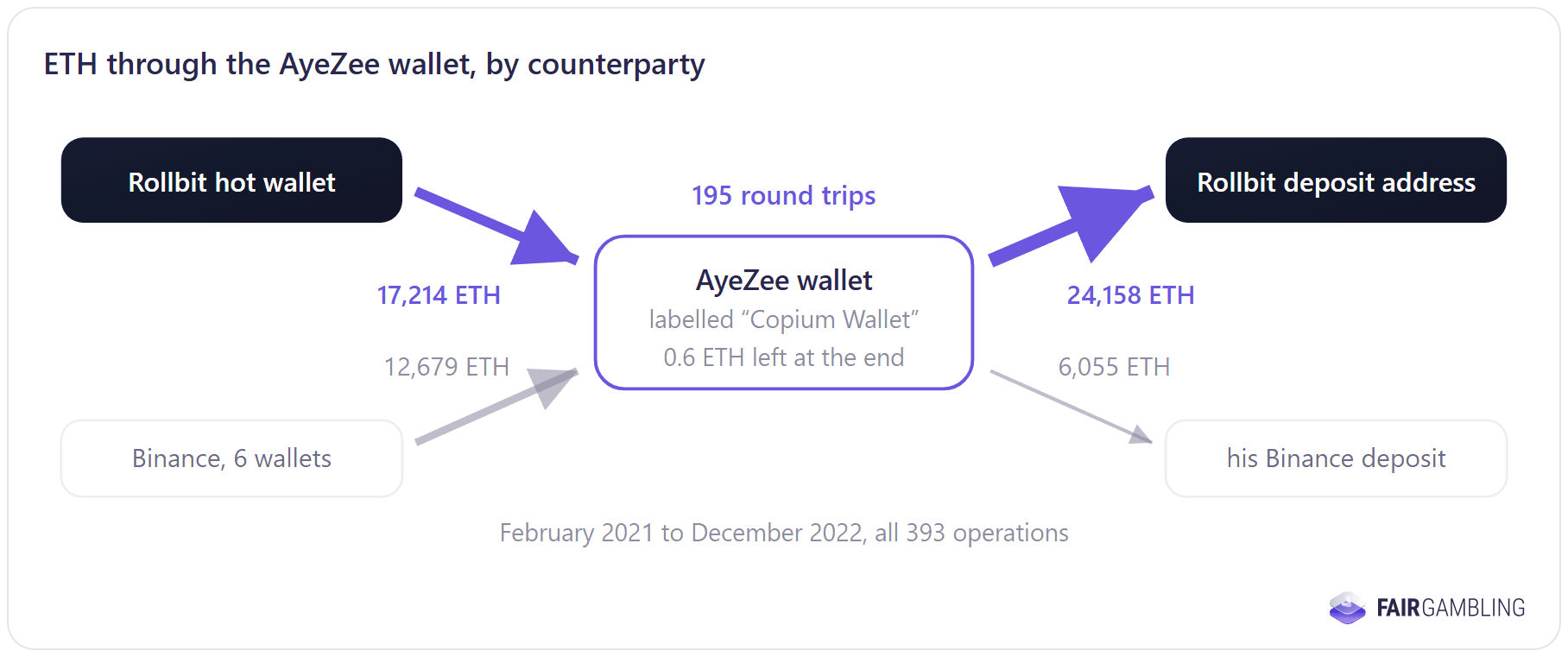
These transfers on their own do not prove play with somebody else's money. Formally the same pattern would fit a player who withdrew a win and later decided to play again, but a one-off withdrawal does not account for 195 cycles in 22 months.
What the transfers do not show is the terms of the deal, because the movement of money cannot separate a sponsored balance from an advance on advertising. Both independent wallet labeling systems, Etherscan and Arkham, mark the receiving address as a Rollbit deposit address, so the circle closed inside a single casino.
The streamers themselves treat such balances as ordinary. AyeZee and Roshtein accused each other in public in 2023 of gambling with casino money, and in Bigwinboard's account of the row each answered that he discloses his own arrangements openly. Neither of them denied that casinos put up balances for streamers, and the whole argument was about who admits it more plainly.
What the accusations against individual streamers settled
Public accusations against streamers are built on screenshots and clips, and the same picture usually fits more than one explanation. Since 2019 no accusation has been carried by the evidence its author produced. One case closed on the streamer's own admission, another fell apart when a stranger explained the clip.
Demo mode on a Roshtein stream, August 2019
A viewer asked whether the play was for real money. The streamer decided to show the difference between real play and demo mode, where bets run on play chips, and switched to demo. On the recording, he says "Now, I have to show it", then "So, that's my balance there", and quickly closes the window. His real-money balance was €22,113.10, and exactly the same sum down to the cent appeared in demo mode.
Demo mode launches without a player account and starts from a fixed round sum of play chips, which is why a match down to the cent is treated as evidence. We checked this on the same game the streamer opened: the Play'n GO demo issues 25,000.00, the Pragmatic Play demo a hundred thousand. The documentation of the aggregator Hub88, through which casinos plug in games, states outright that in demo mode the player's wallet is not queried at all. A demo game technically cannot know the real balance of an account.
The matching sum could have been bonus money rather than play chips, money a casino credits to an account and that cannot be withdrawn. That changes the accusation: the play runs not on imaginary chips but on real casino money, and for a viewer the difference is small. A representative of N1 Casino stated on the Casinomeister forum: "Just to confirm - roshtein playing with real money at N1 casino. And from what I know - it's impossible to somehow show play money and real money. At least at N1." Roshtein himself has never publicly commented on the incident.
Coffeezilla's investigation of SteveWillDoIt, October 2021
The main accusation of the first episode concerned where the streamer's wealth came from, since the man financing him, in the author's account, owned both the casino Roobet and a promotion company, and both firms were registered at the same address in Miami. Right after the video came out the streamer deleted every clip from his gambling channel. Something weightier came in the fifth episode, where SteveWillDoIt himself explains why he took the contract:
"I love to gamble, I gambled a lot, kind of was kind of disgusting, and it was kind of like a great... a great way for me to not gamble with my own money."
Syztmz's breakdown of the streamer Xposed, March 2025
On 17 March the streamer Syztmz posted a video on X, pointing at Xposed's indifferent reaction to giveaways of a hundred thousand dollars and at jumps in his viewer counters. Xposed answered on 11 April by posting receipts from the Resorts World casino in Las Vegas totaling more than one and a half million dollars, with the line "Unlike others, I can back it up." The receipts confirm play in a land-based casino but have nothing to do with his online account.
One term of his Roobet deal is not in dispute. In April 2024, he set it out himself: "I do have a maximum withdrawal currently that carries over to the next month." A ceiling on what he can take off the platform means a big win does not come out in full even if it is real.
The case where the accusation fell apart, November 2025
On 30 November, a clip spread online showing Roshtein trying to place a bet on the slot The Bowery Boys and being refused by the system, posted with the words "This fraud @ROSHTEINS just got EXPOSED!"
Another user answered in the same thread within the hour: "it was because he won a $600 drop prize from Massive Studios and when it got added to balance it activated a $600 wager requirement. Same happened to me." It had nothing to do with the real money in the account.
The one claim that matched the network data
A streamer showed screenshots of a win and of a transfer to another casino, and that transfer really is visible on the blockchain.
On 4 August 2026 an X user going by DonicLivee claimed that the streamer LittleKid gets his huge multipliers off the back of a large gaming balance that lets him make tens of thousands of attempts. LittleKid replied with screenshots from Stake showing two wins and a subsequent transfer of money to another casino.
The argument ran for nine days on screenshots, and neither side went to the blockchain, where the transfer had been visible all along.
On 23 July a Stake wallet sent $800,800 to an address that the labeling service Arkham marks as a deposit address of the casino Shuffle, that is, a top-up account inside that platform.
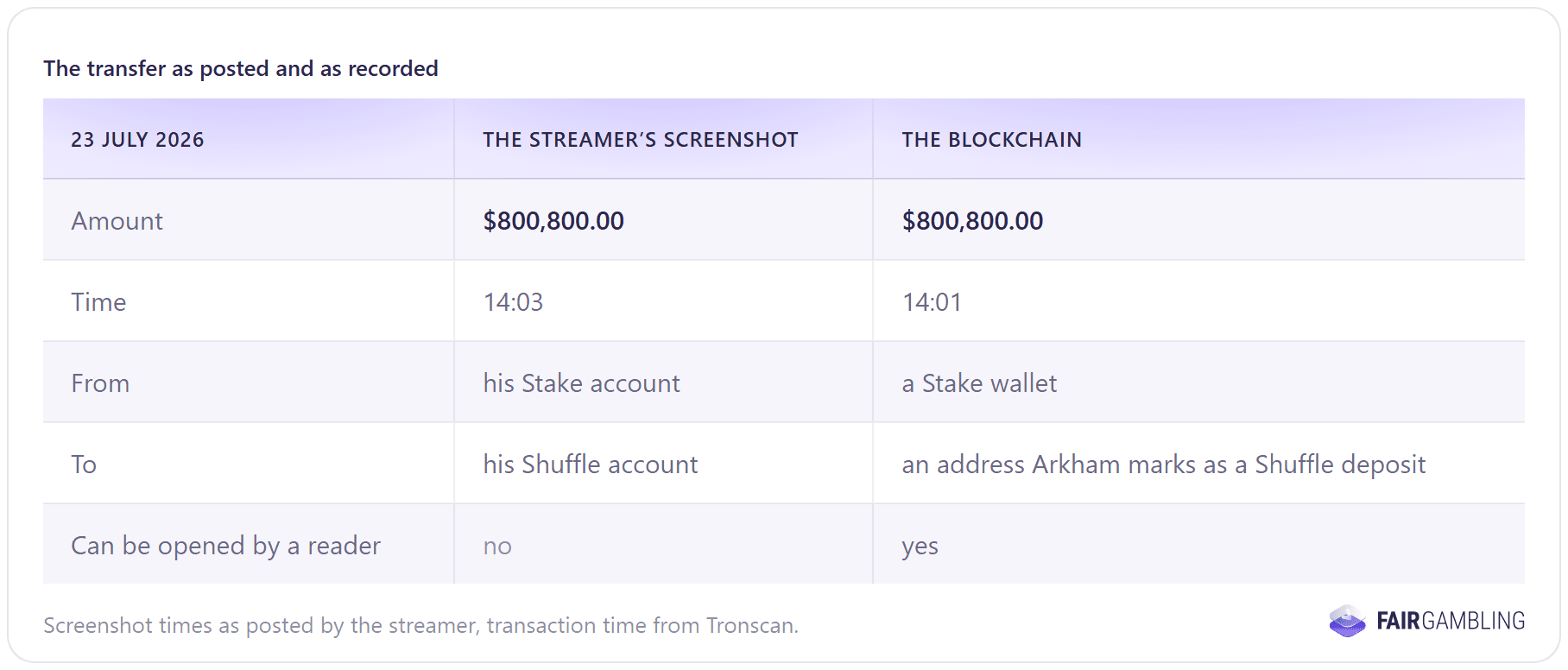
A win is a number inside the casino's software until money moves, and here money moved: $800,800 left Stake for another casino, and the record of it matches his screenshot to the cent. That puts a sum of that order on his account for certain and makes the rest of what he posted harder to wave away.
Where the money on that account came from is still not visible, because the spin itself happened inside Stake.
What Bloomberg's count of stream recordings showed
Drake won big four times as often as the average player, but only in games owned by Stake's owners.
With no access to the casino's data, Bloomberg Businessweek in February 2026 counted what is available from outside, which is the recordings of broadcasts. By the outlet's own description of the method, the journalists went through almost 500 hours of slot play, mostly between June and August 2025, and compared how often big wins land for influencers paid by the platform and for ordinary streamers. A big win was taken to be a multiplier above a thousand times the bet.
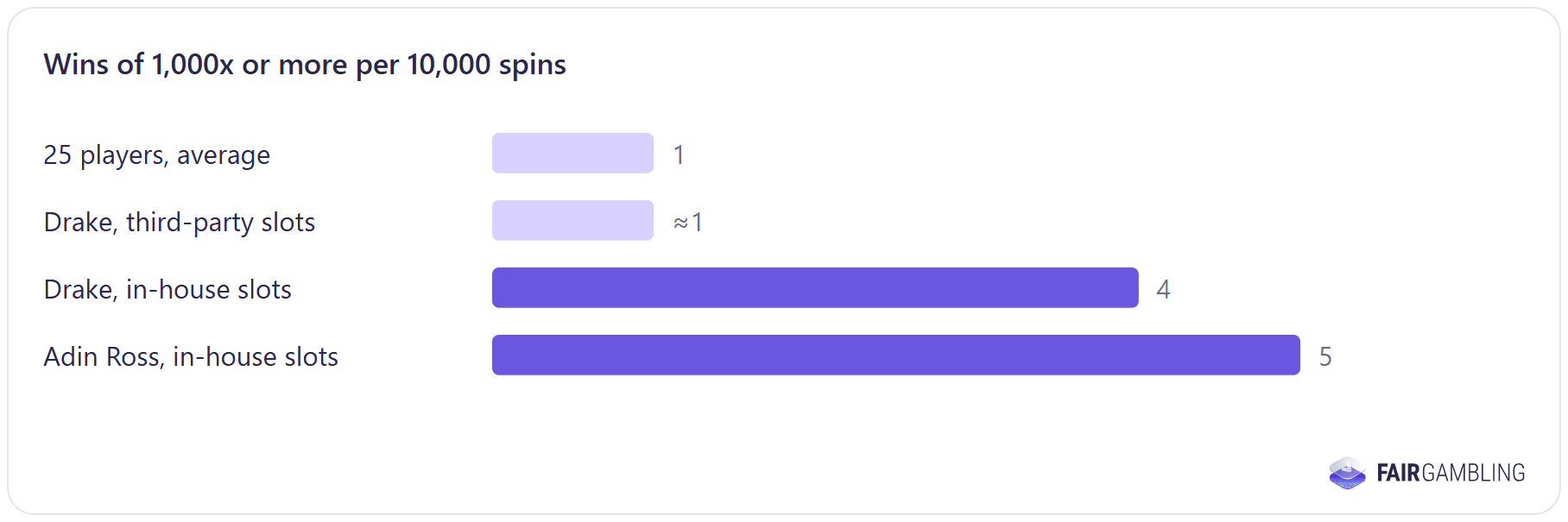
Stake answered on X on the day the investigation came out. The co-founder put the sample behind the two influencer figures at "0.1 hours for adin and 1.3 hours for drake" and called the published method flawed. The chief executive summed it up as "1 year investigation, 1.4 hours of of [sic] data".
A further objection in the trade press concerned how the spins were counted. Streamers barely ever spin a slot one bet at a time; they buy bonus rounds, and such a purchase was counted as a hundred ordinary spins, which is what puts speeds of around ten thousand spins an hour into the count where ordinary play gives roughly 1,200. The same review noted that Bloomberg captured moments where the casino topped up a player's account live on air.
The count cannot be repeated on other data, because nobody except the casino itself holds the records of the bets.
What casinos back their big wins up with
Casinos offer screenshots, videos and announcements of their own.
The attachments differ in kind but not in effect. Rainbet linked a replay of the spin, held in the slot developer's own database. CLAPS put out a paid announcement that invokes blockchain transparency and verifiable outcomes without citing a single transfer. Two of the eight name the player who won. None names an address, a transaction or a bet number.
Can Sportsbet.io's $42m jackpot be found on the blockchain
In December 2023, Sportsbet.io announced a jackpot of about $42m won from a $50 bet, and no transfer of that size moved in those days on any network where that currency circulates.
There are two ways to find a payout on the blockchain and both need starting data. Either the casino's wallet is known, in which case its outflows can be reviewed in full, or the exact sum, currency and date are known, in which case the transfer can be searched for across the whole network.
Of the eight announcements examined, only one qualifies. The wallets of BitStarz and CLAPS are not publicly labeled; the rest of the platforms disclose neither sums nor currencies, and Sportsbet.io named everything at once: 42.1m USDT on 20 December 2023.
The search turned up nothing. There is no USDT transfer of the stated size on the days of the event in any of the seven networks where the stablecoin circulates.
The absence of a match does not mean there was no payout. The money could have gone out in parts, in a different currency or network, stayed in the player's account inside the casino or been withdrawn later. There is one verifiable fact here. The jackpot has no single matching transfer in any network where USDT circulates, and the operator never published data by which the payout could be found.
What Stake's own wallets show
Even when every large transfer a casino makes is visible, none of them can be tied to a win it announced. The biggest ones turn out to be the company moving its own money.
Stake's wallets are labeled, so more can be pulled out of them. Between 1 May and 11 August 2026, 490 transfers larger than a million dollars passed through them. Twenty-seven of those exceed $10m and the largest reaches $92m.
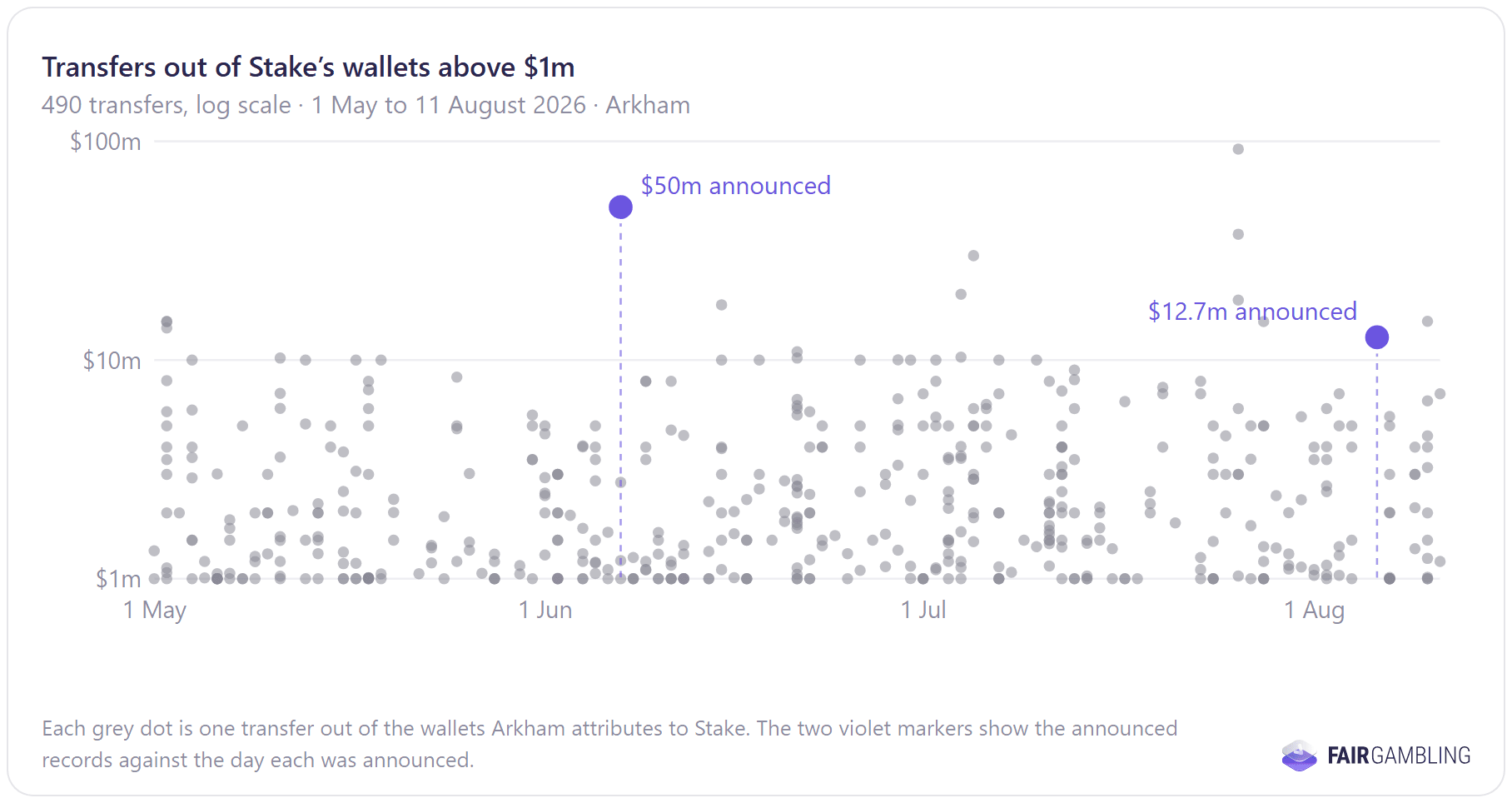
We checked the recipients: $92m went into the Everstake staking pool, where crypto is placed to earn interest, and another $30m to a deposit address of the exchange Binance. This is the company moving its own money.
There are no matches with the announcements in this picture. In the ten days after the $50m record announced on 7 June, the largest outflow came to $17.9m, barely a third of the sum announced.
After the announcement of Drake's $12.7m win a candidate of the right size did turn up. Four days later $15m left the platform's wallets, and such a transfer could in theory have included a payout to a player. We followed it one step further. The money sat at an intermediate address for seven minutes and moved on in full, to the same node that had taken in $5m three days earlier and $1.75m a week before that, each time by the same pattern. The transfer is part of a regular route between the platform's own addresses.
Two smaller platforms can be checked the same way, and they part company. Rainbet has never sent out as much as it announced. BC.GAME has, but not around the announcement: in the ten days that followed it, nothing larger than $750k left its wallets.
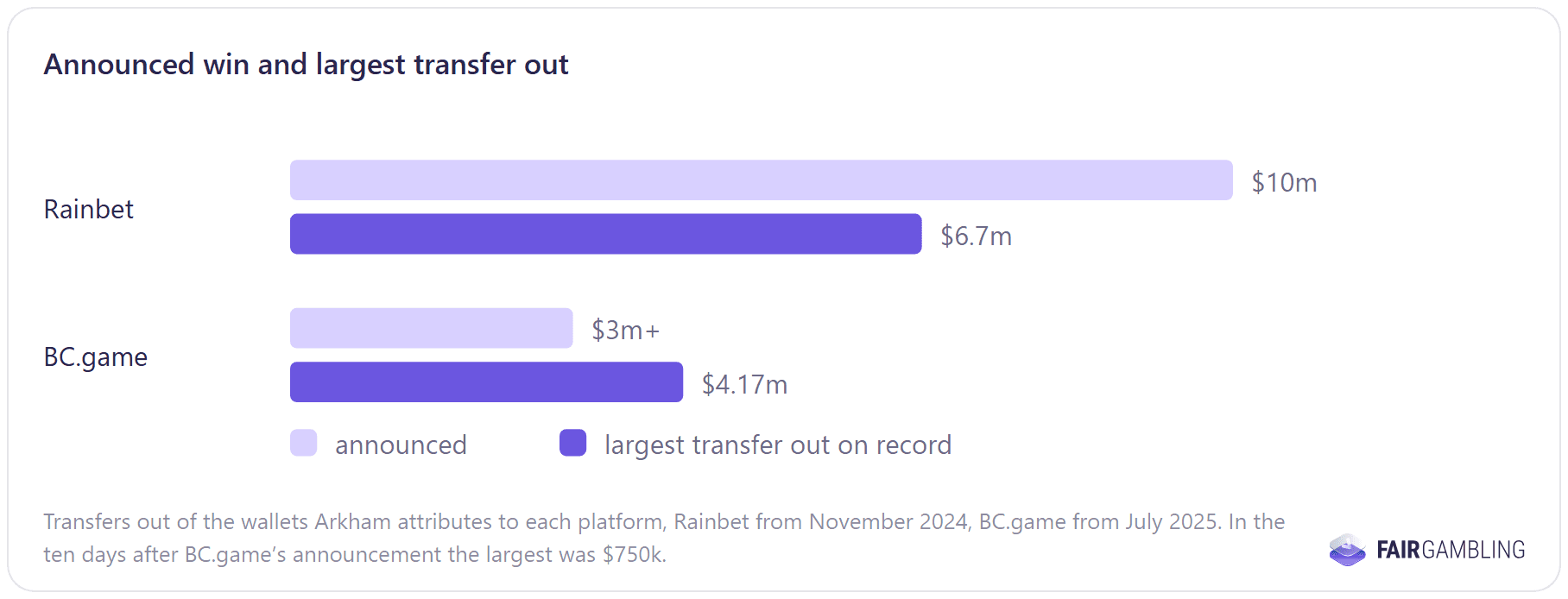
It does not follow from this that there were no payouts. A player could leave the money in his account, take it out in parts, or take it out later, and the completeness of labeling differs from platform to platform. What does follow is that even when all of a casino's large transfers are visible, tying a particular announcement to a particular movement of money is impossible unless the operator names an address or a bet number.
Are there casinos where a win can be checked in full
Casinos that settle every bet with public code exist and are known as on-chain or smart contract casinos. In them anyone can check the bet, the outcome, and the payout. The trade-off is size. Once the outcome is public the sums fall away. The record holds two payouts of a few million dollars; everything below them runs in hundreds or tens of thousands.
Some casinos settle bets through smart contracts on blockchains, public code that takes the bet, determines the outcome and sends out the payout. The bet, the outcome and the payout all stay on the blockchain permanently. Such casinos have been running since 2012, when SatoshiDice took every bet as a separate bitcoin transfer.
The problem with them is the size of what can be won. The largest payout in the whole history of such gambling that we could find came to about $3m, and it was an exploit. The winner of the Fomo3D lottery in 2018 jammed the network with his own transactions so that other people's bets simply could not go through, and waited out the timer.
The largest win that looks like ordinary luck is half that: 550.8 ether, about $1.9m, at the casino YOLO Games in March 2024.
Cheating at a casino like this is possible from the operator's side, by wiring a skew into the code, and from the player's side, by finding a mistake in it. Whichever way it happens, the same public data that shows the payout also shows how it was obtained, which is why the Fomo3D exploit is on the record at all.
The bankroll of such a casino is visible to everyone, which means the ceiling on a payout is visible too. At the largest of the live platforms, Ape Church, it stood at $1.38m on 12 August 2026, and a win is capped at five percent of the bankroll. Stake's deposits run at about $62m a day, forty-five times the bankroll of the largest casino where the result is public.
As soon as the outcome becomes public, records are measured in single millions rather than tens of millions.
What could be learned about the big casino wins and what could not
A win announced by a casino that settles bets in its own software cannot be checked from outside. The movement of money around it sometimes can.
The eight announcements promise $163m between them and contain nothing that can be opened and looked at. A search through the wallets of three platforms produced no match with the announced sums, and the large transfers that look right by size turn out on closer inspection to be the companies' own operations. Among the claims we went through there is not a single big streamer win confirmed by network data.
One claim could be matched, and not the win itself but the transfer after it. The streamer showed a screenshot of an $800,800 transfer to another casino, and that transfer really is on the blockchain, accurate to the cent and to within two minutes. The question of whose money was at stake stayed open in that case too.
The industry has the tools to answer questions like these. Stake runs public bet pages, game developers keep replays, and some platforms settle every bet with public code. Not one of them was used in any of the eight announcements totaling $163m.
The takeaway? Always remain skeptical. These massive crypto casino wins cannot be independently verified, and an ordinary player's experience will differ drastically from what is publicized. Platforms highlight these spectacles while keeping the underlying data hidden for a reason: true transparency would expose exactly how rare these payouts really are.
Treat gambling as entertainment you pay for. 18+, and if it stops feeling like entertainment, help exists at BeGambleAware and GamCare.
Methodology
- Data Verification: All cited posts, announcements, and demo-mode balances were manually checked or tested in mid-August 2026.
- Wallet Tracking: Streamer wallet flows (like AyeZee's) were exported from a public blockchain explorer, with transfers valued at the daily closing price of Ethereum.
- Transfer Verification: Broader casino transfers were tracked using the Arkham labeling service and cross-checked directly against the Tron and Ethereum networks.
- Payout Searching: The search for Sportsbet.io's $42m payout scanned seven major USDT networks for a single massive transaction over a five-day window (meaning split or delayed payments would not have been caught).
- Analytics & Exclusions: Deposit volumes relied on FairGambling's internal analytics. Certain claims (like Roshtein's July 2025 win) were intentionally excluded due to missing or conflicting public data.
- Source Citing: Quotes and third-party methods (like Bloomberg's) were transcribed directly from the original videos or articles, and lawsuit details reflect only plaintiff claims, not admitted liability.