Inside the Fake Balance Casino Stream Market
Billion-dollar wins, 1 in 10 streamers gambling with fake balances, balance overlay tools, and the ethical implications of non-disclosure open new questions for the future of gambling.

An industry analyst put it plainly in March 2026.
"A lot of Kick streamers will be provided with a bankroll by Stake itself and that's what they're paying with when they gamble on stream."
This is Mark Rowland of Stream Hatchet, a GameSquare-owned firm that sells audience measurement to the streaming and gambling industries, speaking to iGaming Business as it reported on a Stream Hatchet study of operator visibility.
Operators provide what one trade outlet has described as "non-withdrawable promotional funds," letting a streamer show gameplay without personal financial risk.
Despite being a significant source of controversy and forum chatter, what has never been measured is how that arrangement lines up with the audience. Not what the streamer earns, which is occasionally disclosed, but how much attention the casino gets alongside it.
A Real Balance Does Not Mean Withdrawable Money
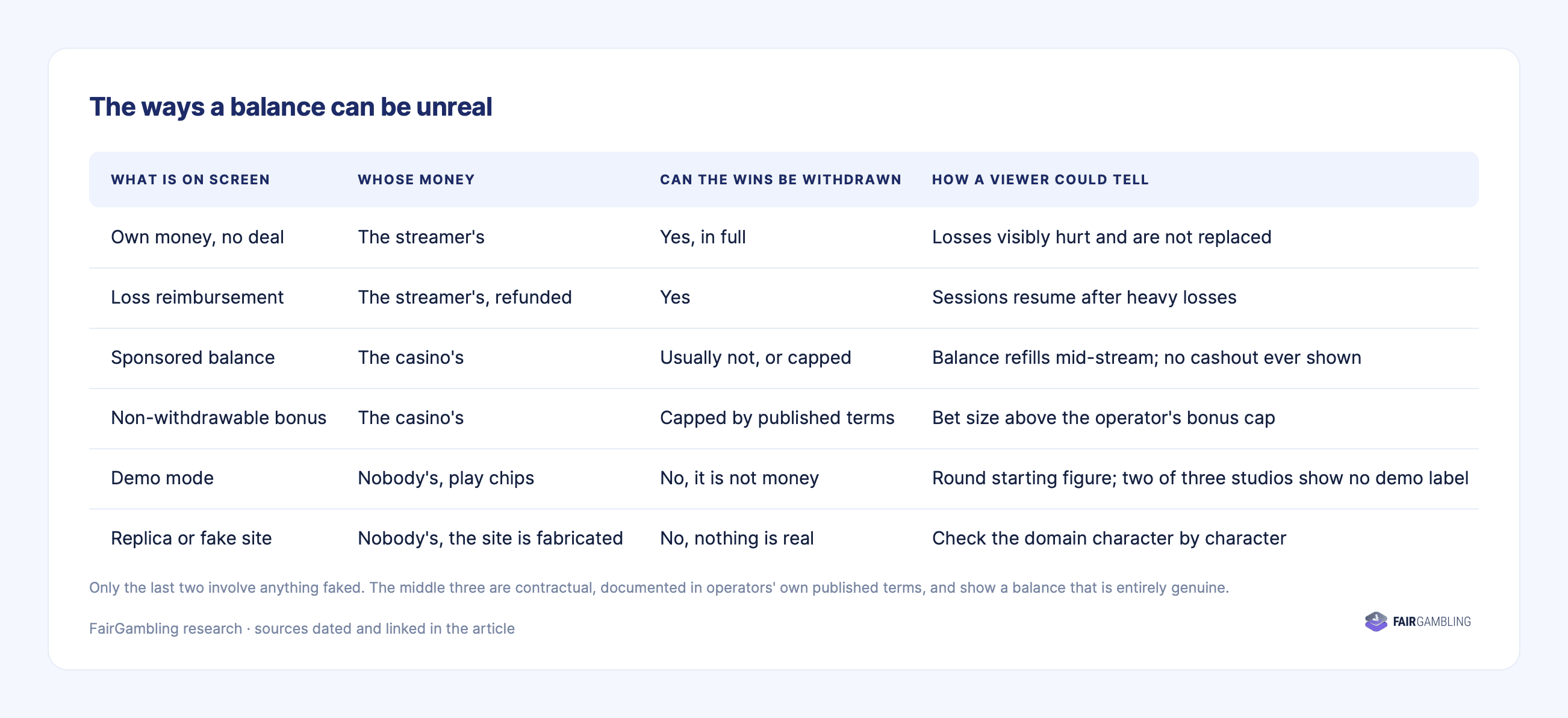
The most popular theory is that a streamer showing an implausible balance faked the number, typing over it with the browser's inspect tool or covering it with a broadcast overlay.
We found a two-minute demo reel for a Stake "larp system": forged withdrawals, deposits and bet history inside a live-looking casino interface. About 33,000 views. A Stake-partnered streamer complained in April that "fake balance & tampermonkey script gamblers" had left viewers unable to tell what was real, naming the scripting tool used to paint overlays onto a page.
This is more nefarious than a simple one-off prank; it's an enabler of widespread deception.
What we could not find is a named streamer caught using one. The tooling is sold openly; the catches are not documented. But there is a duller reason forgery may matter less than it appears: nobody needs to forge a balance when an operator might issue a real one that cannot be withdrawn.
The mechanism sits in operators' own published terms. Casinos issue bonuses which are not real cash, and may be adjusted, canceled, or allowed to expire if conditions are not met. Many cap withdrawals from no-deposit bonus play at 50 EUR. A screen can carry a five-figure number that is entirely accurate and still not be money in the sense a viewer would understand.
Demo mode, the other common suspicion, cannot reach a real wallet on the standard setup. Casinos typically rent their slots from game studios and plug them in through middlemen called aggregators. Some publish their specifications openly and display numbers that look real.
The Streamers Have Been Describing It for Years
Some of it is stated openly. A July 2026 breakdown of the Kick streamer Clavicular's income, watched about 134,000 times, put his gambling sponsorship above $15,000 a day, though nothing there says whose money he wagers.
The clearest account comes from one of the best-paid streamers.
In February 2022, Trainwreckstv said of his Stake arrangement, as reported by Inven Global: "I mix what I make and what I already have together, and I gamble raw."
Four years later, on April 1, 2026, having lost roughly 10 million dollars across two sessions, he posted something different: "This has to be the worst I've ever ran in my entire career. Pay is gone, it's all personal now."
Occasionally the terms surface. On Aug. 19, 2026 the streamer wuskin announced an exclusive Roobet deal and published a screenshot of the offer, saying he wanted people to "have an idea of how this gambling industry works." It garnered over 200,000 views.
The terms, attributed to a Roobet staff account, list a "Fill Amount per stream" of $6,000, a "Maximum Withdrawal per 30 streams" of $200,000, a 10% wager commission and a monthly leaderboard contribution, against 30 streams a month at 90 minutes each.
Two things matter. The operator supplies the stake, and it is called a fill, the same word former employees of Stake's parent company used describing these arrangements to Bloomberg in February 2026. And what comes out is capped, so a large win on screen does not become a large withdrawal.
Trainwreck's remarks describe a sequence: sponsorship money is gambled first; personal money is what is used after it runs out. They do not establish a restricted balance. A casino that pays a fee the streamer then wagers has given him money he can genuinely lose. A casino that credits an account he cannot withdraw from has not. Both get called playing with casino money. But the second is closer to theater.
Trainwreck has also described the mechanism while accusing a competitor. In October 2024, he pointed at the studio Nolimit City, which publishes a global leaderboard of large wins across every operator using its games.
"None of his wins are recorded, which means he has some sort of promotional account and all the providers that work with Stake are on some sort of promotional interface deal [...] Certain individuals still deny they're on fake balance."
His own wins of $20 million and $7 million appeared on that leaderboard. Another streamer's claimed $24 million did not. The check is useful because the leaderboard is maintained by the game supplier rather than the casino, but Nolimit City does not publish what qualifies for it.
One Streamer Says He Was Told to Call It His Own Money
On Aug. 20, 2025, the US slot streamer Mr. Hand Pay published a video playing back what he says is a recorded call with Sweepstakes casino representatives. By his account, he was offered millions on condition he not use his own money and tell his audience it was his. He says he refused.
No contract has ever been produced, and we could not find a response from the named operators.
Most of the Public Accusations Have Not Held Up
Anyone writing about this owes readers the cases that collapsed, and there are more of those than cases that stood. Of the incidents we could date and source, one was answered outright, two remain contested on evidence no better than demeanor or a six-follower account, and few were ever tested by a regulator or a court.
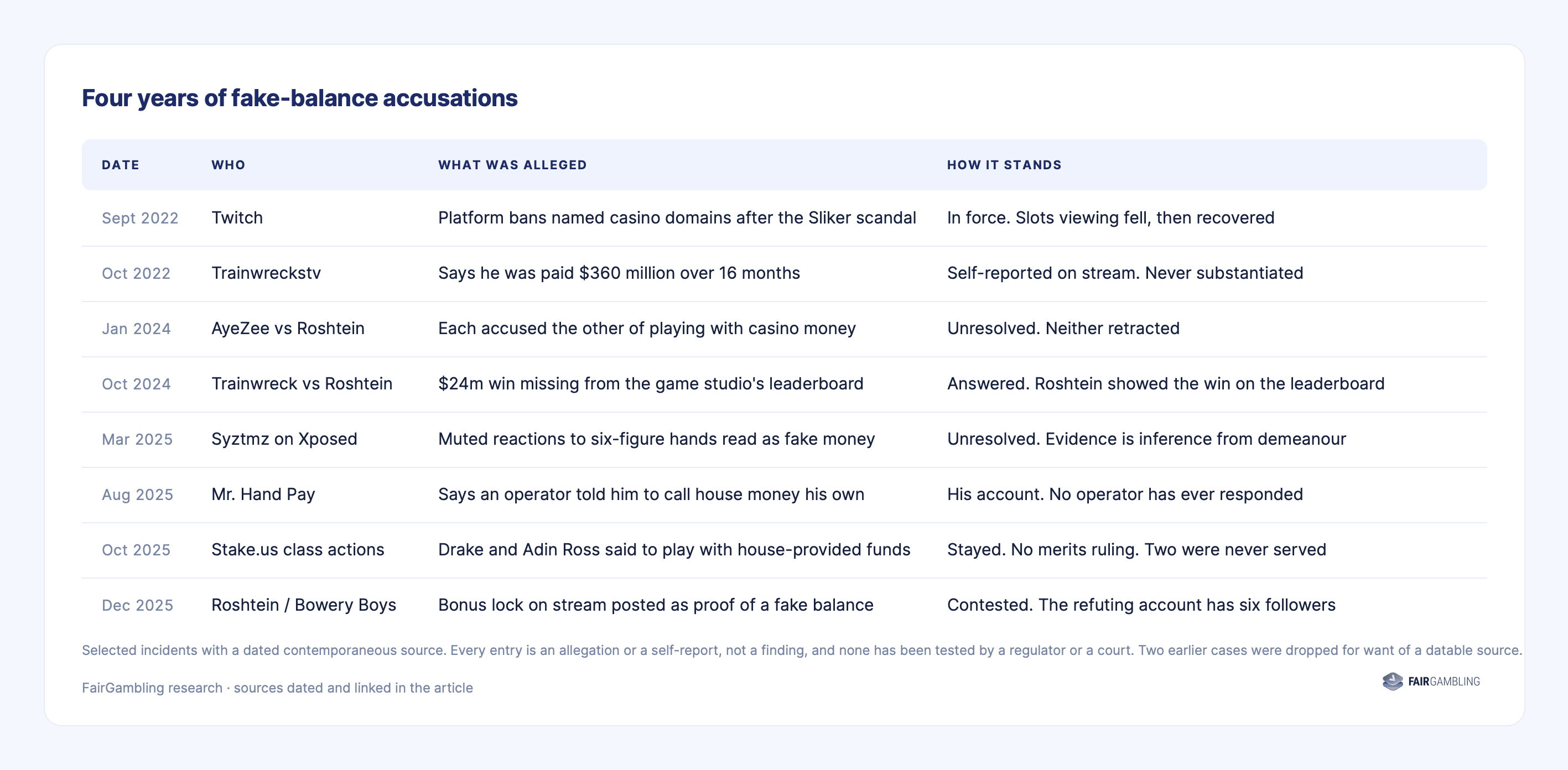
In late November 2025, a clip spread showing streamer Roshtein blocked from placing a real-money bet, posted as proof of a fake balance. Another user replied that a six-hundred-dollar prize had triggered a matching wagering requirement, making it a bonus lock working as designed. That reply is widely repeated as a debunking, which it should not be: the account has six followers, and the original accuser is a competing streamer whose bio advertises "REAL RAW MONEY gambling."
The Enforcement Record Is Almost Empty
We found no enforcement action, in any jurisdiction or database we searched, in which a casino streamer was penalized specifically for gambling with operator-supplied funds while presenting it as their own money.
That is not for want of applicable law. The FTC's Endorsement Guides require endorsements to "reflect the honest opinions, findings, beliefs, or experience of the endorser," make an endorser liable for "falsely represent[ing] that they personally used a product," and require a disclosed connection to "clearly communicate the nature of the connection sufficiently for consumers to evaluate its significance."
A hashtag with an "ad" disclosure tells an audience the stream is sponsored. It does not tell them the stake is not the streamer's.
The Commission came close once, nine years ago. Its 2017 complaint against CSGOLotto and the streamers Trevor Martin and Thomas Cassell alleged they failed to disclose both their ownership of the site and, separately, "that they were gambling with free skins provided by that company." It settled by consent order, with no admission of liability and no finding of wrongdoing.
Even so, the complaint treated sponsor-supplied stakes as a material fact distinct from the sponsorship, the closest any regulator has come.
The settled consent order contains no civil penalty, no redress and no fund confiscation. It remains one of the only enforcement actions against a gambling influencer in the agency's history.
The platforms do not fill the gap. Twitch bans a named list of casino domains and requires branded-content disclosure, though its guidelines never use the word "disclose." Kick has the more prescriptive sponsorship rules, but its only rule on whose money is at stake bans gambling with funds "provided by other users," meaning viewer buy-ins. Funds from the casino go unmentioned.
Regulators elsewhere have written rules about influencers and enforced them against companies. Germany fined the rapper Capital Bra 250,000 EUR in April 2026 and Australia issued its first influencer enforcement in July 2026, a warning with no fine, both for promoting unlicensed operators. Ontario went differently, restricting licensed operators from using "social media influencers" likely to appeal to minors, with no penalty announced under it. None of the three concerns misrepresenting whose money was at stake.
Massachusetts regulation 205 CMR 256.09(2) requires that an individual gambling under a promotional agreement with a sports wagering operator "must disclose the relationship and may not be compensated in promotional credits for additional wagers."
It applies only to sports wagering in Massachusetts and bites the licensed operator rather than the individual. An offshore crypto casino sits outside it entirely: the rule exists where there is a license to threaten, and the streamers here mostly promote operators with no state licenses at all.
Four US class actions plead the house-money allegation directly. The First Amended Complaint in Ridley v. Sweepsteaks Ltd., filed in the Eastern District of Virginia on Feb. 24, 2026, alleges Drake and Adin Ross "purported to be gambling with their own Stake Cash, creating the false impression that they were risking their personal funds just like ordinary users," when they "were in fact using house-provided funds."
On July 30, 2026 Judge Leonie Brinkema compelled arbitration and stayed the case; the opinion never touches the house-money claim, and a footnote records that, on the court's reading of the docket, Drake, Ross and a third defendant still appeared not to have been served seven months after the case was filed.
The basis for the same allegation in the Missouri complaint, one of the four, is openly hedged, saying Stake "apparently" fronts the pair house money, footnoted to media commentary rather than documents.
The Size of Fake Cash Streaming
A 2024 report for the New South Wales government calls the non-live gambling video space "essentially unstudied," and the industry behaves as though the premise is true.
We track 296 gambling streamers and assess each as playing with their own money or the casino's. Joining that to thirty days of audience data produces the measurement.
One thing before the numbers: our classification does not establish that a streamer bears no risk. It captures several arrangements at once, from a cash fee he genuinely stands to lose to a balance he can never withdraw, and we cannot always tell which applies. What follows is an association with casino funding, not with risk-free play.
Twenty-nine of the 296, or 9.8%, are assessed as playing with casino money. They accounted for 15.56 million hours watched, or 33.7% of the total. Their combined estimated pay is $10.8 million a month, or 6.9% of the $146.5 million we estimate flows to tracked streamers.
One in ten streamers draws a third of the attention in our sample on seven percent of its estimated cash pay.
As a rate, that is about $648 per thousand hours watched against $4,458 for streamers assessed as risking their own money.
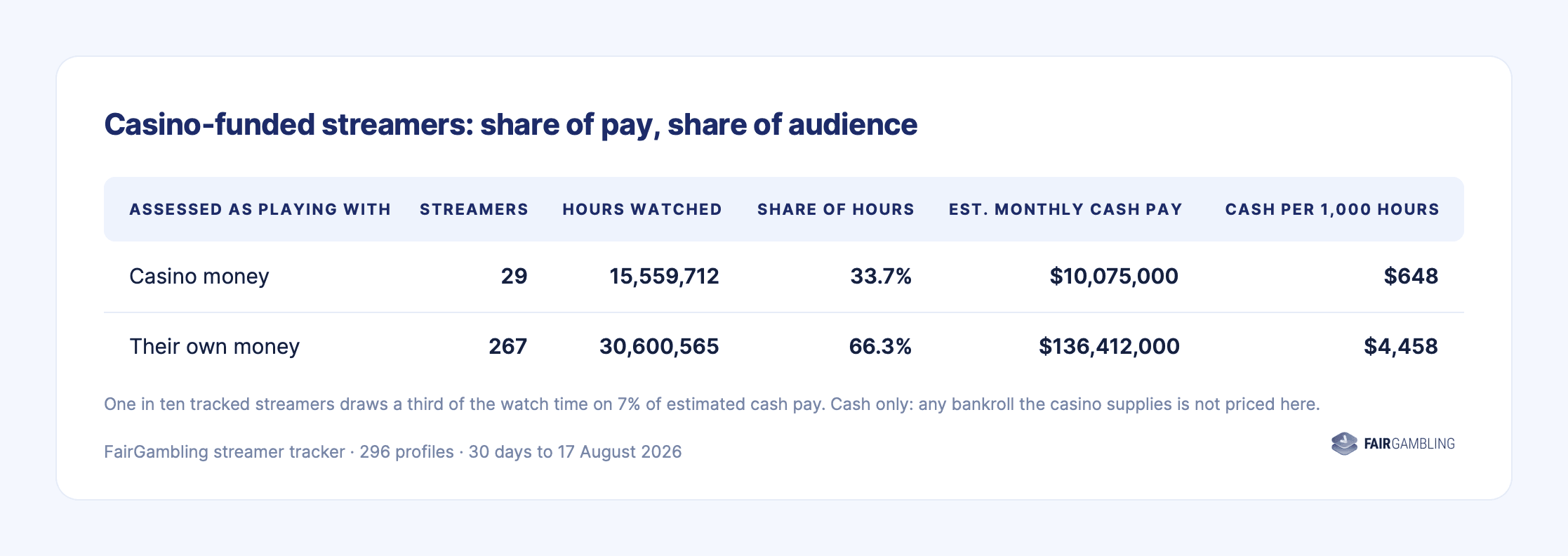
Two caveats. First, we counted cash only. A casino-supplied bankroll is worth money too, and by definition only the casino-funded streamers get one; so their pay is understated and the real gap is smaller than $648 vs $4,458 suggests. Second, this compares two groups of streamers. It doesn't show that the funding arrangement is what pulls the audience.
Casinos do not assign these terms at random, and may offer bankrolls to streamers already good at holding an audience, in which case the arrangement follows the attention rather than producing it.
The obvious objection is that "casino-funded" is simply a proxy for "famous." Size is part of it, not all of it. Within follower bands, the casino-funded group draws roughly double the watch time of same-sized peers in every band above ten thousand followers.
A regression across all 296 profiles says the same thing. Unadjusted, the casino-funded group draws 6.67 times the watch time. Controlling for follower count, it falls to 2.05 times. Adding days streamed, degen level, facecam and broadcast language leaves it at roughly 2 times.
Run against average concurrent viewers instead, the same models show that casino-funded streamers aren't just broadcasting for longer: at any given moment, more people are watching.
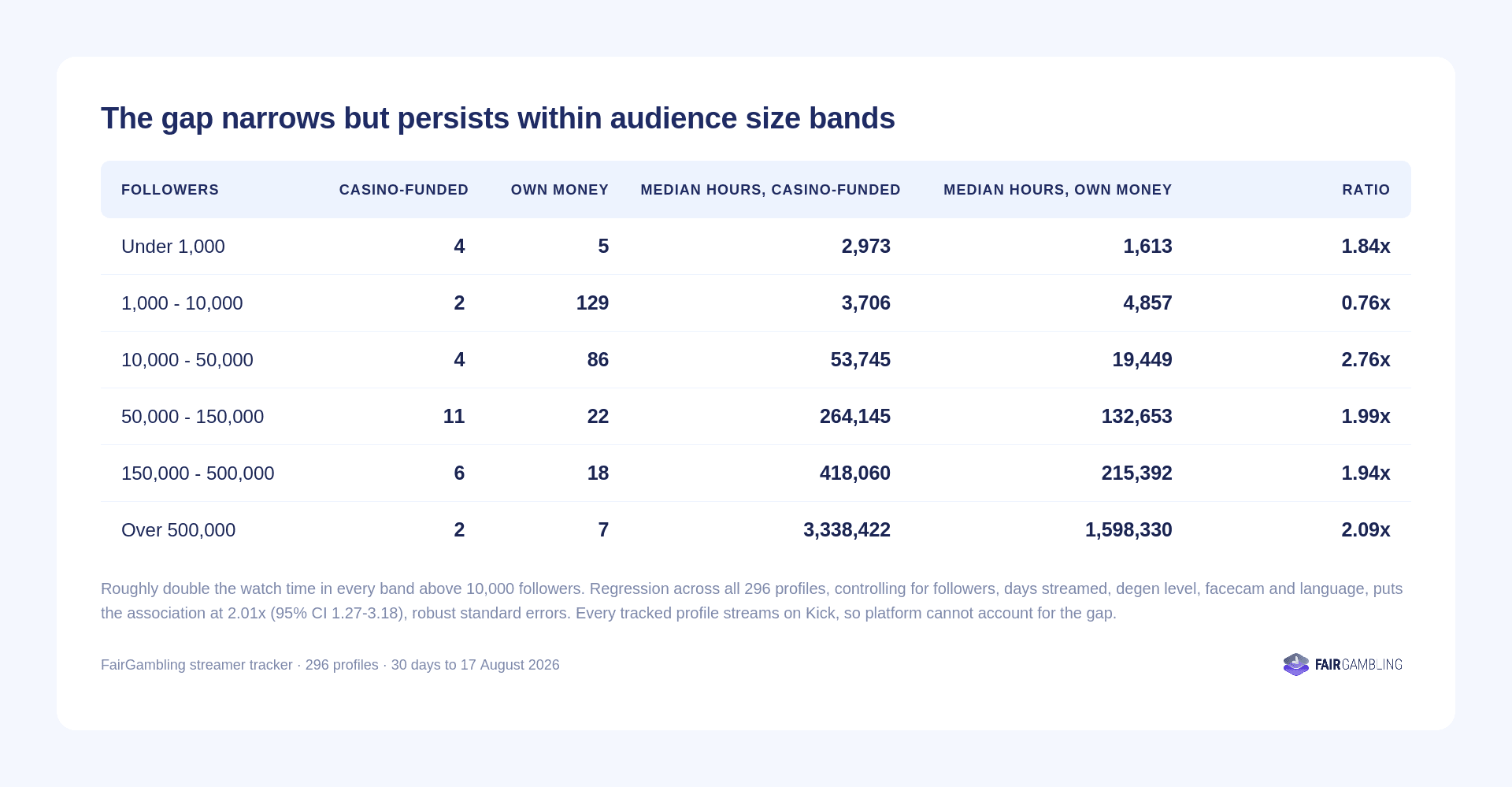
Two further limits. The largest single account supplies 41.5% of the group's hours, and removing it drops the share of watch time from 33.7% to 22.9% while moving the rate from $648 to $1,063 against $4,458 for the own money group, so the gap falls from roughly sevenfold to fourfold without closing.
The classification is our editorial assessment, drawing on disclosed sponsorships, streamers' own statements and observed balance behavior.
If visible spectacle or balances that appear to refill help lead us to classify someone as casino-funded, and those same qualities draw viewers, the classification partly encodes the outcome we are measuring. The gap shrinks when we control for size and activity, but it does not disappear completely, so circular classification cannot be the whole explanation.
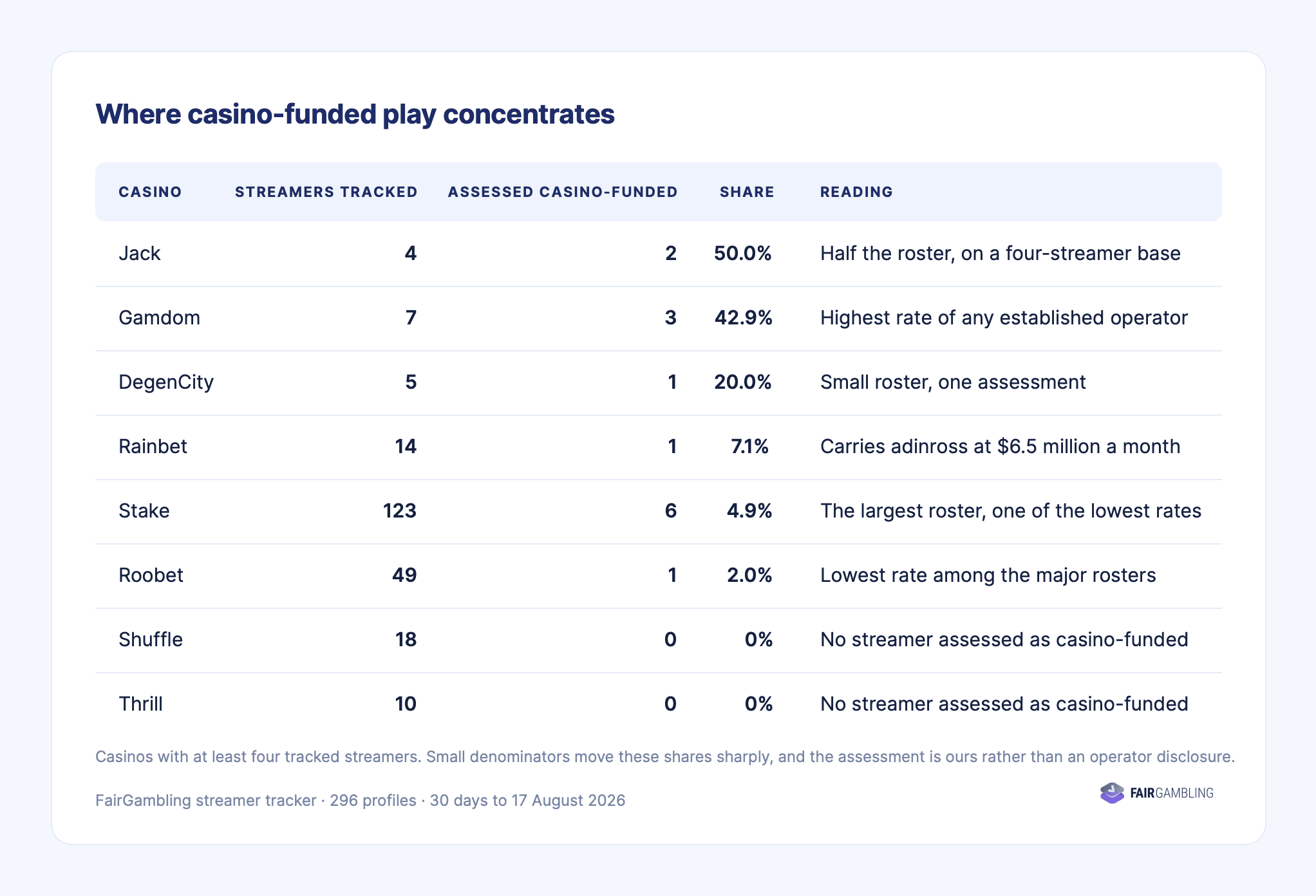
The operator with by far the largest roster we track has one of the lowest rates of casino-funded streamers. Stake rejects the fake-money claim: co-founder Ed Craven has written publicly that streamers and celebrities on the site make real bets with real money, and that Stake pays promoters but does not direct what they wager.
Why the rate should fall as the roster grows, we cannot say from these numbers. Larger operators face more legal and reputational exposure; smaller ones may need spectacle to break through. Both are guesses.
Stake separately denied giving influencers preferential odds after Bloomberg's February 2026 investigation, disputing its methodology.
Related: When the Bets Themselves Were Simulated
In an adjacent regulated market, the bets themselves turned out not to exist.
In June 2026, the Wall Street Journal reported that the prediction market Polymarket paid mostly college-age creators to film themselves winning on replica copies of its own website, one using the domain poiymarket(.)com, an i for the l. Across 1,105 videos, roughly $1.9 million in wagers appeared on screen and none were real.
In 118 videos celebrating about $900,000 of winnings, the same positions on the live platform would have lost more than $166,000. The videos reached over 140 million views, and creators were paid $2,000 to $3,000 a month and told not to disclose it.
Polymarket said it would audit its promotional content and has not denied the findings. A casino streamer on a supplied bankroll places real bets with someone else's money; Polymarket's creators, on the Journal's account, were not betting at all.
Both share a similar outcome: exposure, a promise to review, no penalty so far.
What It Does to the People Watching
- A 2024 study of 1,472 Flemish adolescents found watching gambling streams significantly predicted gambling with real money, though it cannot establish direction.
- A 2024 study of stream viewers found higher problem-gambling severity and stronger cravings than among gamblers who do not watch, with those most stimulated by high-stakes bets and jackpot wins reporting the strongest cravings.
- Britain's Gambling Commission found 42% of 3,666 pupils aged 11 to 17 saw gambling advertising on livestreaming or video platforms.
It is often said that a streamer sweats a small real bet and shows nothing while losing life-changing sums, and that the difference reveals whose money it is. Viewers claim this is the most reliable tell.
On Aug. 12, 2026 an account posted a clip of Clavicular reacting to a purported billion-dollar win on the casino Duel with almost no visible response, captioned as a fake balance.
Laboratory work shows a personal stake drives gambling arousal, and that playing for worthless credits is less stimulating. But nobody has measured whether arousal scales with your own stake, nobody has studied a streamer as a subject, and the one experiment that put gamblers before an audience found they bet smaller.
How to End the Guessing
Everything above rests on assessment rather than disclosure, including ours. That is the actual problem.
There is no standard way for a gambling stream to state the economic nature of the balance on screen. So viewers infer and journalists estimate.
A disclosure standard would need seven categories at minimum: personal funds, cash sponsorship the streamer then wagers, loss reimbursement, a restricted promotional balance, capped withdrawals, mixed funds, and larp overlay bots. A viewer watching a large number move on screen cannot currently tell which one they are looking at.
Until something changes, the honest position is that twenty-nine streamers we track draw a third of the audience in this business, and whether the money they appear to risk is theirs can be assessed but not verified by us or by anyone watching.
Treat gambling as entertainment you pay for. 18+, and if it stops feeling like entertainment, help exists at BeGambleAware and GamCare.
Read more
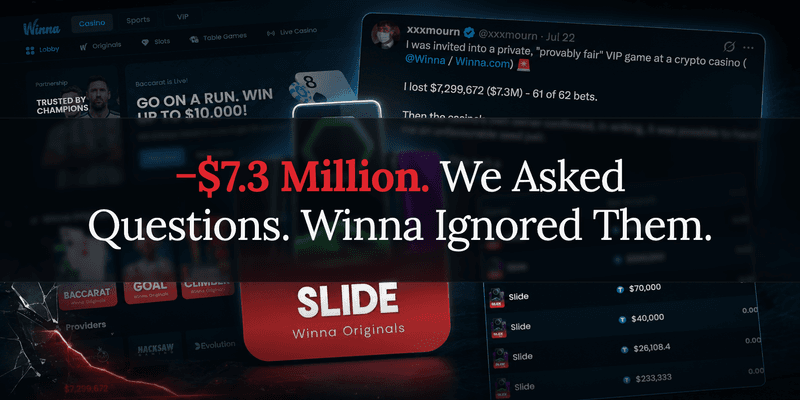
The $10M Gap in Winna's Slide Record
Legal Sports Betting Was Supposed to Kill the Black Market. It's Losing