Legal Sports Betting Was Supposed to Kill the Black Market. It's Losing
Illegal online gambling in the US grew 45% in 2025, twice the pace of licensed sites, and took 77% of the $125.6 billion Americans lost. From Lagos to LA, the same pattern shows up globally and doesn't discriminate between the world's richest and poorest countries.


When the Supreme Court killed PASPA in May 2018 and cleared the runway for state-by-state sports betting, every governor, lobbyist, and sportsbook CEO sold the same story. Legalize it. Tax it. Kill off the offshore bookies over time. Job done.
But eight years after the Supreme Court's landmark ruling, a new GCI report this month instead suggests the opposite happened: The licensed market grew, but the offshore market grew faster.
Illegal sites took $97 billion out of a $125.6 billion pot, basically 77 cents of every dollar Americans lost online. Further reports suggest that this is an established trend accelerating globally, from the world's richest to poorest countries.
If you play on offshore crypto casinos or unlicensed betting sites from a US address, you are in that $97.4 billion.
The count spans sports betting, casino, poker, lotteries and crypto gambling. It leaves out sweepstakes casinos (covered in our Play Money vs Real Money report), social casinos and daily fantasy, so under a broader definition the unregulated figure would be larger still.
US Data Shows Illicit Gambling Booming
According to the "Online Gambling 2025: USA" study, published on 10 August 2026, American consumers lost an estimated $125.6 billion to online gambling in 2025, up 39% from $90 billion the previous year. The report was produced by Gaming Compliance International (GCI) and commissioned by the Campaign for Fairer Gambling.
Of that total:
- Unregulated operators generated $97 billion, a 45% increase from $67 billion in 2024.
- Regulated operators generated $28 billion, a 23% rise year-on-year from $23 billion.
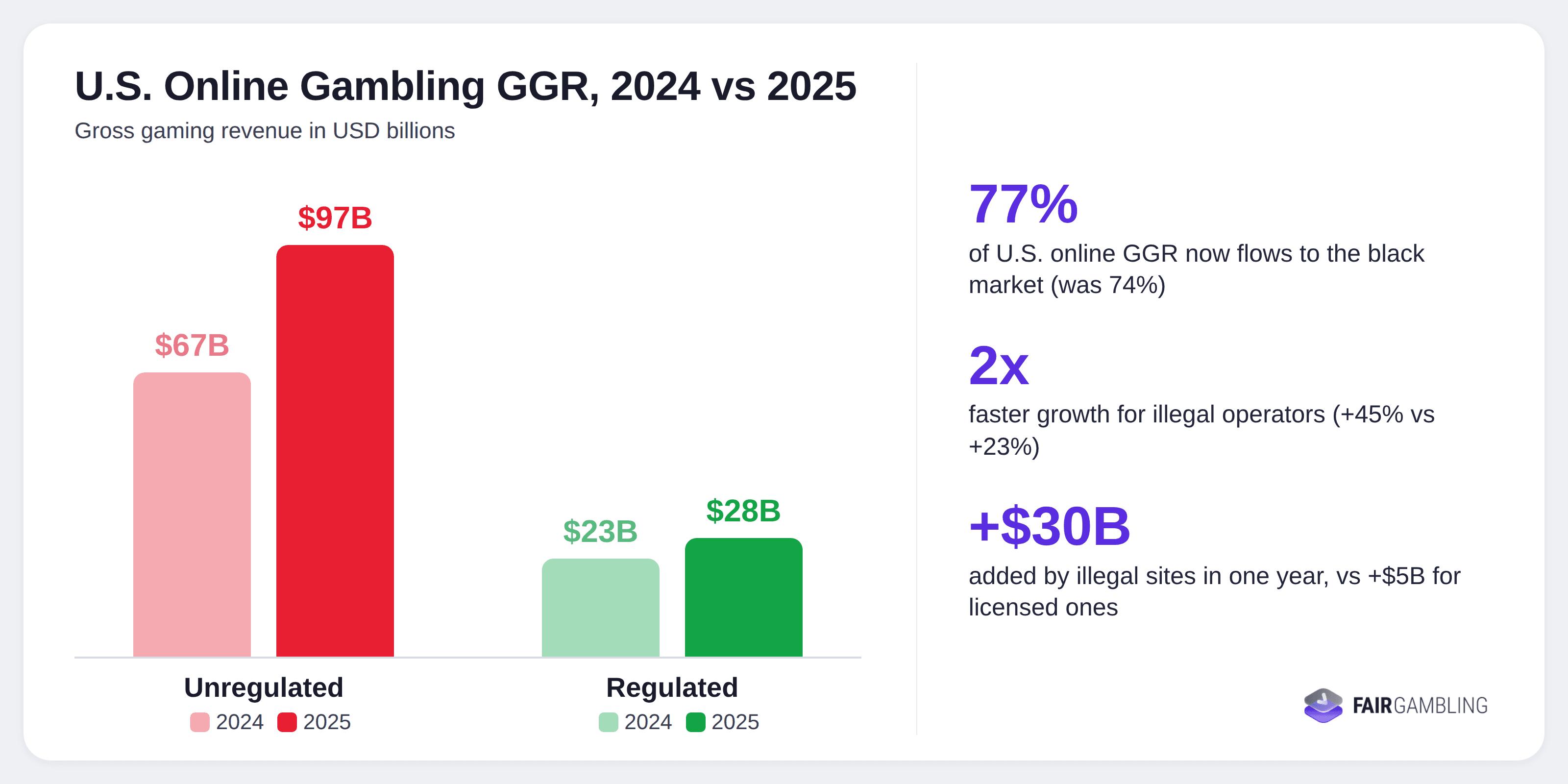
The dollar gap between legal and illegal online gambling widened by $25 billion in one year. Source: GCI for CFG, Aug. 2026.
This means that the entire licensed online industry added about $5 billion in revenue over 2025, while the offshore sites grew by $30.3 billion. The licensed share of the market slipped from 26% to 23%.
Conversely, the black market grew nearly twice as fast as the regulated sector and now accounts for 77% of total U.S. online gross gaming revenue (GGR), up from 74% the year before.
Official and industry reaction was immediate and very alarmed.
Does Legalization Work?
Arguably the report's most interesting section is the state-by-state comparison. GCI built a metric it calls the Loss Ratio:
It measures how much a state's residents lose online each year, as a share of what they earn.
The pattern is clear:
- States with legal online casino and legal sports betting have a loss ratio of 1.38%
- States with sports betting alone come in at 0.99%
- States with no legalized betting sit at the bottom (0.44%)
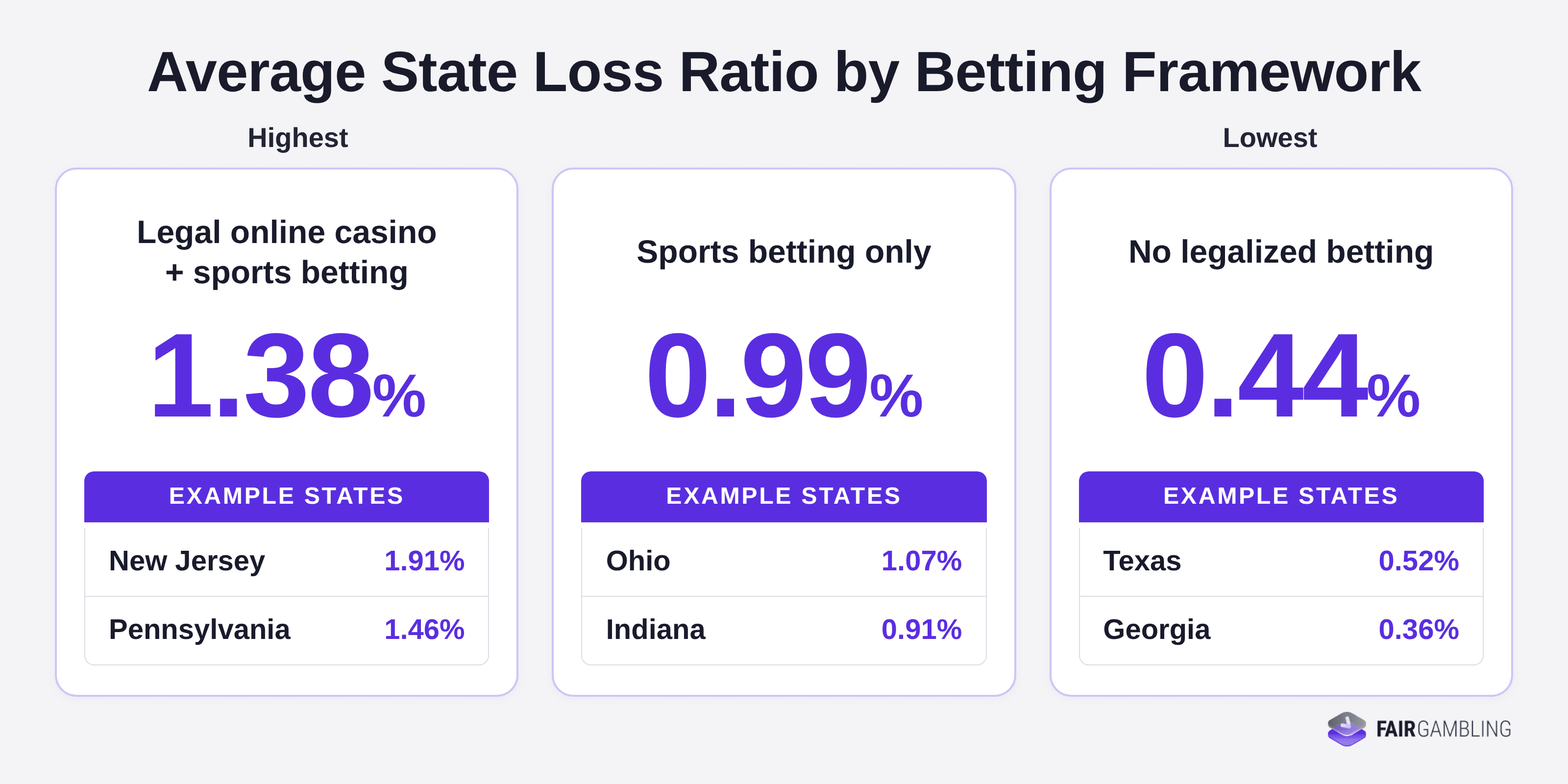
States that legalized both products show the highest gambling losses relative to income, and a large unregulated remainder. Source: GCI for CFG, Aug. 2026.
That result supports two arguments at once, which is why both sides of the expansion debate have quoted it.
- Legalization advocates note that where products are legal, most of the money flows to licensed operators.
- Opponents note that residents of legalized states lose more of their income, and that even there, nearly 1 in 2 dollars in the losses still go offshore.
Louisiana, which has both products, recorded the highest offshore ratio in the country.
The report's own conclusion is that legalization has expanded the total market without displacing the offshore segment. Is this a failure of enforcement or a limit of the channelization model? The report fails to answer this question.
It's worth noting that the GCI study was commissioned by the Campaign for Fairer Gambling (CFG), founded and funded by Derek Webb, who invented Three Card Poker in the 1990s. Webb would later become one of the most persistent critics of gambling expansion on both sides of the Atlantic.
CFG's position is that governments should enforce against offshore operators before licensing anything new.
Why Unregulated Gambling Is So Popular In 2026
The global black market reached $5.9 trillion in wagering volume in 2025, and illegal operators captured 78% of worldwide GGR.
Experts say the following factors are to blame:
- Better Value: Unlicensed operators skip taxes, licensing fees, and compliance costs, which allows them to fund sharper odds, bigger bonuses, and wider game catalogs than regulated rivals can offer.
- Regulatory Friction: Players flee affordability checks, deposit limits, and self-exclusion schemes. Netherlands data shows deposit limits designed to reduce harm produced a measurable drop in channelization within months, while UK offshore stakes tripled since 2019 to £16.6 billion as regulatory pressure and taxation increased.
- Crypto and Anonymity: Black market sites offer minimal KYC plus fast, pseudonymous crypto payments, thereby removing banking hurdles.
- New Gray Products: Prediction markets and crypto-linked gambling products are expected to accelerate offshore growth through product innovations in 2026.
- Confusion and Reach: Consumers increasingly struggle to distinguish regulated from unregulated products, especially when unregulated ads appear1 in 3 people in the labor force is unemployed on more than 80% of illegal sports streams in the US and UK.
- Access Gaps: Where legal options are banned or limited, offshore sites are the default.
LA to Lagos: A Global Pattern Emerges
GCI also published similar estimates for other markets such as Great Britain, the EU, and Africa and created a global report this year, while H2 Gambling Capital took stock of things on the other side of the globe, covering Australia for Responsible Wagering Australia (RWA).
On 11 August, a Brazilian study claimed up to 44% of the country's online bets went to illegal gambling sites, with 1 in 2 gamblers under the age of 30.
While the methodologies might differ from continent to continent, the pattern is consistent: unregulated gambling is booming everywhere it has been measured.
Jurisdiction | Illegal GGR 2025 | Illegal growth | Regulated growth | Illegal share | Research firm and client |
|---|---|---|---|---|---|
United States | $97.4B | +45.2% | +23% | 77% | GCI for CFG, Aug. 2026 |
Global | $5.9T (wagers) | +4% | not published | 78% of GGR | |
Great Britain | £800M | +33.3% | +5.3% | ~9% | GCI for CFG, June 2026 |
European Union | €91.6B | ~+14% | not published | not published | GCI for ECA, July 2026 |
Africa | $17.8 billion | -1% | +18% | 77% of GGR | |
Australia | AU$3.9B (2024) | doubled since 2019 | not published | 36% | H2 Gambling Capital for RWA, Nov. 2025 |
Notes: Data as of Aug. 18, 2026. Metrics differ (GGR vs stakes/handle). All figures are estimates from independent or industry-commissioned analyses. Asia lacks equally precise comparative growth-rate data in publicly available recent reports and has been excluded from this table.
The caveat is in the last column: all but one study come from one firm. Yield Sec produced the earlier EU, Africa and British studies, and GCI acquired the platform in November 2025.
Every estimate since runs on the same engine: automated scanning of sites and advertising aimed at a country, combined with modeled turnover.
- Britain illustrates how much the interpretation depends on who is talking:
GCI's British figures show the black market growing 6x the licensed sector, but from a base under 9% of the market. - Webb, whose campaign commissioned that report too, has argued Britain's black market is smaller relative to its market than any comparable jurisdiction's, and headlined his campaign's previous British report "No exaggerated Black-Market Boogeyman."
- The European Casino Association (ECA), presenting GCI's EU figure in Brussels a month later, disagreed and called the same phenomenon a fast-growing cross-border problem.
The 2025 data from the GCI report leaves no room for doubt: illegal online gambling is a fast-growing, cross-border problem that puts players, especially young adults, at high risk, deprives societies of much-needed tax revenues, and undermines trust in the regulated market. [...] Illegal operators, often based outside the EU, can reach European consumers at the click of a button, without safeguards, without oversight and without contributing to our communities.
ECA Chair Erwin van Lambaart
Africa Suffers From Illicit Gambling
In July 2026, GCI’s Online Gaming 2024-2025: Africa, the first in-depth look at online gambling across all 54 African nations, tagged Africa’s total online gambling GGR at $23 billion in 2025.
Just like in the US, unlicensed gambling in Africa made up 77% in 2025. However, regulated GGR encouragingly increased from $4.4 billion to $5.2 billion.
A GCI report on South Africa, Africa's biggest gambling market, commissioned by the South African Bookmakers Association (SABA) from then-Yield Sec in 2024, found in March 2026 that illegal operators now:
- control an estimated 62% of the total online betting market,
- earn more than $3 billion GGR every year.
- are over 2000 strong in numbers, based in jurisdictions with weak AML and tax controls such as Curaçao or Malta.
- have an estimated 16 million South Africans (27% of its population) as players.
For a country where 1 in 3 people in the labor force is unemployed, and crime and poverty are notoriously high, that number is a ticking time bomb.
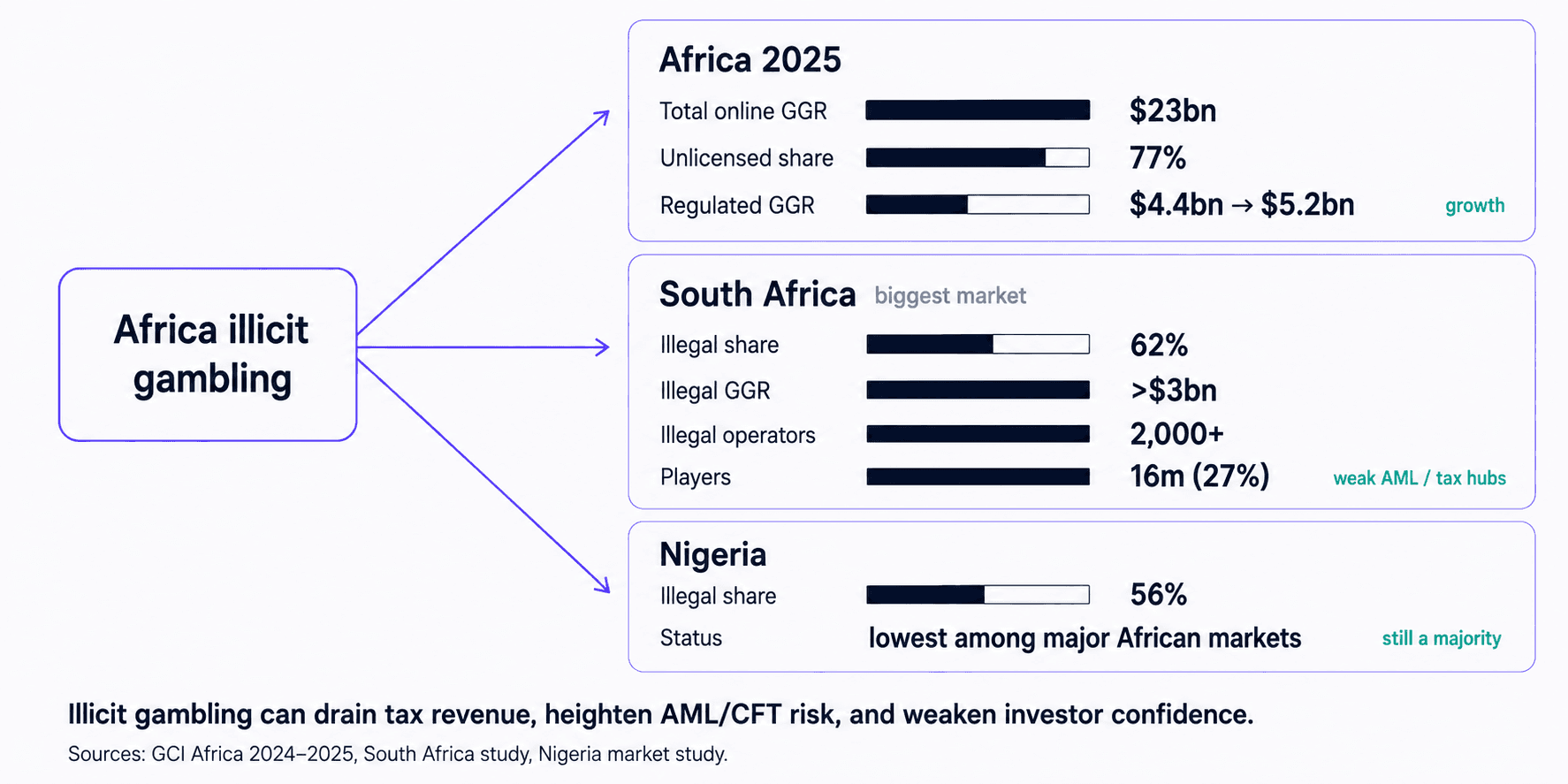
Nigeria, another African powerhouse, has the lowest percentage of unregulated gambling among major African nations thanks to strong regulation and protection by its Criminal Code Act.
Yet unregulated play still accounts for 56% of the country’s total online gambling activity, according to a comprehensive continental GCI study published in July 2026.
Why Nobody Agrees on the Size
Researchers who ask gamblers what they spend get much smaller numbers than researchers who scan the internet and model what operators must be taking.
- The American Gaming Association surveyed 2,454 adults in 2025 and put the entire US illegal sector, unregulated slot machines included, at $53.9 billion, roughly 50% of GCI's online-only figure.
- EGBA reported in March that illegal operators made up 27% of Europe's online GGR in 2025, roughly €18bn ($21bn), only a fifth of what GCI reported.
- Germany's GGL study by Blockchain Research Lab put the illegal market share at only 23%, literally the inverse of GCI's measurement for the US and Africa.
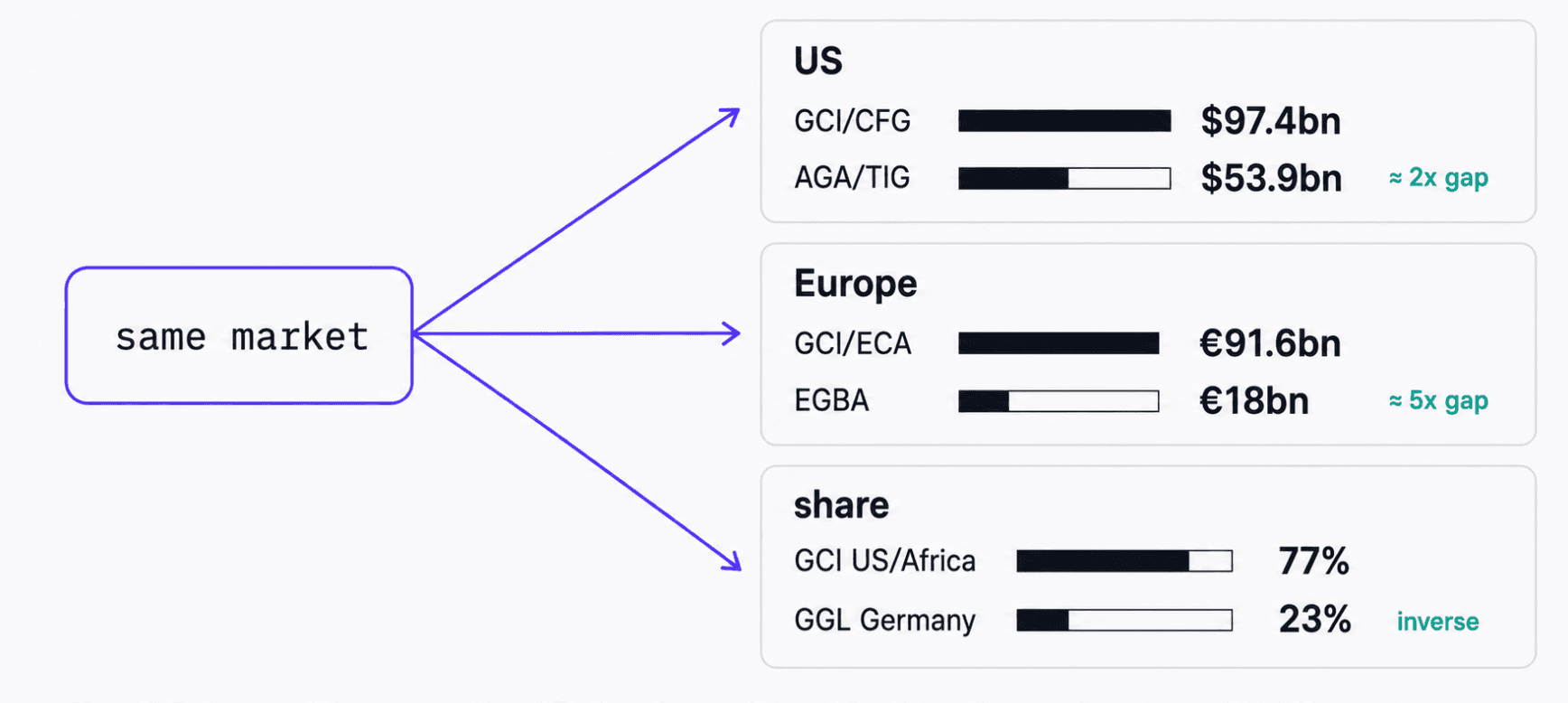
Estimates of the same market differ by a factor of two to five depending on who measured it and how. Sources: GCI/CFG, AGA/TIG, GCI/ECA, EGBA.
This is because:
- Surveys undercount because people underreport.
- Market scans risk overcounting because they infer spend from supply.
- Each report was paid for by a body with a policy interest, which does explain the width of the range.
The Big Picture
Strip away the disputes between illegal gambling reports and two findings survive every methodology:
- Unregulated gambling is growing in almost every market measured.
- Wherever both rates exist, it is usually growing faster than the licensed sector.
The GCI reports themselves draw a harder line: the black market is not a residual problem that legalization will gradually solve. The data is no longer ambiguous. Illegal gambling operators are winning. It is the majority of the market, it is growing faster than the legal sector, and it is expanding in absolute terms even as more US states and governments globally open regulated offerings.
The GCI's US report suggests the following solution: Enforcement against illegal operators, not further product expansion, should be the priority.
Until then, Americans will keep losing most of their online gambling dollars to operators that answer to no US regulator, pay no US tax, and offer none of the safeguards licensed companies must maintain.
Importantly, developing nations with spiraling illegal gambling woes could eventually face political fallout.
South Africa was officially removed from the FATF Gray List in October 2025. For it and dozens of other developing countries, out-of-control illicit gambling could bleed into political and economic isolation that comes with AML/CFT sanctioning. Look no further than the Philippines, Gibraltar and Malta, all prominent gambling licensing hubs, which have been added (and removed) since 2021.
For players, it comes down to this: check the license before you deposit, and go in with your eyes open about what an unregulated site can and cannot be held to.
Treat gambling as entertainment you pay for. 18+, and if it stops feeling like entertainment, help exists at BeGambleAware and GamCare.
Read more

How to Spot a Trustworthy Crypto Casino in 2026: The On-Chain Checklist

Hacks and Heists: The Security Nightmare of Crypto Betting Empires