How to Spot a Trustworthy Crypto Casino in 2026: The On-Chain Checklist
Crypto casinos have made fairness provable and solvency invisible. The five on-chain checks worth running before you deposit anything in 2026.

· 9 min · 9 min read
Open any guide to picking a crypto casino and you'll find the same list. Provably fair. Licensed. Has a public wallet. Decent reviews.
The list is not wrong, but it is no longer useful, because many operators now pass it.
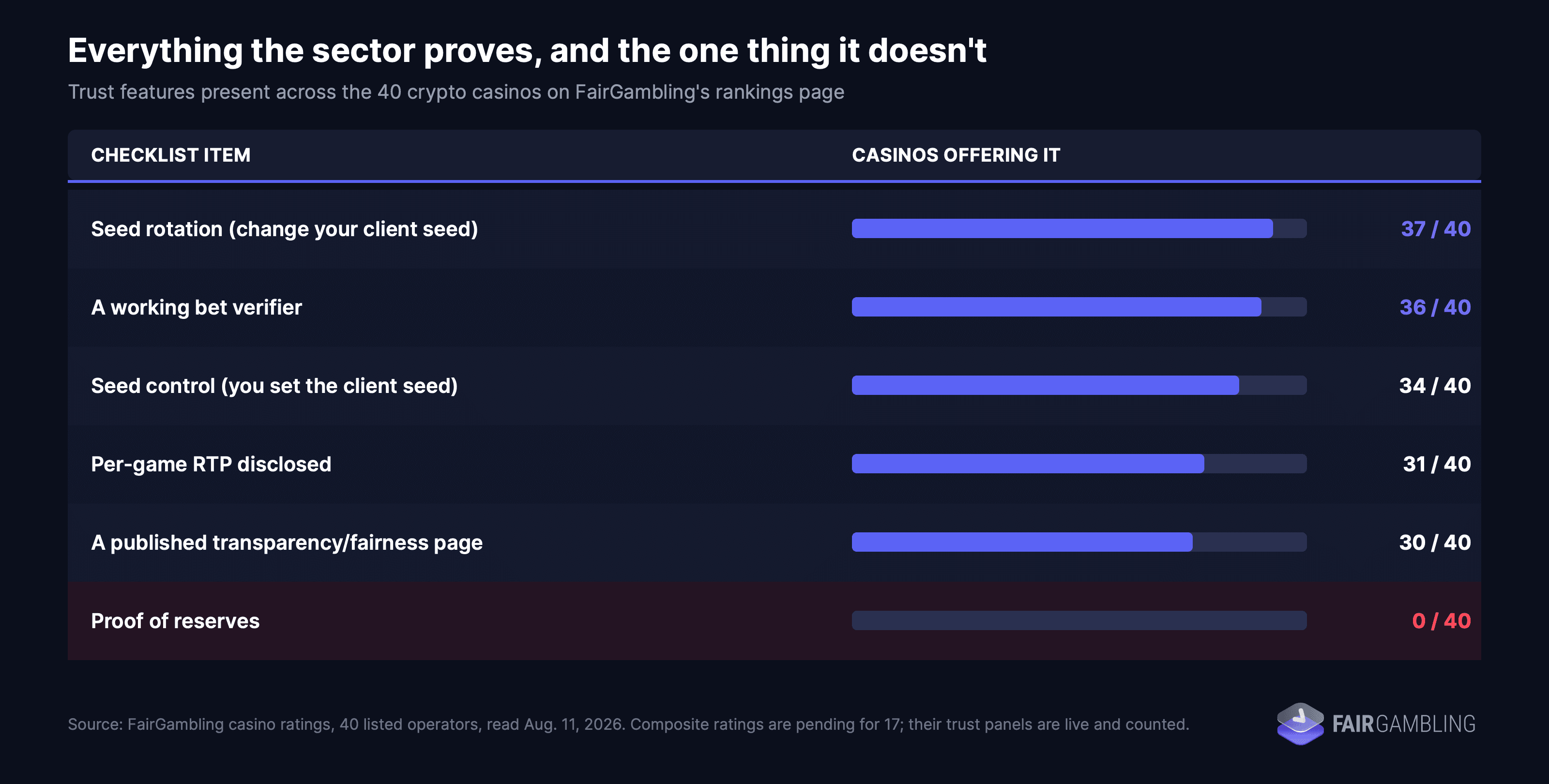
FairGambling's crypto casino rankings list 40 operators, and almost all of them clear the standard checklist. Seed rotation, a working bet verifier, seed control, a published fairness page: on every one, the count is in the thirties.
A checklist almost everyone passes is not a checklist, but a floor.
Check 1: Provably Fair Proves Less Than the Name Suggests
Provably fair is a commitment scheme: the casino locks in an answer before you play and hands you the key afterward. It publishes the hash of a server seed, you supply a client seed, and each bet carries a nonce, a counter that increments with every wager. Because the hash came first, the casino cannot change the server seed after seeing your bet.
The guarantee proves one thing: this bet's outcome was cryptographically locked in before you placed it. It says nothing about whether the game's real return matches the advertised figure, and nothing about whether the operator still has your balance.
And you cannot verify a bet while you are playing it: the unhashed server seed is only revealed when you rotate your seed pair, which closes out every bet before it. Verification is always retrospective, and most people don't actively perform it.
The feature is built to be seen, not used. Our provably fair verifier checks one bet in seconds; our seed analyzer replays a retired seed pair in one pass.
Winna, ranked third, faces a pending $7.3 million Provably Fair dispute on our complaints hub and has publicly promised a session-log breakdown.
In March 2026, certification firm ProvablyFair found Winna's Plinko used hardcoded probability tables for three months; Winna called it a "configuration error" and offered refunds. A July 2026 report judged a private "VIP Slide" build "not provably fair."
A full implementation and a seven-figure dispute are not contradictory. They measure different things.
Check 2: Hot Wallet Addresses and Balances
Casino hot wallet addresses are often sourced, derived, and sometimes published — they're the working accounts a casino pays out of, unlike cold storage held offline.
Our analytics carry labeled wallet balances for 35 of the 40 casinos we track, with balances across multiple chains. Derived addresses are half the story though, as an address attributed to a casino by an analytics platform is a lead, not proof.
Case in point: Arkham Intelligence had to publicly disown viral user-generated mislabels of supposed US government wallets in 2023.
A published address, when it's disclosed, gives you something concrete: you can watch payouts leave, see withdrawals slow before support admits it, and catch a wallet draining into a bridge at three in the morning.
What a hot wallet cannot tell you is how much the casino holds in total, or how much it owes.
Check 3: How It Behaved the Last Time It Lost Money
Every casino claims it is secure, and the practices behind the claim, like two-factor login, account alerts, and withdrawal confirmations, read near-identically across our casino cards.
But casino claims are unfortunately tested in public, every once in a while.
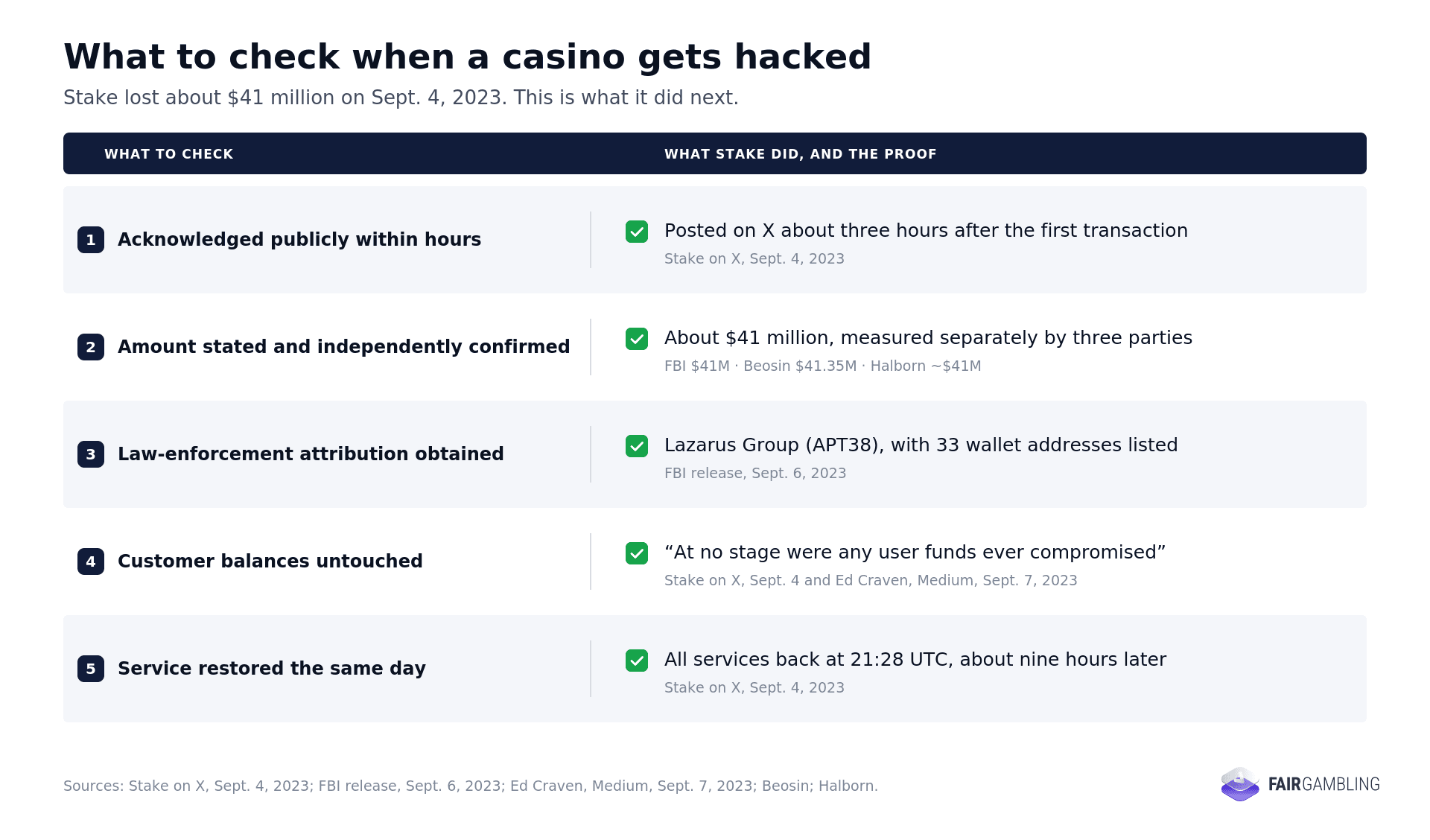
On Sept. 6, 2023, the FBI issued a release confirming the theft of "approximately $41 million in virtual currency" from Stake.com "on or about September 4, 2023," and attributing it to the Lazarus Group, also known as APT38, the DPRK state-linked hacking unit sanctioned by the US Treasury in 2019.
The first transfers left Stake's hot wallets at 12:48 UTC, per the rekt.news timeline: roughly $16 million on Ethereum, followed the same day by $25.6 million more across BSC and Polygon. No smart contract was involved.
"Private keys were not compromised, but the attacker was able to make several unauthorised transactions from our hot wallets," Stake Co-founder Ed Craven told DL News on Sept. 5, 2023. Days later, security firm Halborn assessed the most likely cause as compromised hot-wallet keys.
Then Stake did the thing that matters.
Stake suspended deposits and withdrawals on the affected chains, kept its Bitcoin and other wallets running, and restored full service the same day. "At no stage were any user funds ever compromised," Craven wrote on Sept. 7, 2023. "Only a small portion of Stake's bankroll to support large winning customers was affected."
Note what this demonstrates. Not that Stake is unhackable; it was hacked by the most capable state actor in crypto. It was holding enough of its own capital to absorb a $41 million loss without touching customer balances.
No certificate on any homepage tells you that. You only learn it when something goes wrong, depending on whether it ends well or badly.
Check 4: License, ID Timing and Who Hears a Dispute
Three things sit outside the blockchain and carry significant weight.
Where the license is from: Of the 40 casinos on our rankings page, 25 hold an Anjouan license, 12 Curaçao, two Tobique, and one lists none. Anjouan is the sector's default, and its value to a player with a frozen balance is unknown, because there is no public enforcement record to read. Neither it nor Curaçao should be mistaken for a regulator that will surely get your money back.
When they ask for your ID: Our casino cards grade how much verification each operator runs. The field that decides your withdrawal is at what point verification is required. And most don't make that information public, judging on a case-by-case basis.
"No KYC" is usually marketed as a feature, and for privacy it is one. But an operator with no stated verification step has not waived the right to demand documents. It has just not told you when. Terms in this sector almost always reserve that right, and it is most likely to be exercised the moment you try to withdraw a large win.
Whether anyone will hear a dispute: Every casino runs its own support desk, and that is where many complaints go quiet. We built our complaints hub as the layer above it: a public, independent record of every dispute, mediated by FairGambling with our operator relationships behind it. The hub is new; 16 disputes have been filed since launch, and several are in mediator review now.
The early pattern is the telling part. A ticket sitting in a casino's own portal is easy to ignore; the same complaint in public is not. In the seven-figure Winna case above, the casino was in the thread promising a session-log breakdown before the filing had even cleared review.
File where it can be seen to maximize your odds of an amicable resolution.
One caution on reviews. Ratings measure who bothered to write. Stake carries 4.7 out of 5 across 16k+ reviews on our own reviews page and 3.8 across 15.2k+ on Trustpilot: the same casino, two populations with different reasons to show up. Review sites often collect grievances, because a player who withdraws smoothly rarely writes about it.
The themes matter more than the score. "Rigged or scam" is the top negative topic at almost every casino we track, including the best-rated, appearing in hundreds of reviews. But it's often frustration after a loss put into words, as most complaints don't come with actual proof. "Withdrawal issues," the complaint that actually predicts trouble, appears less. Read the boring complaints. Ignore the accusations of rigging unless proof is offered.
Check 5: Nobody Proves It Can Pay You
Here is the item nobody on our rankings page satisfies.
Of the 40 crypto casinos we currently track, zero publish proof of reserves (a verifiable demonstration that assets stand behind player balances). As opposed to centralized exchanges, several of which publish and update theirs.
Stake scores high across our methodology, but it still does not publish reserves, because nothing in the sector requires it.
Proof of reserves, too, would only half-close the gap: solvency is assets against what you owe, and a reserve snapshot proves one side. PwC Switzerland, writing after FTX collapsed, found the approach "provides no information on the actual liabilities beyond assets held for customers," and that the assets shown "might have been borrowed, for the purpose of the PoR or for other reasons."
There are no professional audit standards for the exercise, so two casinos claiming an audited proof of reserves would not be making comparable claims.
Outside our rankings page, CoinPoker, BlockBet and NibbleBet have each been reported to have released proof-of-reserve information.
What a Month of Deposits Leaves Behind
The gap is visible in our own numbers. Because our analytics labels wallets for 35 of the 40 casinos we list, we can put each operator's visible balance next to what it took in deposits over the same month. Here are the eight largest by deposit flow.
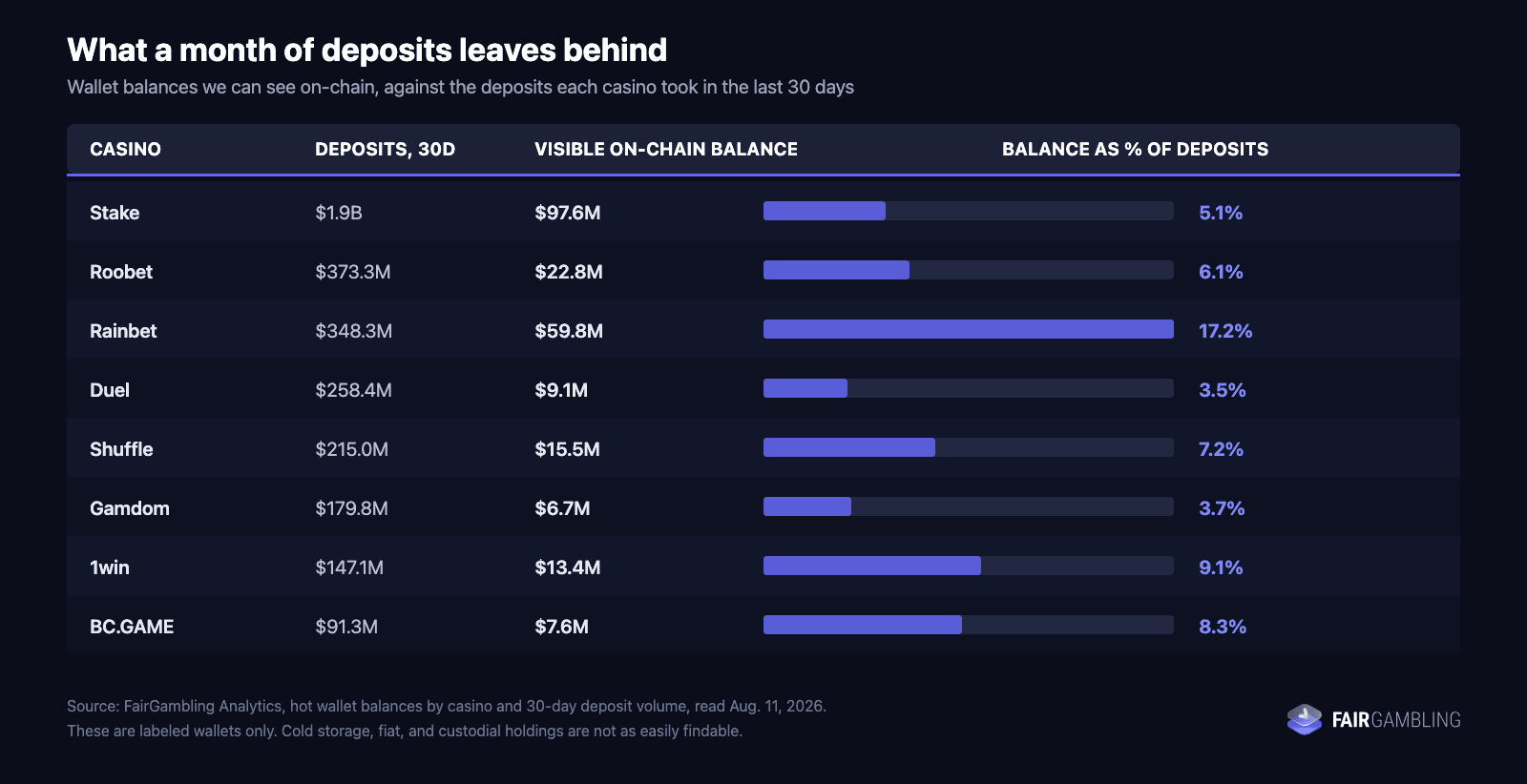
Across those eight, the wallet balances we can identify on-chain run between 3.5% and 17.2% of a single month's deposits. Stake took $1.9 billion in deposits over the 30 days to Aug. 11, 2026 and holds $97.6 million in wallets we can label, or 5.1%. Roobet sits at 6.1%, Shuffle at 7.2%, Gamdom at 3.7%.
These are labeled hot wallets. Cold storage, fiat and custodial holdings are not as easily findable, and a healthy casino has every reason to keep most of its money there. A 5% ratio is entirely consistent with a well-run operator, and equally consistent with one running on fumes.
That is the whole problem, and it is the thing the on-chain-transparency pitch never admits. The blockchain shows you flow, not stock. You can watch every dollar move into a casino and never learn what stayed. Deposits are public; the balance sheet is not.
The first operator to publish reserves and liabilities together, audited and on a schedule, will be able to say something no competitor can say about its own balance sheet.
The Checklist in One Place
- Is it provably fair? Almost every operator we rate passes. Treat it as a floor, then run your retired seeds through the analyzer anyway; it costs a minute.
- Are there public wallets? We track labeled wallets for 35 of 40 casinos, so you can watch fund movement yourself.
- How did it behave when it lost money? A public incident with full restitution beats a clean sheet, because a clean sheet has faced no test.
- When does it ask for ID, and who hears a dispute? A stated rule beats an unstated discretion, and a public complaint beats a private ticket.
- Does it prove reserves? Almost nobody does yet.
License, KYC level, fairness certification, house edge and 30-day deposit volume sit side by side on our crypto casino rankings, with every entry's financial transparency and compliance scores published in full.
No single check certifies a casino, which is why you run them together. Stack the checks, then add the one only you can run: deposit the minimum, play a little, withdraw everything, and time it. Repeat as the stakes rise. Scale your balance only as fast as the casino keeps proving it pays, and follow FairGambling's reporting so nothing catches you off guard.