What Is a Prediction Market (and How Is It Not Sports Betting)?
Yes/no contracts, prices that double as probabilities and no bookmaker on the other side. Here is how prediction markets work, how they differ from sports betting and where the law stands.


A prediction market is an exchange where people trade yes/no contracts on real-world events: elections, games, prices. Each contract settles at $1 if the event happens and $0 if it does not, and the live price (say 62¢) is the crowd's estimate of the probability. You trade against other people, not a bookmaker.
How a Prediction Market Works
A prediction market turns a question into a tradable contract. "Will this team win the final?" becomes a YES/NO pair, and the two sides always add up to $1. If YES trades at 62¢, NO trades at 38¢.
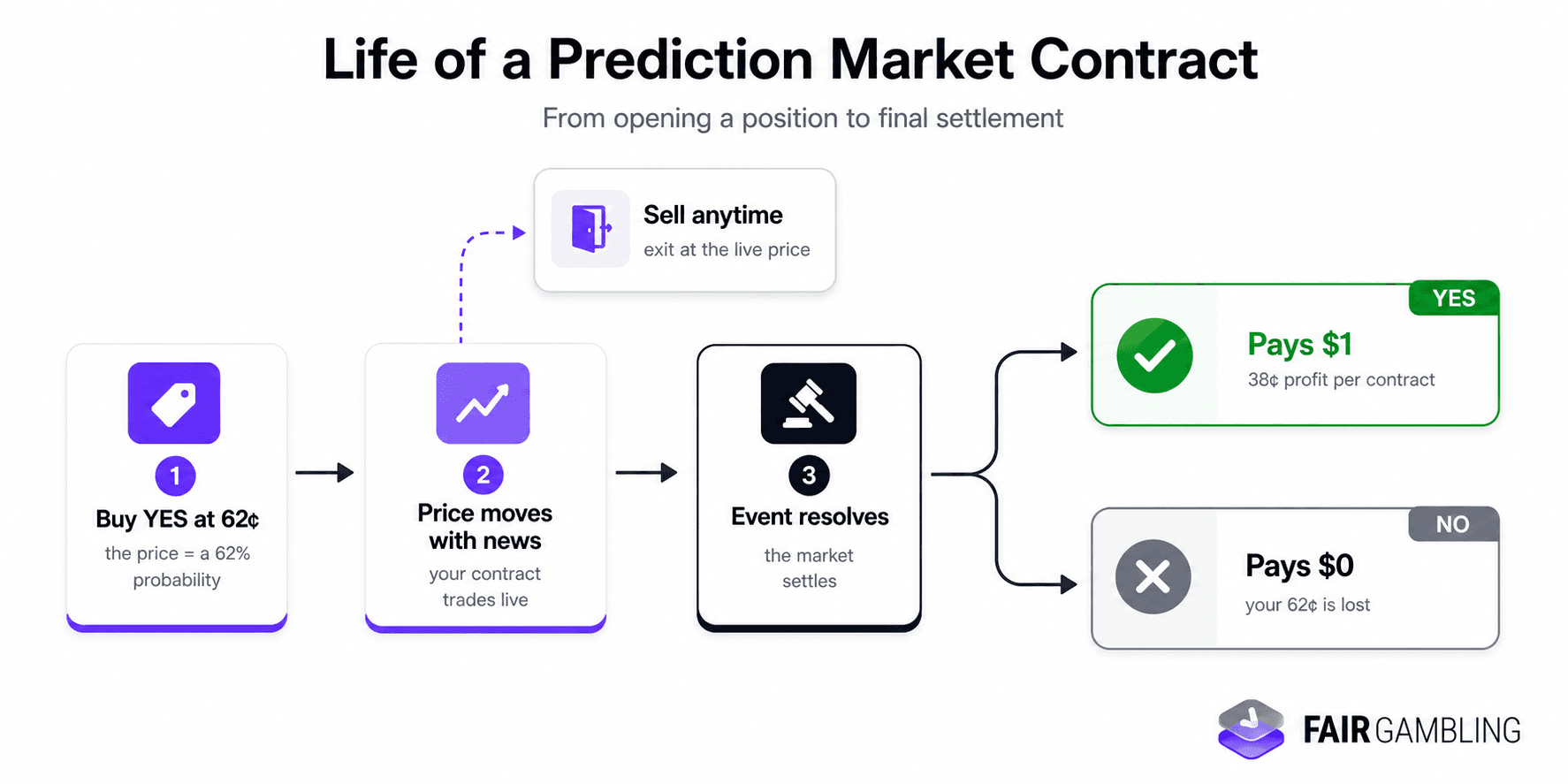
Say you buy YES at 62¢. From there, three things can happen. The event resolves YES and your contract pays $1, a 38¢ profit per contract. The event resolves NO and it pays $0. Or you sell before resolution at whatever the market price is at that moment. That exit ramp is what sports bettors notice first: no lock-in until the market closes.
The price is the probability. A contract trading at 62¢ means the market gives the event about a 62% chance. When news breaks, the price moves the way a stock does, because traders are updating their estimates in real time.
Who is on the other side of your trade? Another person. Prediction markets run on an order book, a live list of what buyers will pay and sellers will accept, the same machinery a stock exchange uses. The platform matches those orders and charges a fee. It does not set the odds and it does not care who wins.
Prediction Market vs Sports Betting
The two look similar from a distance: you put money on an outcome and get paid if you are right. But the machinery underneath is very different, starting with who takes your money.
Prediction market | Sports betting | |
|---|---|---|
Who takes the other side | Other traders | The bookmaker |
How odds are set | Supply and demand on an order book | The book sets the line, with vig built in |
Getting out early | Sell at the live price whenever you want | Only some books offer an early cash-out feature |
Who regulates it | The CFTC, a federal financial regulator | State gaming commissions |
What you are buying | A contract that pays $1 or $0 | A bet slip |
Vig is the bookmaker's margin, baked into every line so the book profits whichever side wins. Prediction markets have no vig, but they are not free either. Trading fees and the spread, the gap between what buyers offer and sellers ask, replace it.
The difference is these costs sit in plain view on the order book rather than hidden inside the line.
The Legal Gray Zone: Why States Are Fighting It
In the US, markets are federally regulated by the Commodity Futures Trading Commission (CFTC), the agency that oversees futures and commodities. Operators like Kalshi argue that federal oversight makes them legal in all 50 states. That is their position, and 13 states are testing it in court.
As of July 2026, those states have active enforcement actions or litigation against prediction market operators, and the fight runs in both directions: the CFTC sued Arizona, Connecticut and Illinois in April 2026 to block state enforcement, while a Washington court ruled against Kalshi's federal-preemption defense. Seven states have gone so far as to ban prediction market trading for their own employees.
Why do gaming regulators care so much? Sports. About 80% of Kalshi's trading volume since July 2024 has come from sports contracts, per CFTC figures reported by ESPN, which makes the product look a lot like the thing states already license and tax. The CFTC itself proposed new rules on June 10, 2026 that would bar contracts on injuries, refereeing decisions and youth sports.
None of this has slowed the market down. Combined Kalshi and Polymarket volume grew from under $5 billion a month in September 2025 to $24 billion in April 2026. The rules are being written while the product scales, so check your state's status before trading.
Where Crypto Fits
Polymarket runs on crypto rails: positions live on a public blockchain and trades settle in stablecoins (cryptocurrency tokens pegged to the dollar).
In practice, that means fast settlement, access from most of the world and order flow anyone can audit, the same public-ledger transparency behind FairGambling's crypto casino analytics.
Crypto rails don't, however, change the legal picture: where a state contests prediction markets, simply settling in stablecoins isn't grounds for an exemption.
Frequently asked questions
Are prediction markets legal in the US?
Contested, as of July 2026. Operators hold that CFTC regulation makes them legal nationwide; 13 states have active enforcement or litigation saying otherwise, and the CFTC has sued three of them back. Federal courts are deciding who wins. Check where your state stands before trading.
Are prediction markets gambling?
That definitional fight is what the lawsuits are about. The CFTC treats these as event contracts, a financial instrument it regulates. Several states say trading on game outcomes is gambling and needs a gaming license. Courts have gone both ways, so the honest answer is: legally unresolved.
Can you actually make money on prediction markets?
Some traders do, and there is no built-in house edge working against you. But fees, spreads and being wrong all cost real money, and most positions have a loser on the other side. Treat it like trading, with trading's risks, not like a payout machine.